

In a 304 vs 316L water tank decision, chloride is the first number to check, then temperature, then how the tank is built. SUS 304 is sound in cool potable water up to about 50 mg/L chloride on a conservative reading and about 200 mg/L on the general one. 316L, with 2–3% molybdenum and carbon held to 0.030%, stretches those figures to about 250 and 1,000 mg/L. Bolted joints, a chlorinated vapor space, welds and warm water all push the choice toward 316L.
At a glance
- The difference
- 316L adds 2.0–3.0% molybdenum and caps carbon at 0.030%
- PREN
- 304: 17.5–20.8 · 316/316L: 23.1–28.5 (BSSA, EN compositions)
- Chloride limit, 304
- About 200 mg/L general, 50 mg/L conservative, potable water at ambient temperature
- Chloride limit, 316
- About 1,000 mg/L general, 250 mg/L conservative
- Temperature
- Risk rises beyond about 50 °C; over 60 °C neither grade is recommended with chlorides
- Above the waterline
- Chlorine can concentrate in droplets; use the higher grade there
- Welded tanks
- Low-carbon L grades avoid sensitization in the 450–850 °C band
- Coastal sites
- 316 as a minimum within about 5 km of the surf
- LVJIA plate
- SUS 304, 316 and 316L, 1.5–4 mm (standard; up to 8 mm by design), bolted or argon-arc welded
What is the difference between 304 and 316L stainless steel?
316L is essentially 304 with 2–3% molybdenum added, a little less chromium, more nickel and carbon capped at 0.030% instead of 0.08%. The molybdenum raises resistance to pitting and crevice corrosion in chloride water, and the low carbon protects welds from sensitization.
304 and 316L stainless steel rely on the same thing: a thin, chromium-rich oxide film that re-forms wherever oxygen reaches the surface. Chloride ions break that film locally. On an open, well-aerated surface the film usually heals. In a pit, under a gasket or beneath a deposit, oxygen cannot get in, the local chemistry turns more aggressive, and the attack concentrates on one spot. That is why stainless tanks fail by small, deep holes rather than general thinning.
ASSDA describes grade 316 as having an increased ability to resist pitting and crevice corrosion in warm chloride environments, and calls it the first step up from the basic 304 grade. 316L is the low-carbon version, often used to avoid sensitization corrosion in welded components.
| Grade | Cr % | Ni % | Mo % | C max % | PREN range |
|---|---|---|---|---|---|
| 304 | 18.0–20.0 | 8.0–10.5 | none specified | 0.08 | 17.5–20.8 |
| 316 | 16.0–18.0 | 10.0–14.0 | 2.0–3.0 | 0.08 | 23.1–28.5 |
| 316L | 16.0–18.0 | 10.0–14.0 | 2.0–3.0 | 0.030 | 23.1–28.5 |
The composition rows come from ASSDA’s pages on grade 304 and grade 316, and the PREN ranges from the British Stainless Steel Association’s European-standard compositions. One detail matters when you buy plate: under the European designation 1.4404, 316L carries 2.0–2.5% molybdenum, while 1.4435 carries 2.5–3.0%. If the margin matters, specify a minimum molybdenum and check the mill certificate.
How do PREN and chloride limits decide the grade?
PREN ranks grades by their pitting resistance, and published chloride limits tell you where each grade stops being safe in real water. Use PREN to compare, and the chloride limits, adjusted for crevices and temperature, to decide.
The British Stainless Steel Association gives the formula as PREN = Cr + 3.3Mo + 16N, with percentages by weight. It also warns that PREN is useful for ranking grades but cannot predict whether a grade will suit a particular application. That is why the second half of the calculation below uses water-industry chloride guidance, not the PREN alone.
The UK water industry’s guidance note IGN 4-25-02 gives 304 types as suitable up to about 200 mg/L chloride and 316 types up to about 1,000 mg/L, in potable waters of pH 6–8.5. It also records a more conservative approach: 50 mg/L for 304 and 250 mg/L for 316. LVJIA uses the conservative figures wherever a tank has crevices, which every bolted tank does.
Worked example
Grade decision for a bolted rooftop tank
- Water analysis (stated)
chloride 140 mg/L · free chlorine 0.8 mg/L · pH 7.6 · up to 28 °Cchlorinated municipal supply - PREN, 304 (mill certificate)
18.1 + 3.3 × 0 + 16 × 0.05 = 18.9Cr 18.1 %, Mo 0 %, N 0.05 % - PREN, 316L (mill certificate)
16.8 + 3.3 × 2.05 + 16 × 0.04 = 24.2Cr 16.8 %, Mo 2.05 %, N 0.04 % - PREN gap
24.2 − 18.9 = 5.3molybdenum alone adds 6.8 - 304 against chloride limits
140 ÷ 200 = 0.70 · 140 ÷ 50 = 2.8inside general, 2.8 × over conservative - 316L against chloride limits
140 ÷ 1,000 = 0.14 · 140 ÷ 250 = 0.56inside both - Temperature check
28 °C < 50 °Cno temperature penalty, but no spare either - Construction check
bolted → gasket crevices → use conservative figures304 fails, 316L passes
Result: 316L throughout. At 140 mg/L chloride, 304 would pass a welded, crevice-free tank on the general figure, but a bolted tank has a gasketed crevice at every joint. Had the analysis read 40 mg/L, we would use SUS 304 for submerged panels and 316L for the top course and roof.
This is a typical 304 vs 316L water tank decision, and it shows what the PREN step does and does not tell you. It confirms that 316L ranks several points higher, and that molybdenum more than accounts for the gain, since 316L gives back some chromium. It says nothing about whether 18.9 is enough for 140 mg/L chloride. Only the chloride guidance, read with the construction and the temperature, answers that.
Choosing a 304 vs 316L water tank by chloride, temperature and duty
For cool, low-chloride potable water, 304 is enough for submerged panels; for anything with more chloride, crevices, heat or a food or process duty, 316L is the safer grade. Above about 1,000 mg/L chloride, or hot water with chlorides, neither grade is the right answer.
| Water and duty | Construction | Our pick |
|---|---|---|
| Potable, chloride ≤ 50 mg/L, ambient, chlorinated | Bolted | SUS 304 wetted panels; 316L top course and roof |
| Potable, chloride 50–250 mg/L, ambient | Bolted | 316L throughout |
| Potable, chloride up to 250 mg/L, ambient | Welded, pickled, crevice-free | 316L, the L grade our range offers for welding |
| Chloride 250–1,000 mg/L, ambient | Welded only | 316L with caution; bolted tanks move to GRP/SMC |
| Chloride above about 1,000 mg/L, brackish or sea water | Any | Not 304 or 316L; GRP/SMC or a higher alloy |
| Warm water, 40–50 °C, low chloride | Any | 316L |
| Hot water above 60 °C with chlorides | Any | Neither 304 nor 316; different material |
| RO or demineralized ingredient water | Welded | 316L |
| Coastal site, within about 5 km of the surf | External surfaces | 316 minimum outside |
The table is our starting point, not a rule book. The chloride limits come from IGN 4-25-02 and assume potable water at ambient temperature. The temperature rows follow ASSDA, which says 304 and 316 both become subject to pitting, crevice corrosion and stress corrosion cracking beyond about 50 °C in warm chloride environments, and that over 60 °C neither is recommended. Where stainless is marginal, our comparison of GRP, stainless, galvanized, enamel and BDF tanks covers the other materials, including the GRP/SMC sectional tank, our usual answer when chloride is high.
How do you choose the grade for a specific tank?
Run five checks in order: chloride, temperature, construction, the space above the water, and the air outside the tank. Each one can only move a 304 vs 316L water tank answer toward 316L, never back toward 304.
Get a recent analysis with chloride, pH and free chlorine. Compare chloride with 50 and 200 mg/L for 304, and 250 and 1,000 mg/L for 316L.
Use the warmest the water will be, not the average. A rooftop tank in summer or a tank near hot plant can sit well above mains temperature.
Bolted joints, lapped seams and gasket lines are crevices, and crevice corrosion starts at chloride levels an open surface would tolerate. If there are crevices, use the conservative chloride limit. If there are welds, use an L grade.
If the water is chlorinated, the top course and roof see condensate richer in chlorine than the bulk water. Put the higher grade there.
Near the coast, salt deposits on the outer surface. ASSDA recommends 316 as a minimum within about 5 km of the surf.
Then write the answer where it cannot be lost: on the panel schedule, grade by course and by zone, and on the purchase order. A grade that lives only in an email is a grade nobody checks at goods-in.
What goes wrong: failure modes in stainless water tanks
Stainless water tanks fail locally, at crevices, above the waterline and at welds, rather than by general corrosion. The pattern behind most of these failures is a grade chosen for the bulk water, while the attack happens where the bulk water analysis does not describe the conditions.
| Failure | Where | Cause | Prevention |
|---|---|---|---|
| Pitting | Wetted walls and floor | Chloride above what the grade tolerates | Grade by chloride limit; 316L margin |
| Crevice corrosion | Under gaskets, bolt heads, lapped joints | Oxygen-starved gap concentrates chloride | Conservative figures; inert, chloride-free gasket |
| Vapor-space pitting | Roof underside, top course | Chlorine concentrating in condensate | 316L above waterline; ventilation |
| Heat-tint corrosion | Weld zones | Chromium-depleted layer under the oxide | Pickle and passivate |
| Intergranular attack | Weld heat-affected zone | Chromium carbides at 450–850 °C | L grade |
| Stress corrosion cracking | Hot, stressed areas | Chloride plus heat plus tensile stress | Keep 304/316 out of hot chloride water |
| Tea staining | External surfaces | Salt deposits near the coast | 316 minimum, smooth finish, washing |
The vapor space deserves its own warning. ASSDA notes that chlorine in droplets or films above a still water surface can be higher than in the bulk water, and gives about 2 ppm chlorine for 304 and about 5 ppm for 316 in continuous exposure at ambient temperature and neutral pH. IGN 4-25-02 recommends ventilation, regular washdown, or a more resistant grade at and above the waterline.
Watch out
Do not judge the roof by the water analysis. A tank holding 0.5 mg/L free chlorine can carry condensate stronger than its contents on the underside of its own roof. If you only upgrade one part of a 304 tank, upgrade the top course and the roof.
Welds need two separate precautions. Sensitization, which ASSDA explains in its note on carbon, is chromium carbide forming at grain boundaries between 450 and 850 °C; the L grades’ 0.030% carbon limit guards against it. ASSDA adds that without heavy-section welding or high-temperature exposure, standard and L grades usually resist corrosion identically. At 1.5–4 mm (standard; up to 8 mm by design), tank plate is not heavy section, so we specify 316L on welded tanks as cheap insurance rather than a strict need.
Heat tint is a separate problem. ASSDA’s page on pickling and passivation explains that welding leaves a chromium-depleted surface layer with lower corrosion resistance, which pickling removes. An L grade does not fix heat tint, and pickling does not fix sensitization.
What the standards and guidance say, in plain language
No single standard settles a 304 vs 316L water tank choice for you. Material standards fix the chemistry, water-industry guidance gives chloride limits, and cleaning and passivation standards cover what happens after welding.
- Chemistry. ASTM A240, as tabulated by ASSDA, caps carbon at 0.08% for 304 and 316 and 0.030% for 304L and 316L. European 1.4404 allows 2.0–2.5% molybdenum; 1.4435 requires 2.5–3.0%.
- Ranking. BSSA publishes PREN = Cr + 3.3Mo + 16N and warns it ranks grades but does not predict suitability.
- Chloride. IGN 4-25-02 gives about 200 mg/L for 304 and 1,000 mg/L for 316 in potable water, or 50 and 250 mg/L on a conservative approach, and asks for inert, chloride-free gaskets at flanged joints.
- Welds. ASTM A380 is the practice for cleaning, descaling, pickling and passivation; ASTM A967 specifies chemical passivation treatments and the tests that confirm them. IGN 4-25-02 says heat tint darker than light straw should be removed.
- Coastal exposure. ASSDA’s guidance on tea staining puts 316, or a grade of equivalent resistance, as the minimum within about 5 km of the surf, and notes that tea staining can occur 20 km or more inland in some conditions.
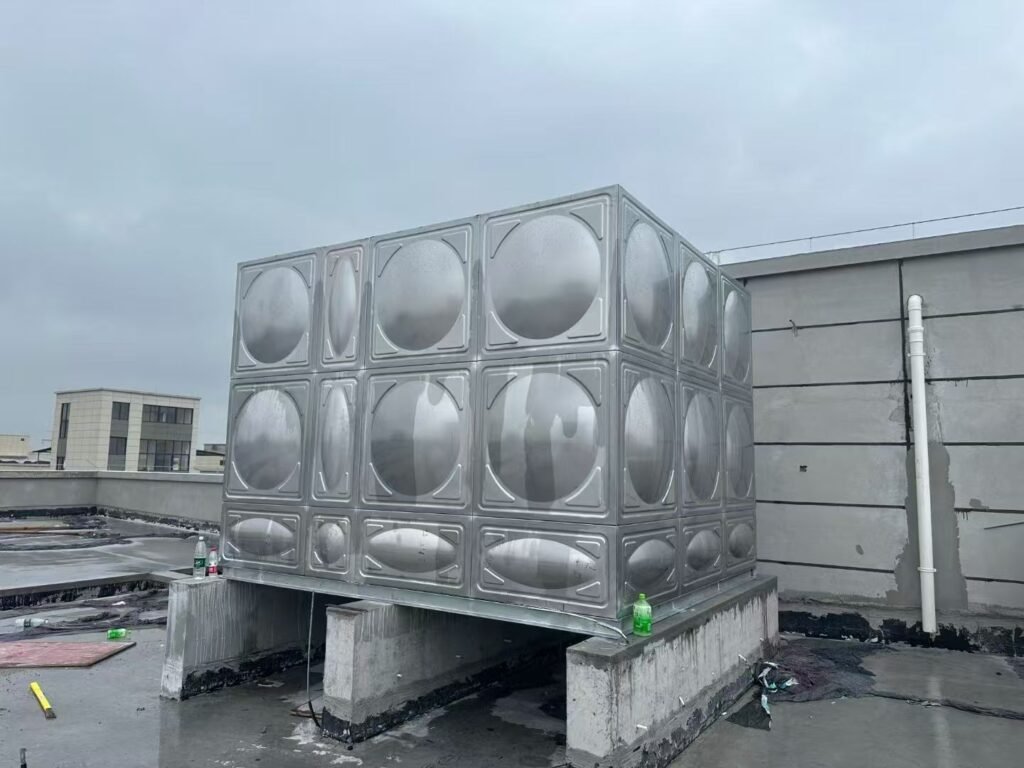
How LVJIA handles grade selection at the works and on the drawing
We settle every 304 vs 316L water tank question panel by panel on the drawing, from your water analysis, before any plate is cut. The grade then follows the panel schedule through pressing, kitting and the 48-hour water test, and the material certificates travel with the tank.
Our stainless steel water tank range is built in SUS 304, 316 and 316L, in 1.5–4 mm (standard; up to 8 mm by design) plate, either as bolted pressed panels with stiffeners or argon-arc welded. Send the analysis to the engineering desk and the first written reply comes within two hours; a drawing review comes back as a marked-up PDF within one working day. The stainless tank manufacturing page shows how the panels are pressed and punched.
Where the answer is 316L stainless, we point you to models built for it, such as the stainless steel 316 water tank for chloride-heavy water or the 316L process water tank for treated and process water. Where 304 is right, the stainless steel drinking water tank is the usual base. The stainless range carries GB/T 17219-2025 drinking-water report SP2630498, listed on our certifications page.
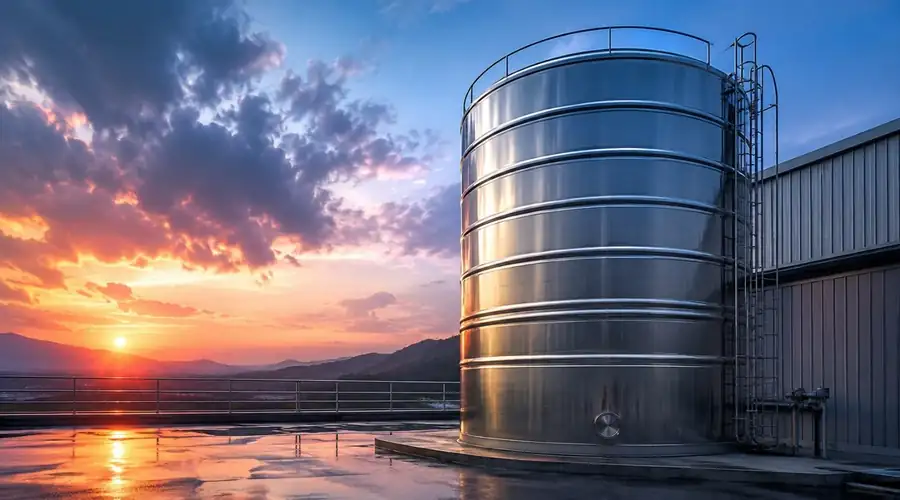
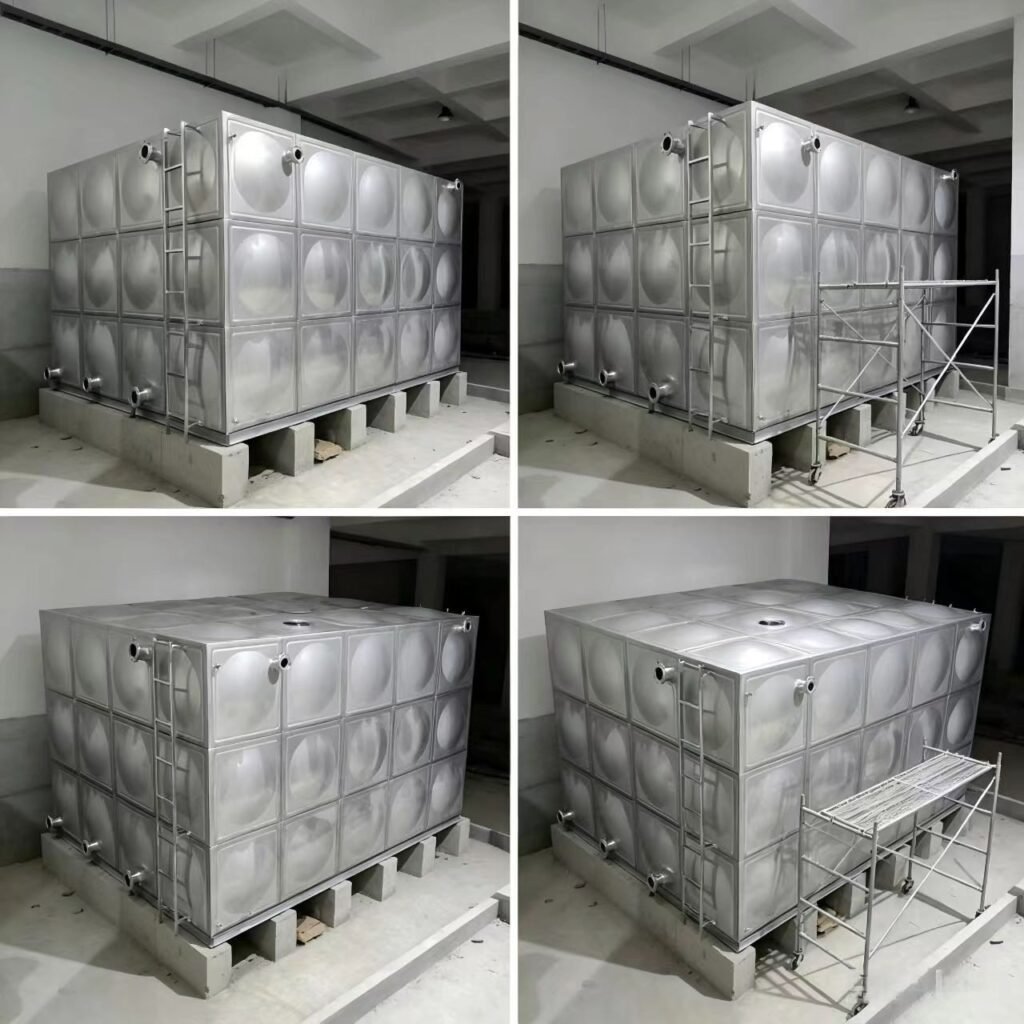
A 304 vs 316L water tank checklist
Before you fix the grade, confirm each point below in writing. If any answer is “don’t know”, treat it as the worse case until someone finds out.
- A recent water analysis with chloride, pH and free chlorine, not a regional average.
- The warmest water temperature the tank will see, including summer on a roof.
- Bolted or welded construction, and so which chloride limit applies.
- Whether the water is chlorinated, and so whether the roof and top course need the higher grade.
- Distance to the coast and exposure of the outer surfaces.
- For welded tanks: an L grade, and pickling and passivation written into the inspection plan.
- Gasket material that is inert and chloride-free.
- Grade by panel on the drawing and on the purchase order, checked against mill certificates.
Frequently asked questions: 304 vs 316L water tank
Is 316L always better than 304 for a water tank?
It is the more resistant grade, but not always the better buy. On a cool, low-chloride mains supply, a 304 tank with a 316L top course and roof spends the extra money only where the risk is. The full 316L price is worth paying where the water, the joints, the heat or the duty take away 304’s margin.
What chloride level is too high for 304 stainless?
Read the highest chloride result from the last twelve months, not the average, because supplies change with season and source. If that worst reading is above the conservative 50 mg/L chloride limit and the tank is bolted, choose 316L for the wetted panels too. Ask the water supplier whether blending or a new source is planned during the tank’s life.
What is the difference between 316 and 316L?
Only the carbon ceiling, 0.08% against 0.030%, so the two behave alike in a bolted tank. ASSDA notes that dual-certified plate, meeting both the standard and L specifications, is increasingly stocked. If your mill certificate shows 316/316L, the plate meets both specifications and can go into a welded tank as 316L.
Does a higher PREN guarantee a tank will not pit?
No, and grade names alone hide a spread. The BSSA range for 316/316L runs from 23.1 to 28.5, a 5.4-point band about as wide as the gap in our worked example between a typical 304 and 316L. Two plates sold as the same grade can differ that much, so read Cr, Mo and N on each mill certificate.
Can stainless steel tanks hold hot water?
With chlorides present, neither 304 nor 316 is a safe choice above about 60 °C. ASSDA points hot chloride duties toward grades resistant to stress corrosion cracking, such as 2205 duplex, which is outside our stainless range. For warm water below that line, send the analysis and peak temperature and we will state the grade on the drawing.
Why does the roof corrode first on a chlorinated stainless tank?
The roof underside is never rinsed by the bulk water, so condensate sits there and concentrates. At the annual inspection, look at the roof underside and the top course first: rust-colored spots or pinholes there are the earliest warning, and they should be dealt with before a pit goes through the plate.
Can a 304 tank be upgraded later?
On a bolted tank, individual panels can be replaced with 316L panels of the same module, which is the practical way to deal with a corroding roof. On a welded tank, replacement means cutting and re-welding on site, so it pays to get the grade right at the drawing stage.
Talk to an engineer
Send us your water analysis
We will state the grade for every course and the roof on a marked-up drawing, with the chloride and temperature reasoning written next to it.