


Technical help
Ask us first.  Engineering desk
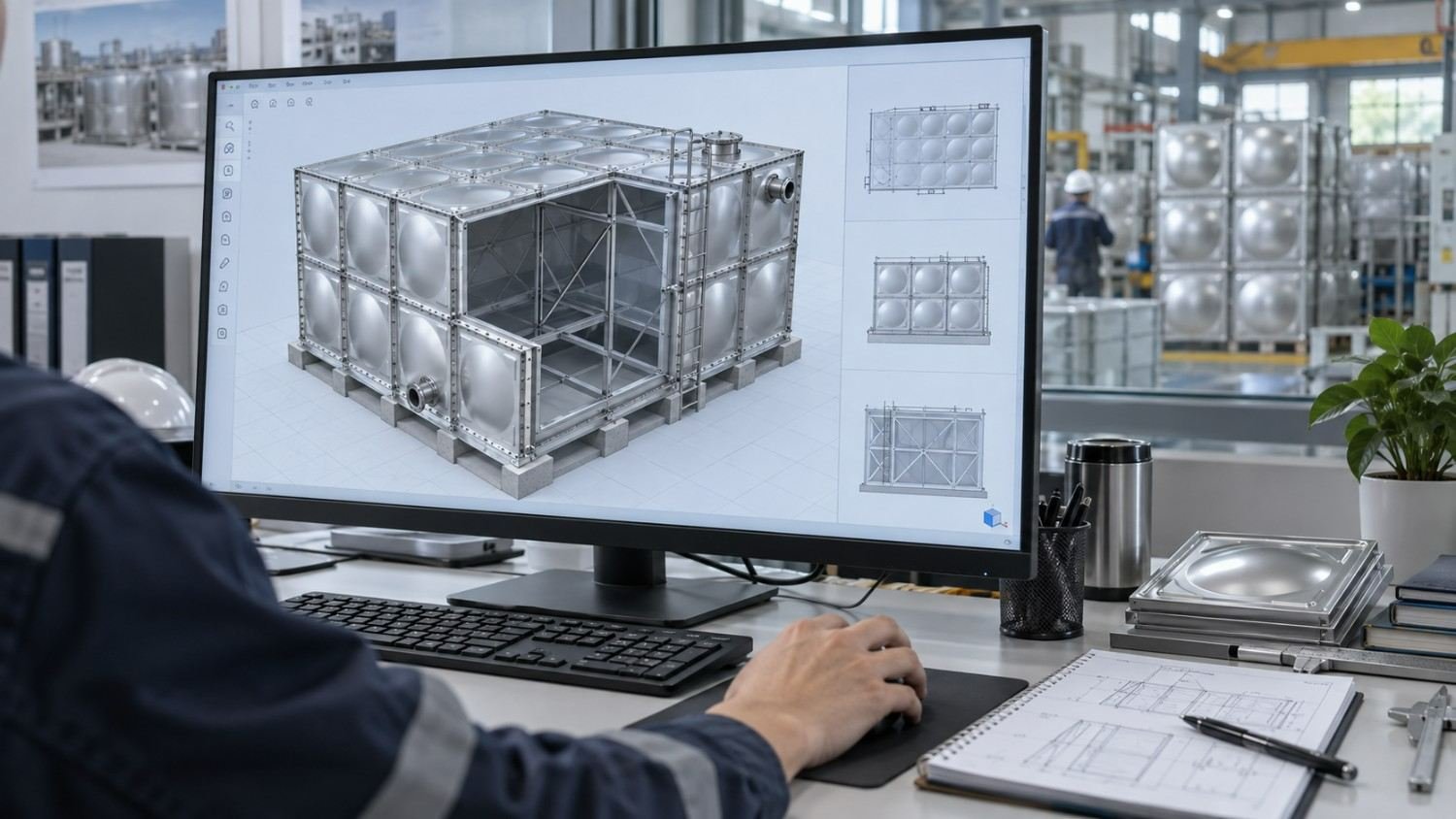 2 h first reply Water tank
 answers in millimeters.
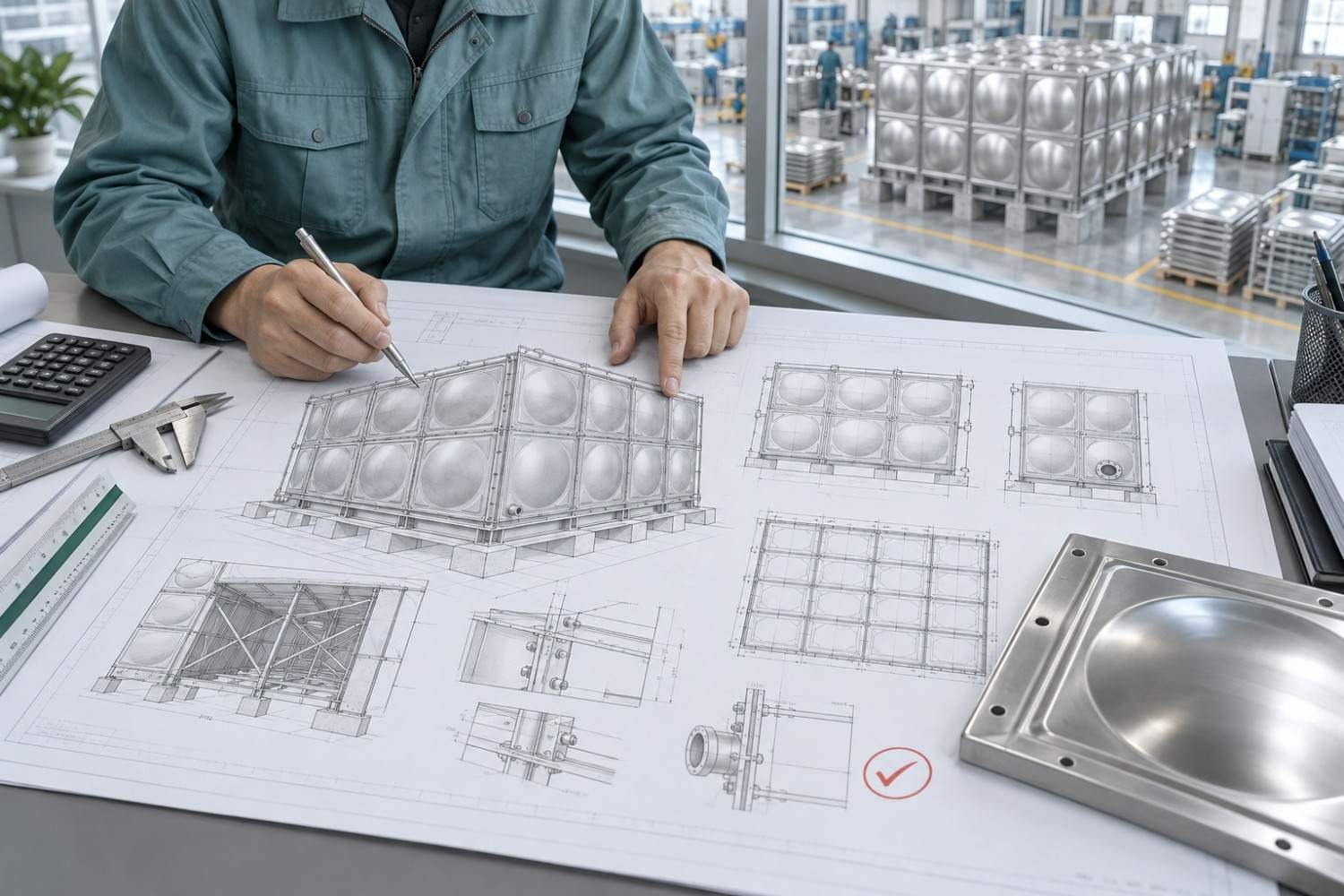
Water tank technical support for sizing, materials, installation and maintenance of sectional water tanks — answered by the engineers who press the panels in Wucheng and run the water test, not by a ticket queue. Send a STEP file, a DWG or a photograph of a sketch. What comes back is a marked-up drawing.
Engineering & technical support
Five ways in. One engineer owns your file.
Whatever you send — a scribble on site, a full assembly, a tender specification — the same engineer takes it through consultation, review, DFM, material and tolerance, and stays on it until the panels are pressed.
Consult
Thirty minutes with the engineer who will own the job: stored volume, the footprint you actually have, panel module, tier count, nozzle schedule and the standard your inspector will hold you to. Bring a sketch, a site photograph, or nothing at all.
STEP · IGES · DWG · DXF · PDF
MON–SAT · 08:00–20:00 CST · EN / 中文
First reply, in writing
Typical first reply from the engineering office · EN / 中文
Drawing review
- Turnaround
- 1 working day
- Formats
- DWG · DXF · PDF
- Checked
- Dims, datums, notes
- Returned
- Marked-up PDF
- Revisions
- Unlimited
DFM analysis
- Panel modules
- 2×1 … 0.5×0.5 m
- Panel thickness
- 6 – 22 mm
- Maximum height
- 5 m
- Capacity range
- 0.125 – 5,000 m³
- Minimum order
- 1 m³
Material selection
- GRP / SMC
- 6 – 22 mm panels
- Stainless
- SUS 304 / 316 / 316L
- Galvanized
- Q235, 2 – 5 mm
- Enamel
- Glass-fused-to-steel
- Underground
- BDF composite plate
Tolerance guidance
- Panel flatness
- ±1.5 mm
- Bolt hole
- [CONFIRM]
- Overall length
- [CONFIRM]
- Plate thickness
- [CONFIRM]
- Squareness
- [CONFIRM]
Figures marked [CONFIRM] come from the works before publishing — draft figures — confirm against the works before publishing
Design & engineering resources
Everything we need from you, written down.
The engineering library, a page of rules and a page of worked examples at a time. Read the CAD file requirements before you export and the review comes back with answers instead of questions. Filter by topic, search for the thing you are about to draw, or page through the lot.
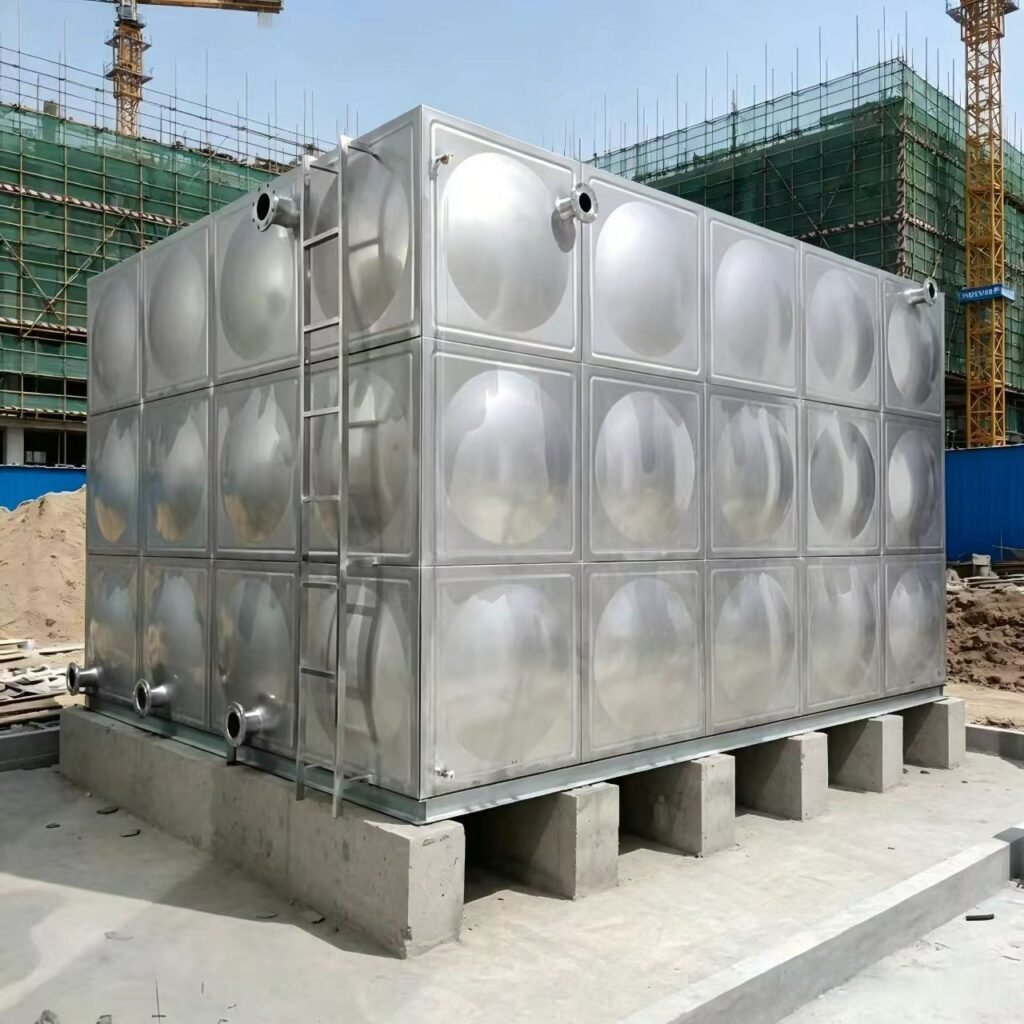
Sectional Water Tank Foundation: Levelness, Plinths and Base Frames
Levelness, plinth centers, steel grillage, loads and bearing pressure: how to build a base a bolted sectional tank will seal on at first fill.
Open the guide Surface finishHot-dip galvanizing vs glass-fused-to-steel · coating guide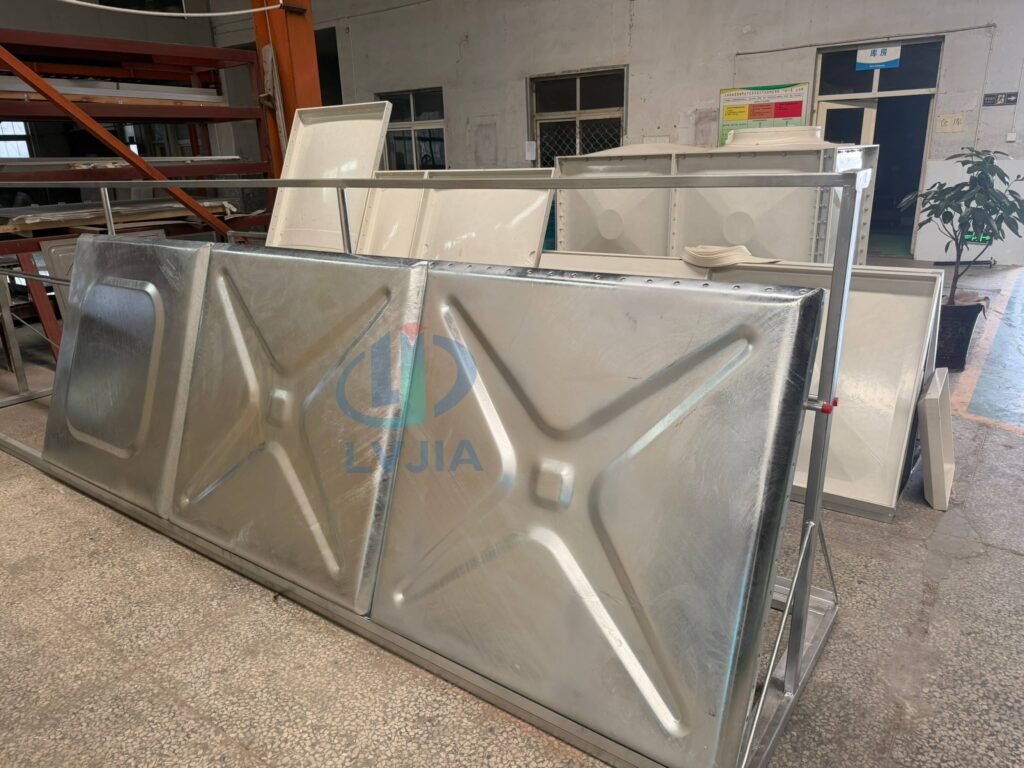
Galvanized vs Enamel Water Tank: ISO 1461 Zinc or ISO 28765 Glass?
Zinc or glass? How hot-dip galvanizing and glass-fused-to-steel enamel protect a bolted tank, how to test each at delivery, and how to estimate zinc life.
Open the guide MaterialsSUS 304 · 316 · 316L · grade selection
304 vs 316L Water Tank: Chlorides, Temperature and Welds Explained
When is SUS 304 enough and when does a water tank need 316L? Chloride limits, PREN, vapor space, crevices and welds, with a worked example and selection table.
Open the guide InspectionBolted sectional tanks · 48-hour water test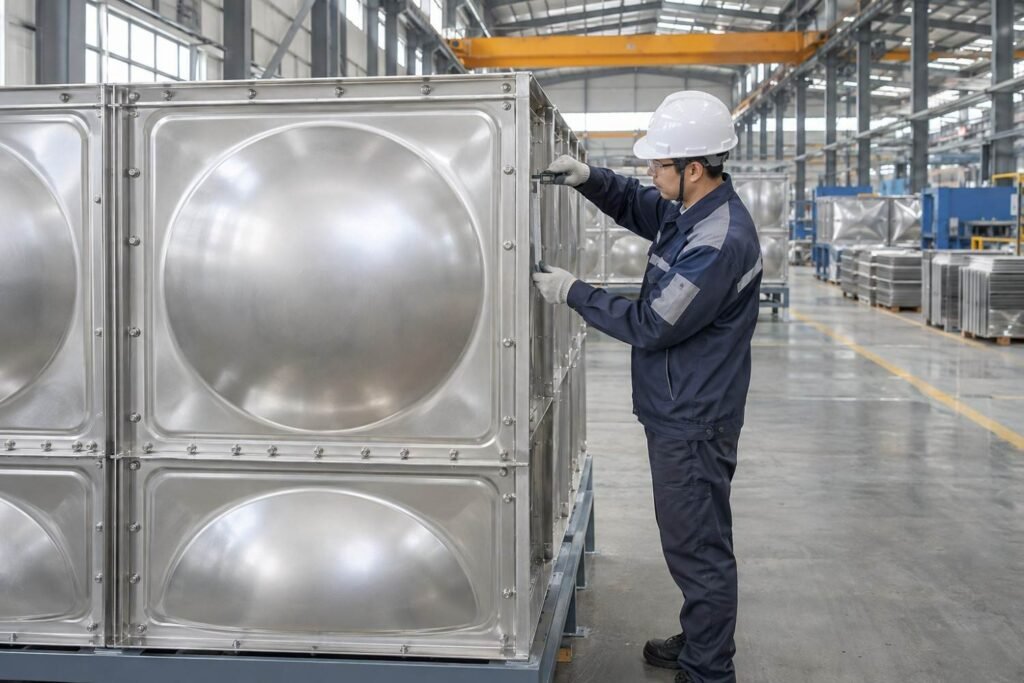
Water Tank Hydrostatic Test: Procedure, Hold Time and Pass Criteria
How to water test a bolted sectional tank: preconditions, staged fill, hold, correcting the level log for temperature, what passes, and how to fix a weeping joint.
Open the guide Drawings & CADBDF underground tank · 72 m³ flotation check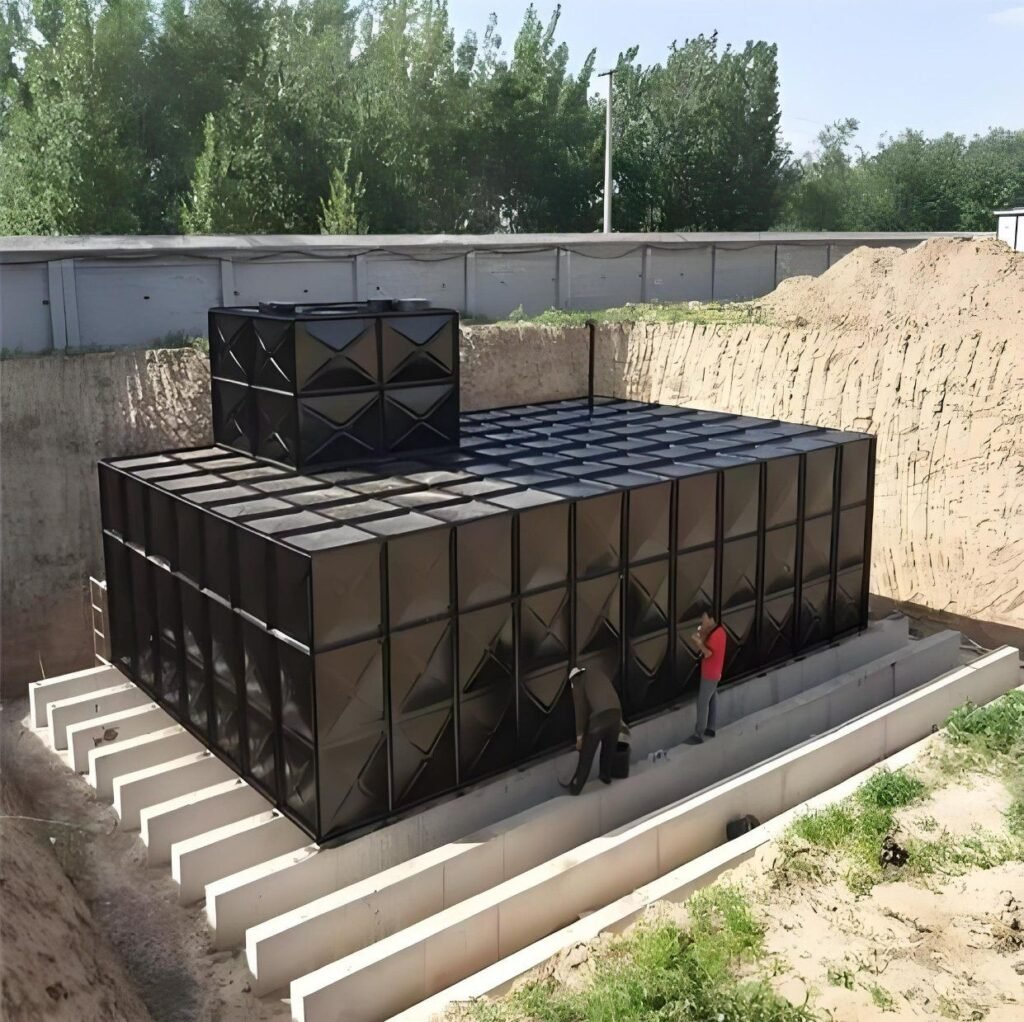
Underground Water Tank Buoyancy: Flotation Check and Pit Drawing
How to check a buried BDF tank against flotation: uplift against dead weight, a 72 m³ worked example to USACE factors, and the pit drawing items that hold it down.
Open the guideNo guide matches that.
Clear the search, or ask the engineering desk for the one we have not written yet.17 guides
Ask for a guide we have not writtenManufacturing guidance
From your drawing to a pressed panel
Five decisions sit between a file and a water tank on a slab. This is how we make each one, what it costs you in time and money, and where you still have a say. Open any stage; nothing here is a secret we keep until the quotation.
- PlantWucheng County, Dezhou
- Machinescount 25
- Modules2×1 … 0.5×0.5 m
- TestedGB/T 17219-2025
Compression molded · 1000 × 1000 140 °C · 10 MPa · 8 min
Tooling already cut
38sizesNo new tool for a standard panel
Machines in the works
25Machines on three production lines
The five decisions05
Stage 01 · Process
Pick the process before you pick the shape
Every water tank we make comes out of one of four routes, and the route decides the geometry you are allowed to draw. Compression-molded SMC gives you panels from 0.5×0.5 m up to 3 × 1 m, 6 to 22 mm thick. Pressed stainless gives you SUS 304, 316 or 316L in 1.5 to 4 mm (standard; up to 8 mm by design) plate. Roll-formed galvanized suits fire reserves where the water never goes near a person. Fully welded is for the odd sizes nothing modular can hit.
Send the duty and the footprint and we will tell you which one it is inside a day, along with what changes if you move a wall by 300 mm.
- SMC compression molding — potable and process water, the default for anything between 1 m³ and 1000 m³
- Pressed stainless — SUS 304 or SUS 316L where the water is hot, aggressive or under a food-safety audit
- Hot-dip galvanized — fire reserves and irrigation, lowest cost per cubic metre
- Fully welded — non-standard geometry, tight plant rooms, no modular fit
Route confirmed before tooling is booked
Stage 02 · Tooling
Use a tool we already own
We hold press tools for the whole standard panel family, so a water tank drawn on the module needs no tooling spend and no tooling wait. A new tool is a real cost and a real delay, and there are only two good reasons to cut one: a nozzle pattern nothing existing carries, or a volume large enough to pay it back.
Where a bespoke feature is genuinely needed, it is almost always cheaper as a secondary operation on a standard panel than as a new mold.
- Standard panels — 1000 × 1000, 1000 × 500 and 500 × 500 mm, all tooled
- Nozzles and manways — cut and reinforced after molding, no tool needed
- New mold — only past a run large enough to pay the tool back [CONFIRM]
- Tool trial — first-off panel dimensioned and sent to you before the run
Tooling signed off with the first-off panel report
Stage 03 · Production
Small changes upstream, large savings downstream
A water tank that is 5.8 m long has to be drawn as six panels and a 300 mm filler. At 6.0 m it is six panels and nothing else, the filler tooling disappears, and two joints leave the build. That is the kind of change we look for and the kind we will always propose.
The other half of the work is packing: panels ship flat, and a water tank that lands on a container multiple costs less to move than one that misses it by two panels.
- Round to the module — every 1000 mm removes joints, gaskets and site hours
- Batch the nozzles — one setup for all penetrations rather than one per panel
- Fill the container — one container carries a water tank that would never fit on a truck in one piece
- Nest the offcuts — stainless plate nested across the order, not per tank
Every proposal comes back as a marked-up drawing, not an opinion
Stage 04 · Quality
Write the hold points in before the first panel is pressed
Quality is cheap when it is designed in and expensive when it is discovered. Tell us at drawing stage which standard the water tank is being bought against and which points your inspector wants to witness, and the inspection and test plan is written around your programme rather than ours.
Every water tank is trial-assembled and water-tested in Wucheng before it is taken apart and packed, so the first time it holds water is not on your site.
- Incoming material — mill certificates matched to the heat number on the plate
- First-off panel — dimensioned report, signed, before the run continues
- Trial assembly — the full tank built up in the works
- Water test — 48 h hold, level logged at start and finish
- Witness points — attend in person, or by video call with the QC lead
Nothing ships until the water test record is signed
Stage 05 · Cost & time
What actually moves the number
Four things drive the price of a sectional tank, and panel count is only one of them. Material grade is the largest single lever — SUS 316L against SMC on the same volume is a different order of cost. After that it is height, because tiers add reinforcement, then bespoke features, then how well the packed tank fills a container.
We would rather show you the trade before you commit to a layout than explain it afterwards, so ask for the comparison while the drawing is still open.
- Material grade — the biggest lever, and the one most often over-specified
- Tier count — every metre of height adds internal tie reinforcement
- Bespoke features — nozzles and manways are cheap, new tooling is not
- Freight fill — a water tank drawn to a container multiple lands cheaper on site
- Programme — 6 weeks works lead time, quoted firm at order
Figures are indicative until the drawing is fixed
All five stages, one file
Every guideline on this page, as one PDF
The process routes, the tooling position, the tolerance tables and the inspection plan, in a single document your design team can keep open beside the model.
Five families of document, all of them free and none of them behind a form. Hover a card, or tap it on a phone, to see what is inside before you spend a click.
CAD templates
Draw on our blocks and a review comes back same day — the module, the bolt pitch and the origin are already right.
Download the setTechnical datasheets
Each sheet carries the panel schedule, the base loading and the nozzle table — enough to size a slab without calling us.
Download all fiveGrade selection chart
SMC, SUS 304, SUS 316L and galvanized against duty, temperature and chloride.
A3 · 1 sheetChemical compatibility
What each liner and each grade will and will not hold, with concentrations.
A3 · 2 sheetsTolerance tables
Panel, hole, assembly and site tolerances in one printable page.
A4 · 1 sheetmaterial pack
Capability documents
Includes the plant layout, the process flow and the QC organisation chart — the three things every audit asks for first.
Download the packCertification documents
Every certificate carries its issue and expiry date. Ask and we will send a dated bundle for a specific tender.
Download the bundleFrequently asked questions
Water tank technical support: common questions
What our engineering desk gets asked most. If your question is not here, water tank technical support is a message away and the first reply lands within 2 hours.
What does LVJIA water tank technical support actually include?
Five things, all handled by the same engineer: consultation on duty and sizing, review of a drawing you send us, design-for-manufacture analysis, material selection and tolerance guidance. One engineer owns your file from the first sketch to the moment panels are pressed, so you are not re-explaining the job to a ticket queue. Send a STEP file, a DWG, a PDF or a photograph of a hand sketch; what comes back is a marked-up drawing, not a form letter.
How fast is the first reply?
Two hours during working hours in China time. That first reply is a real engineering response, not an acknowledgement: it will either answer the question or tell you exactly which dimension, pressure or water analysis is missing before it can be answered. Complex tender reviews take longer, and we will say so in that first reply rather than going quiet.
What file formats can I send for a drawing review?
STEP and IGES for 3D, DWG and DXF for 2D, plus PDF for marked-up prints. If all you have is a sketch on site paper, photograph it and send that. For 3D we prefer STEP over a native format because it survives the round trip without version problems. File naming and revision control conventions are set out in the guidelines on this page so that the drawing you approve and the drawing we press from are provably the same one.
Can you help me size a water tank if I only know the duty?
Yes, and that is the better starting point. Give us three things: the stored volume the duty requires, the footprint and headroom available, and the fill and draw arrangement. From those our engineers lay out a panel configuration using 2x1, 1.5x1, 1x1, 1x0.5 and 0.5x0.5 m modules and return a general arrangement. If you are still choosing between materials, the buying guide walks through the decision in six steps.
Which material should I specify for my water chemistry?
It depends on chloride content, temperature and whether the water is potable. 316L stainless resists chlorides far better than 304; galvanized steel to ISO 1461 gives roughly 85 micrometres of zinc for outdoor duty; GRP/SMC is inert and the usual answer for potable storage; enameled steel suits aggressive municipal water. Send a water analysis and we will put the recommendation in writing rather than leaving it to a chart.
What tolerances do you build and install to?
Panel and assembly tolerances are published in the guidelines above. The two that catch people out on site are the plinth, which must be flat to 3 mm over any 3 m, and the bolt torque and gasket compression schedule, because the seal is made by gasket compression rather than by the bolt itself. Both are issued with the approved drawing so the installer is not guessing.
Do you review drawings for tanks you will not be building?
We will look at a drawing at tender stage without an order in place, because a specification that cannot be manufactured helps nobody. What we will not do is silently redraw someone else's design and return it as ours. If the review finds a problem, you get the problem, the reason and the options, and you are free to take that to any manufacturer.
What hold points and tests can I witness?
The standard inspection and test plan covers material receipt, panel pressing, punching and dimensional check, assembly, and a hydrostatic test before dispatch. Witness points and ITP templates are downloadable from this page. If you want a third-party inspector at a specific stage, say so before the drawing is approved so the hold point is written into the production order rather than added later.
How do I get the datasheets and CAD blocks for my drawing?
They are on the datasheets and downloads page, in PDF for specification and DWG or STEP for dropping straight into your layout. Technical datasheets, grade selection charts, chemical compatibility tables and tolerance tables are all there, along with the current certificates listed on the certifications page.
Who do I talk to, and can I visit?
Engineering sits on the same site as the production lines in Wucheng County, Dezhou, which is how a drawing change reaches the floor quickly. You can book a visit or take the virtual factory tour first. To open a file, email guan@lvjiatank.com, call +86 186 0534 4338, or use the form on the contact page.
Can you check my water tank sizing before I issue the tender?
Yes. Send the duty, the footprint and the head and we will check the water tank sizing against a real panel layout rather than a rule of thumb. Most over-sizing we see comes from adding a safety margin to a figure that already had one. A water tank sized from the actual draw-down is cheaper to buy and cheaper to keep clean.
What water tank drawing review do you offer at no cost?
A full water tank drawing review: we mark up the general arrangement, flag anything that cannot be pressed or bolted as drawn, and suggest the panel configuration that uses the fewest special parts. You get the marked-up water tank drawing back whether or not you place the order, because a water tank specification that cannot be built wastes everyone time.
How do I specify water tank penetrations correctly?
Give the position from a fixed datum on the water tank, not from a wall that may move on site. Every nozzle, manhole and ladder fixing is punched into the water tank panel at the factory, so a penetration added later means a replacement panel. List size, orientation and flange standard for each one, and our engineers will place them on the water tank drawing for your approval.
What water tank maintenance should I plan for?
An annual internal inspection and a clean, with gaskets checked at the same visit. A bolted water tank is designed to be opened, so a partitioned water tank can be cleaned one side at a time without losing supply. Keep the water tank test sheet and the drawing together; the next inspector will want both. Guidance is on this page and in the buying guide.
Can you advise on water tank installation on a difficult site?
That is most of what the desk does. A water tank that has to pass a 2.1 m door, sit in a live plant room or land on an existing bund needs the panel module chosen around the access, not the other way round. Send photographs and dimensions of the route as well as the space, and the water tank layout will be drawn to fit both.
Do you provide water tank technical support after delivery?
Yes, from the same engineer. Bolt torque values, gasket replacement, panel replacement and re-testing are all covered, and a damaged water tank panel can be replaced individually rather than scrapping the water tank. Quote the water tank drawing number and we can pull the exact build. Email guan@lvjiatank.com or use the contact page.
Which water tank range should I draw against?
Pick the range first, because panel module and thickness follow from it. The five are GRP/FRP/SMC, stainless steel, hot-dip galvanized, enameled steel and BDF underground water tanks, 13 models each. Open the nearest model, take its panel grid into your layout, then send the drawing to the desk and we will confirm it against the press. The full catalogue lists every model in one place.
Technical FAQ & engineering support
Ask the desk
The ten questions the engineering desk answers most weeks, then a form that goes to the same desk. Nothing here routes through a sales inbox first.
What do you need before you can review my design?
A 3D model as STEP or IGES, a 2D drawing as DWG, DXF or PDF, and one line telling us the duty and the volume. If you only have a sketch on site paper, photograph it and send that — we have started plenty of jobs from one.
Export solids rather than surfaces, work in millimeters, and put the origin on the base centre of the water tank. The CAD file requirements guide above says the rest.
My site is an awkward shape. Can a sectional tank still fit?
Usually, and this is the most common reason people call us. Panels are pressed at 2×1, 1.5×1, 1×1, 1×0.5 and 0.5×0.5 m, so the water tank is built to a module rather than to a single molding, and an L-shaped plant room or a low ceiling is a layout problem rather than a dead end.
Send the room, not the water tank you think you need. Give us the access opening as well — a 900 mm door decides more than the floor area does.
SMC, stainless or galvanized — how do I choose?
Duty first, then temperature, then budget. SMC composite covers most potable and process water, and our SMC tank passed all 20 items of GB/T 17219-2025 (report SP2630502) and is the cheapest per cubic metre once you are past a few tonnes. Stainless earns its cost where the water is hot, chlorinated hard, or under a food safety audit. Hot-dip galvanized Q235 suits fire reserves and irrigation, and enamel and BDF cover aggressive contents and buried tanks.
The grade selection chart in the material pack sets all four against duty, temperature and chloride content on one sheet.
Can I get samples before committing?
Yes. We post a material card with a cut section of each panel type, the gasket material and a bolt set, at no charge. Ask on the form below and give a postal address that will accept a small parcel.
Cards usually land within two weeks outside China.
What tolerances can you actually hold?
Panel size and bolt hole position are checked against the approved drawing rather than against a previous run, and the finished product is inspected before packing. The figures our works holds are confirmed per order — ask and we will put them in writing. [CONFIRM]
If your drawing calls a tighter number than these, say so early. Some are reachable with a secondary operation; some are not reachable at any price, and it is cheaper to find out at drawing stage.
Do I need to allow tolerance on the base slab?
Yes, and it is the one that causes the most trouble on site. The slab or steel base must be level and flat across the whole footprint [CONFIRM], because a bolted tank transfers its load through the panel edges and will not correct a twisted base.
The base preparation drawing goes out with every order, before the water tank ships.
Will my design need new tooling?
Almost certainly not. We hold press tools for the whole standard panel family, and nozzles, manways and brackets are added as secondary operations rather than molded in. A new tool only makes sense past roughly 600 panels of one bespoke shape.
Send the feature you think needs a tool and we will tell you which of the two it is.
What is the lead time, and when does the clock start?
Works lead time is typically 7 to 15 working days for custom tanks and 15 to 25 days for BDF batches [CONFIRM] from a fixed drawing and a confirmed order, quoted firm at order rather than estimated. Sea freight is on top and depends on the route.
The clock starts at drawing approval, not at enquiry, which is the main reason we push to get the review done in a day.
Is the water tank tested before it ships?
Every tank is trial-assembled in Wucheng and water-tested for 48 hours, with the level logged at the start and the finish. It is then taken apart, packed flat and loaded. The first time it holds water is not on your site.
The signed test record travels with the water tank and a copy is emailed at dispatch.
Can my inspector witness the tests?
Yes, in person or by video call with the QC lead. Tell us at drawing stage which hold points you want to witness and we will write them into the inspection and test plan around your programme.
If your QA team already has an ITP, send it and we will mark our hold points onto yours rather than issuing a competing document.
No question on that topic yet — the form below reaches the same engineers.
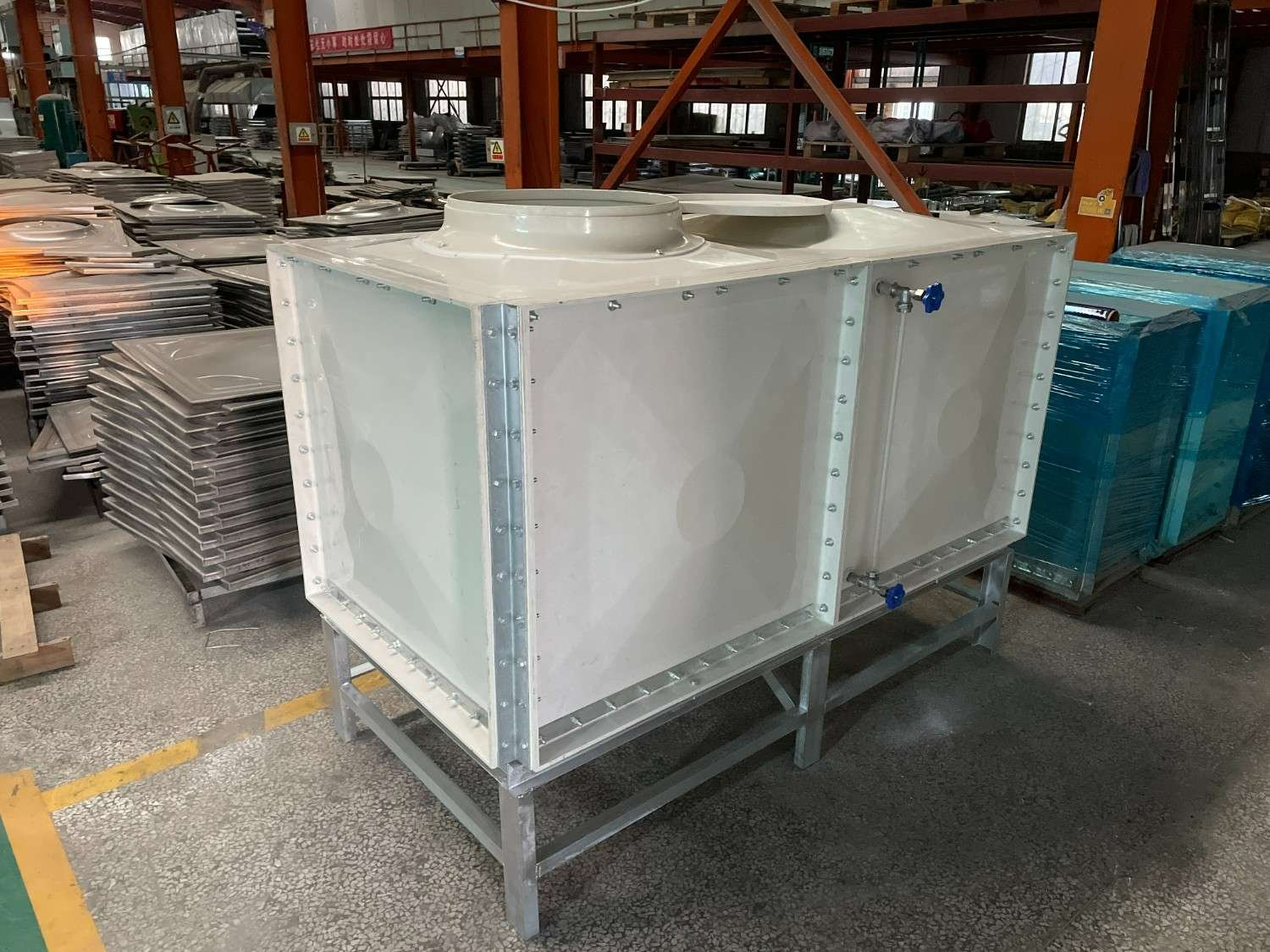
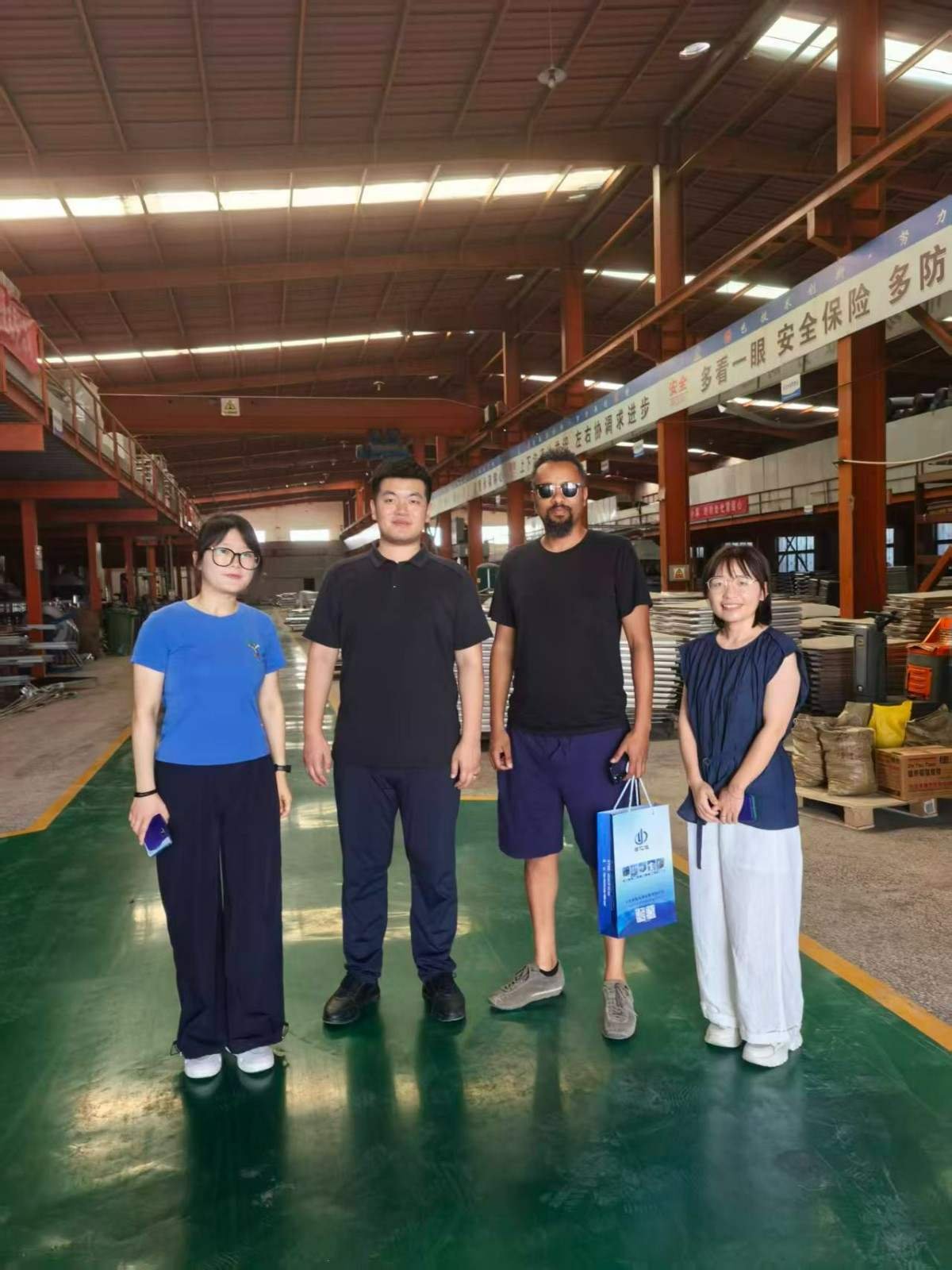
 Drawing inMarked upOpen files31 In review7 Answered today12 Engineering desk · Wucheng
Reply time
2 hFrom the engineer who owns your file.
Mon–Sat · 08:00–20:00 CST
What to send
Four things get a real answer
Less, and the first reply is a question.
Send a drawing, or book the call
This goes straight to the engineering desk. Files stay between us and are never passed to a third party.