

In the galvanized vs enamel water tank choice, the water decides more than the weather. Hot-dip galvanizing to ISO 1461 gives a 2–5 mm panel a mean of at least 55–70 µm of zinc that sacrifices itself to protect bare spots, but soft, acidic or hot water eats it away. Enamel is an inert glass barrier fired onto the steel; it resists most waters but protects nothing once chipped. Pick galvanized for hard, neutral water at lower cost; pick enamel for aggressive water or long life.
At a glance
- Galvanized coating
- Zinc-iron alloy layers under a pure zinc outer layer, from a molten zinc bath at about 449°C (840°F)
- Enamel coating
- Glass fused to the steel in a furnace, typically at 750–890°C
- Zinc thickness
- ISO 1461 minimum mean 55 µm (1.5–3 mm steel) or 70 µm (over 3–6 mm steel)
- Glass thickness
- Set by the standard named on the order (ISO 28765 or AWWA D103)
- Protection
- Zinc: barrier plus sacrificial. Glass: barrier only
- Test at delivery
- Zinc: magnetic gauge. Glass: magnetic gauge plus discontinuity (holiday) test
- Water limits
- Zinc: pH 5.5–12, hard water, below 60°C. Glass: acidic and neutral water; not fluorides or hot, strong alkalis
- LVJIA panels
- 1000 × 1000 mm standard panel; galvanized 2–5 mm, enamel 2–4.5 mm by height
- Standards
- ISO 1461, ISO 9223 categories · ISO 28765, AWWA D103
How does each coating protect the steel?
Zinc protects twice: as a barrier, and as a sacrificial anode that corrodes in place of any steel it touches. Glass protects once, as an inert barrier, so it has to be continuous; a single pinhole leaves bare steel with nothing guarding it.
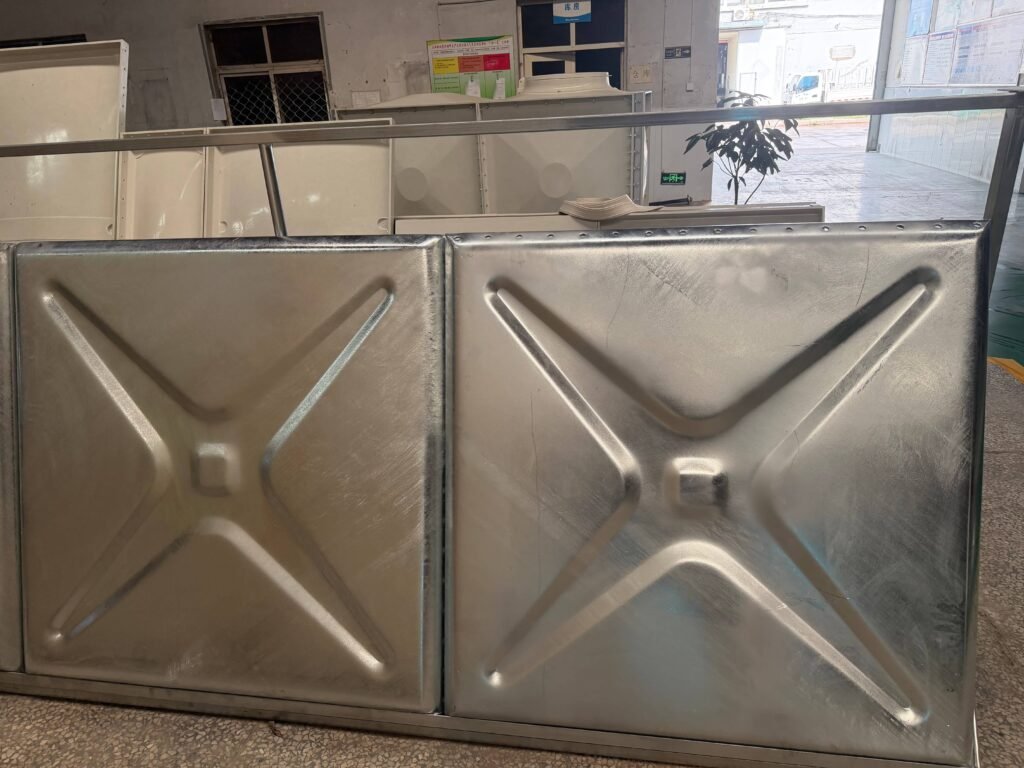
Hot-dip galvanizing: an alloy grown into the steel
A fabricated article is cleaned, fluxed and dipped in molten zinc. The American Galvanizers Association’s specifier guide gives a bath of at least 98% pure zinc at about 449°C (840°F), and four layers: gamma (75% zinc, 25% iron, 250 DPN), delta (90/10, 244 DPN), zeta (94/6, 179 DPN) and an outer eta layer of pure zinc (70 DPN), over base steel of 159 DPN. The alloy layers are harder than the steel itself, which is why galvanizing survives handling on site better than paint.
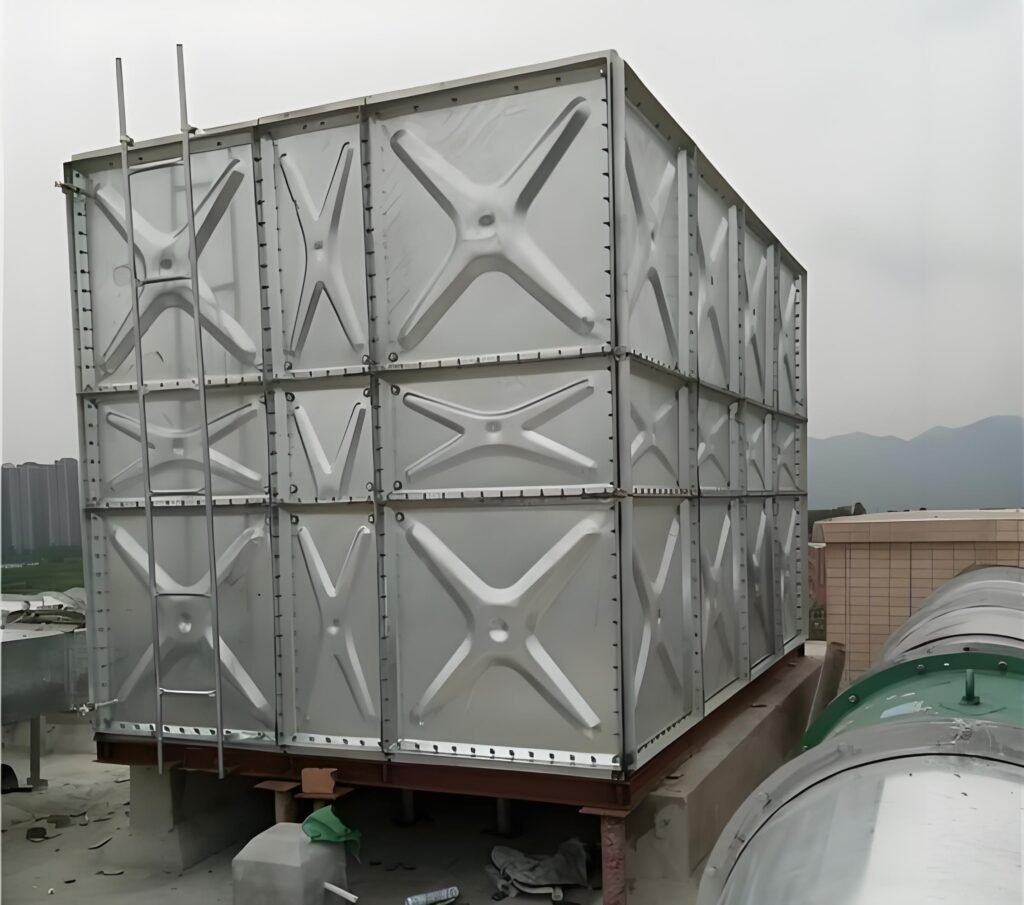
The same guide makes two points that matter for a tank panel. The coating is naturally as thick on corners and edges as on the flat. And because zinc is anodic to steel, a bare spot up to about 6 mm (¼ in) across does not start to corrode until the surrounding zinc is consumed. Both hold only if the panel is galvanized after it is cut, pressed and punched.
Glass-fused-to-steel: a fired glass barrier
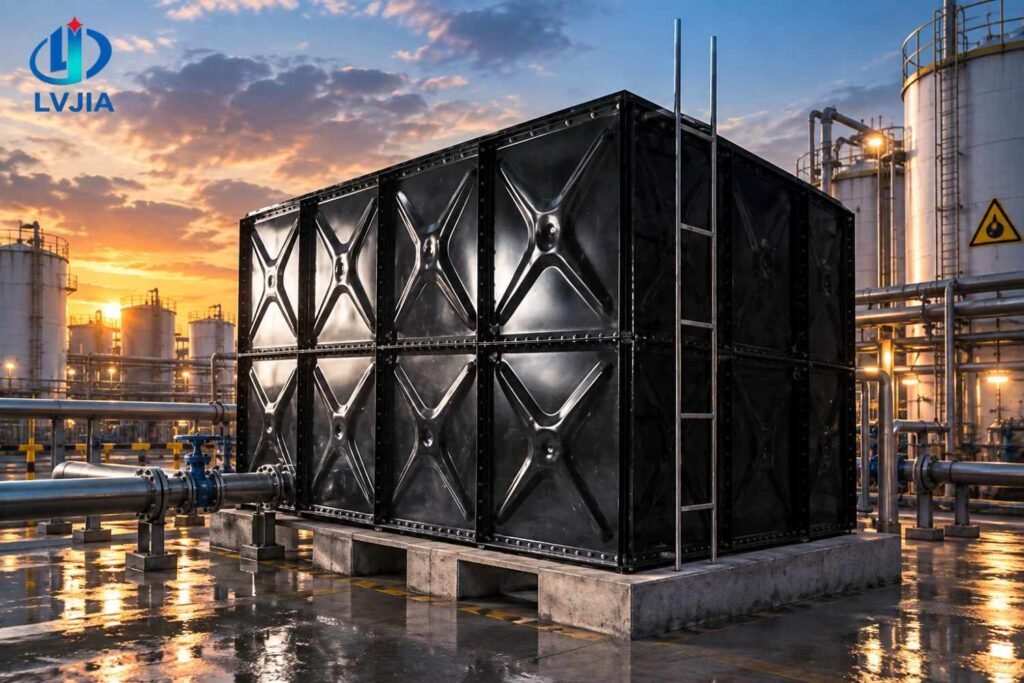
Enamel panels are coated with a glass frit and fired. A peer-reviewed review of porcelain enamel coatings gives firing temperatures of 750–890°C for 2 to 8 minutes on steel, and notes that enamels resist most solvents, acids and neutral solutions but are attacked by fluorides and by strongly alkaline boiling solutions above pH 12. The glass keeps the water away from the steel, and it is hard, smooth and chemically inert, with no sacrificial action at all.
That last point shapes everything about enamel. Its life depends on staying unbroken: a chip from a dropped wrench, a crack from a mis-torqued bolt or a hole drilled on site is bare steel under water. Enamel inspection therefore tests continuity, not only thickness.
How long does the zinc on a galvanized tank last?
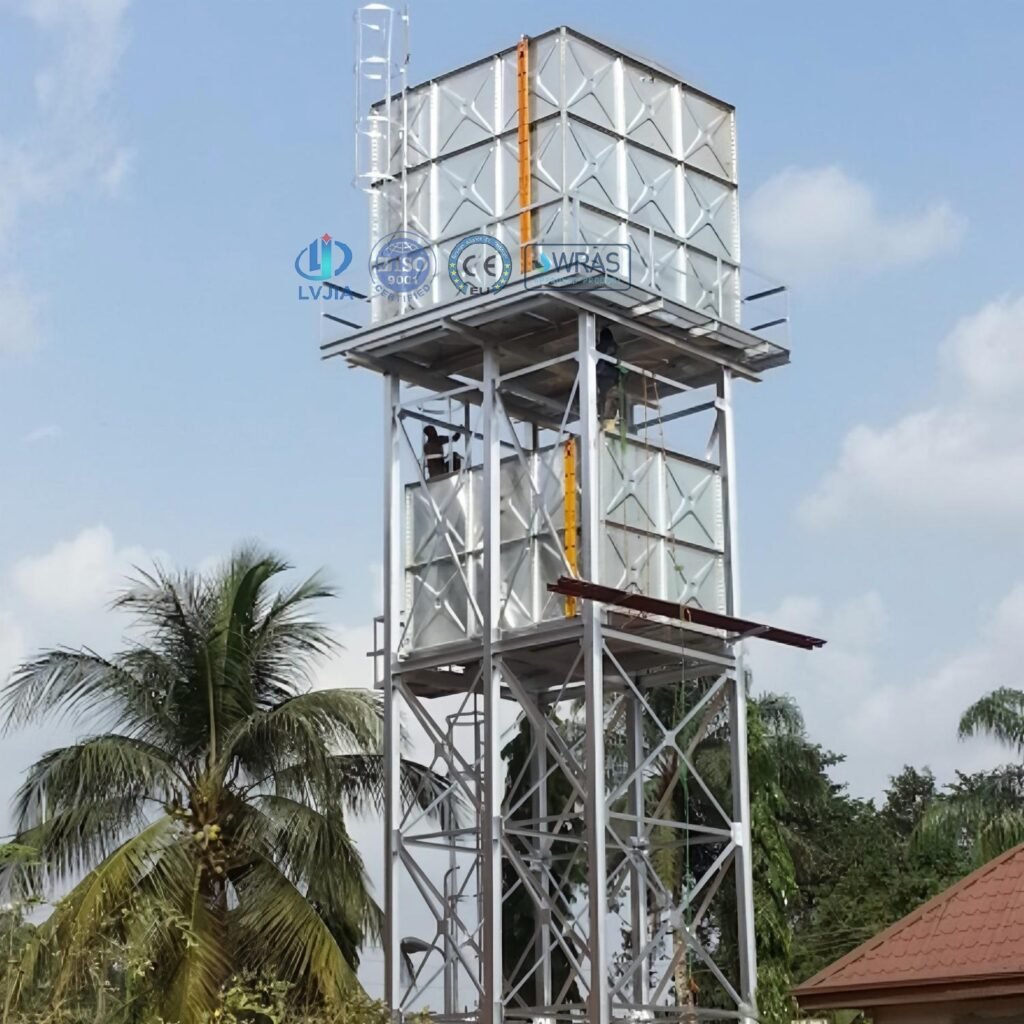
Roughly, coating thickness divided by the zinc corrosion rate for the environment. The American Galvanizers Association lists the ISO 9223 first-year zinc corrosion rates by corrosivity category, up to 0.1 µm a year for C1, 0.1–0.7 for C2, 0.7–2.1 for C3 and 2.1–4.2 for C4, and divides coating thickness by these rates to estimate the time to first maintenance.
Minimum thickness comes from ISO 1461. The Galvanizers Association lists the ISO 1461 table for articles that are not centrifuged: steel over 6 mm needs 70 µm local and 85 µm mean; over 3 to 6 mm, 55 and 70 µm; 1.5 to 3 mm, 45 and 55 µm; under 1.5 mm, 35 and 45 µm. A 4 mm tank panel therefore carries at least 70 µm on average.
Worked example
Estimated life of the zinc on a galvanized water tank panel
- 4 mm panel, ISO 1461 minimum mean
t = 70 µm (local minimum 55 µm)≈ 2.8 mils - Outside face, category C3, worst rate
70 ÷ 2.1 µm/yr = 33 yearsbest rate: 70 ÷ 0.7 = 100 years - Same face, using the local minimum
55 ÷ 2.1 = 26 yearsthe conservative figure - Outside face, category C4, worst rate
70 ÷ 4.2 = 17 yearslocal: 55 ÷ 4.2 = 13 years - 3 mm top-course panel, C4, local minimum
45 ÷ 4.2 = 11 yearsthinner steel, thinner zinc - Inside face, aerated pure water
70 ÷ 15 µm/yr = 4.7 yearsat the low end of a 15–150 µm/yr range
Result: outside, a galvanized water tank in a C3 climate has decades before first maintenance. Inside, in water close to pure, the same zinc can be gone in under five years, so the water analysis, not the climate, decides between zinc and glass.
Three cautions apply. The ISO 9223 figures are first-year rates, so read them as a guide rather than a prediction. The inside of a tank is immersion, not atmosphere, and atmospheric rates do not apply there. The last line uses the American Galvanizers Association’s figure for zinc in aerated pure water, 15–150 µm (0.6–5.9 mils) a year, to show how fast an unsuitable water can work.
What the water analysis tells you
The same article sets out the water chemistry that decides the inside life of zinc. The zinc corrosion rate is lowest between pH 5.5 and 12 and rises steeply below 4 or above 12. Moderately hard (60–120 ppm as CaCO₃) and hard water lay down a protective scale; soft water under 17 ppm is much more corrosive. Chloride above 50 ppm is aggressive, and between 60 and 82°C (140–180°F) zinc can reverse polarity and stop protecting the steel.
Copper matters too. The Galvanizers Association of Australia warns that dissolved copper of the order of 0.1 ppm can cause rapid pitting of a galvanized coating, so a copper pipe or brass valve upstream of a galvanized tank is part of the corrosion design.
Galvanized vs enamel water tank: selection and acceptance
Choose on water chemistry first, design life second and first cost third. Accept on measured coating thickness for both systems, plus a continuity test for enamel, because a glass coating can be thick enough and still have a hole in it.
| Point | Hot-dip galvanized (ISO 1461) | Glass-fused enamel (ISO 28765 / AWWA D103) |
|---|---|---|
| Coating | Zinc-iron alloy layers plus pure zinc | Glass fused to the steel |
| Process temperature | About 449°C (840°F) bath | Typically 750–890°C firing |
| Coating thickness | 55 or 70 µm minimum mean on 2–5 mm panels | Set by the standard named on the order |
| Protection | Barrier plus sacrificial | Barrier only |
| Small damage | Bare spot up to about 6 mm protected by surrounding zinc | Chip exposes steel; must be repaired |
| Water chemistry | Lowest corrosion at pH 5.5–12 | Resists acidic and neutral water; attacked by fluorides and hot, strong alkalis |
| Soft water | Much more corrosive below 17 ppm hardness | No reliance on a scale layer |
| Temperature | Polarity reversal risk at 60–82°C | ISO 28765 covers tanks from −50 to +100°C |
| Edges and holes | As thick as the flat, if galvanized after punching | Coated and fired after punching; a site-drilled hole is bare steel |
| Delivery test | Magnetic gauge, local and mean readings per reference area | Magnetic gauge plus discontinuity test |
| Repair | Zinc-rich paint or thermal-sprayed zinc | Maker’s approved repair system |
| First cost | Lower | Higher |
Our view: for a fire reserve, irrigation store or bulk tank filled with hard, neutral mains water, galvanized steel gives the best value and a coating you can repair with a brush. For soft or chloride-rich water, rainwater, leachate or process duties, or when the owner wants a long life without relining, enamel is worth its higher first cost.
Acceptance values for the zinc
Tank panels are thin, so they fall in the two middle rows of the ISO 1461 table. Note what that means for a stepped tank: the thin top-course panels can carry less zinc than the base and still comply, and they sit in the wet-and-dry zone under the roof.
| Steel thickness | Local minimum | Mean minimum | Typical tank panel |
|---|---|---|---|
| Under 1.5 mm | 35 µm | 45 µm | Not used for walls |
| 1.5 to 3 mm | 45 µm | 55 µm | Roof and top-course panels |
| Over 3 to 6 mm | 55 µm | 70 µm | Middle and base courses, floors |
| Over 6 mm | 70 µm | 85 µm | Heavy brackets and base steel |
For enamel there is no equivalent table here, because the glass thickness and the continuity test depend on which standard, and which grade within it, the order names. Write the standard, the thickness range for each face and the test method and voltage into the purchase order; “enamel” on its own is not a specification.
Inspecting a galvanized or enamel water tank at delivery and in service
Measure the coating before the panels go into the tank, because a thin or broken coating is cheap to reject on the ground and expensive to find under water. After commissioning, look inside once a year and read the coating at the same points each time.
Match the crate list to the approved drawing and confirm the coating standard, and for enamel the agreed thickness range and test voltage, on the delivery documents.
Inspect every panel face and edge in daylight: lumps, bare spots and flux residue on zinc; chips, crazing and edge damage on glass.
Use a calibrated magnetic gauge and spread the readings over each reference area. Every reading must meet the ISO 1461 local minimum and their average the mean minimum.
Use the same magnetic method on enamel panels, inside and outside faces, against the range on the order.
Run a wet-sponge (low-voltage) or spark (high-voltage) test at the agreed voltage over the water-side face. Mark every indication for repair before erection.
Use soft slings, protect edges and bolt holes, and never cut or drill a panel on site.
Once a year, look inside: white corrosion product or rust on zinc, chips or rust blooms on glass, and the condition of gaskets and bolt heads.
In service, we recommend an internal look at least once a year, or at the interval your fire or potable water rules set if that is shorter. Take coating readings at marked points every visit, so the trend, not a single reading, tells you when the zinc is running out.
Failure modes and how to prevent them
Galvanized tanks fail slowly and visibly when the water is wrong; enamel tanks fail locally and quietly when the glass is broken. Both are prevented at the specification stage far more cheaply than they are repaired.
| Failure | Coating | Cause | Prevention |
|---|---|---|---|
| General zinc loss, rust staining | Galvanized | Soft, acidic or low-hardness water | Water analysis before ordering; enamel if soft |
| Pitting of zinc | Galvanized | Dissolved copper, high chlorides | No copper upstream or in the tank; check chlorides |
| Zinc stops protecting | Galvanized | Water held at 60–82°C | Keep galvanized tanks on cold water |
| Rust at a drilled hole | Both | Hole or cut made on site | All penetrations made at the factory |
| Rust bloom at a chip | Enamel | Impact during handling or erection | Continuity test, repair before filling |
| Weeping joint | Both | Uneven plinth, wrong torque pattern | Plinth flat to 3 mm over 3 m, torque in a pattern |
Watch out
Ask whether a galvanized panel is dipped after it is pressed and punched, or pressed from pre-galvanized coil. ISO 1461 does not cover continuously galvanized sheet, and a panel cut and punched from coated coil has bare steel at every edge and hole. Two tanks can both be sold as “galvanized” and differ in exactly the places where tanks leak and rust.
What the standards say, in plain language
ISO 1461 governs the zinc on the panels, and ISO 9223 sorts the site’s atmosphere into corrosivity categories. ISO 28765 governs enamel tanks and AWWA D103 factory-coated bolted tanks, and both are written for cylindrical tanks, which matters if yours is rectangular.
- ISO 1461:2022 covers batch hot-dip galvanizing of fabricated articles and sets the local and mean thickness table above. It also limits how much a galvanizer may renovate: no more than 0.5% of the surface, no single spot over 10 cm², and a repair coating of at least 100 µm, in practice almost always zinc-rich paint.
- ISO 9223 classifies atmospheres from C1 to CX; the zinc rates in the worked example come from its first-year values.
- ISO 28765:2022 covers vitreous-enamel bolted cylindrical tanks of carbon steel for −50 to +100°C, with a minimum shell of 1.5 mm. It calls on ISO 2178 for thickness, ISO 8289-1 and ISO 2746 for low- and high-voltage defect testing, ISO 28706 for chemical resistance and EN 10209 for enameling steel, and has clauses on inspection, on-site rectification and maintenance.
- AWWA D103 sets requirements for new cylindrical, factory-coated, bolted carbon steel tanks; the published contents of its 2009 edition show sections on galvanized, glass, thermoset liquid and thermoset powder coatings and on holiday testing.
For a rectangular sectional tank, the practical reading is this: ISO 1461 applies to the galvanized panels in full. For enamel panels, ISO 28765’s coating tests are the right yardstick, but its structural rules were written for cylinders, so agree in writing which clauses apply.
How LVJIA handles coatings at the works and on the drawing
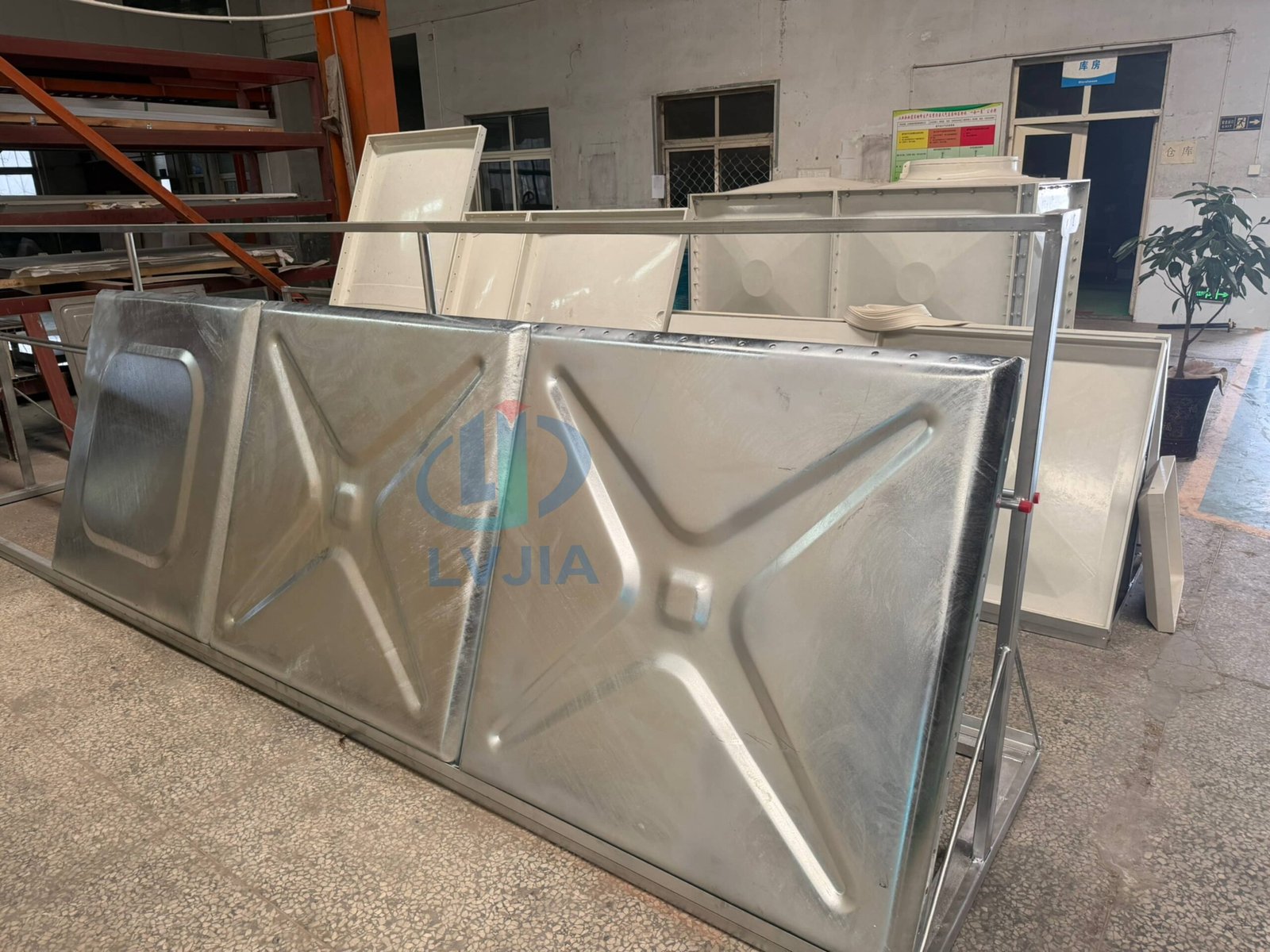
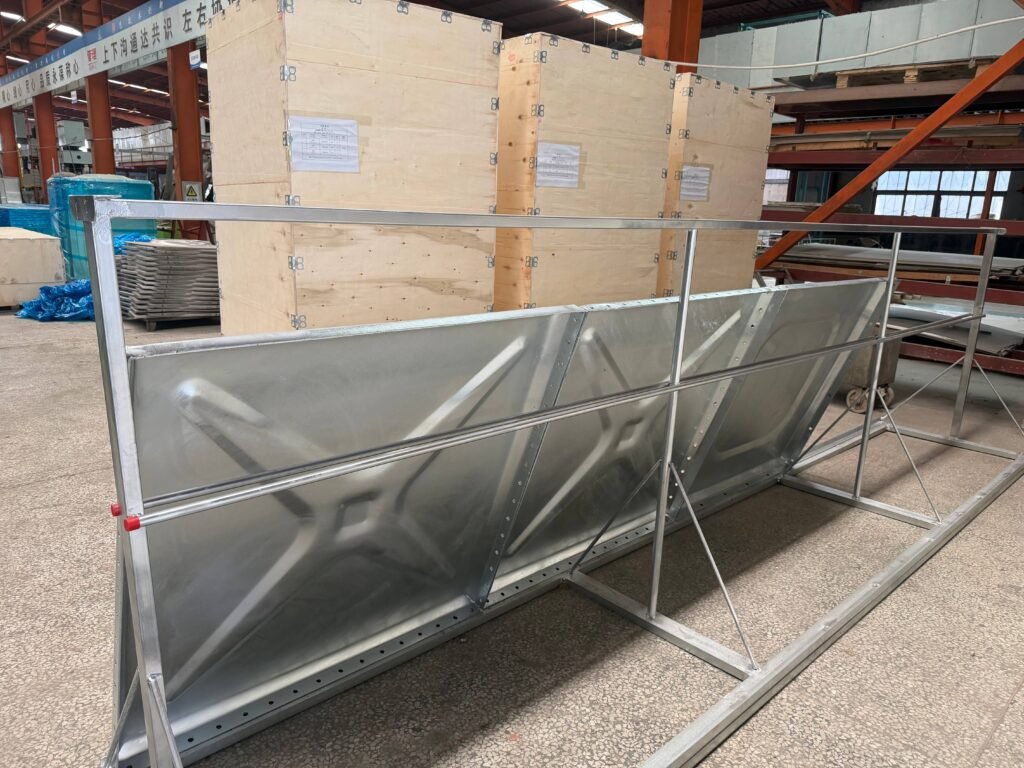
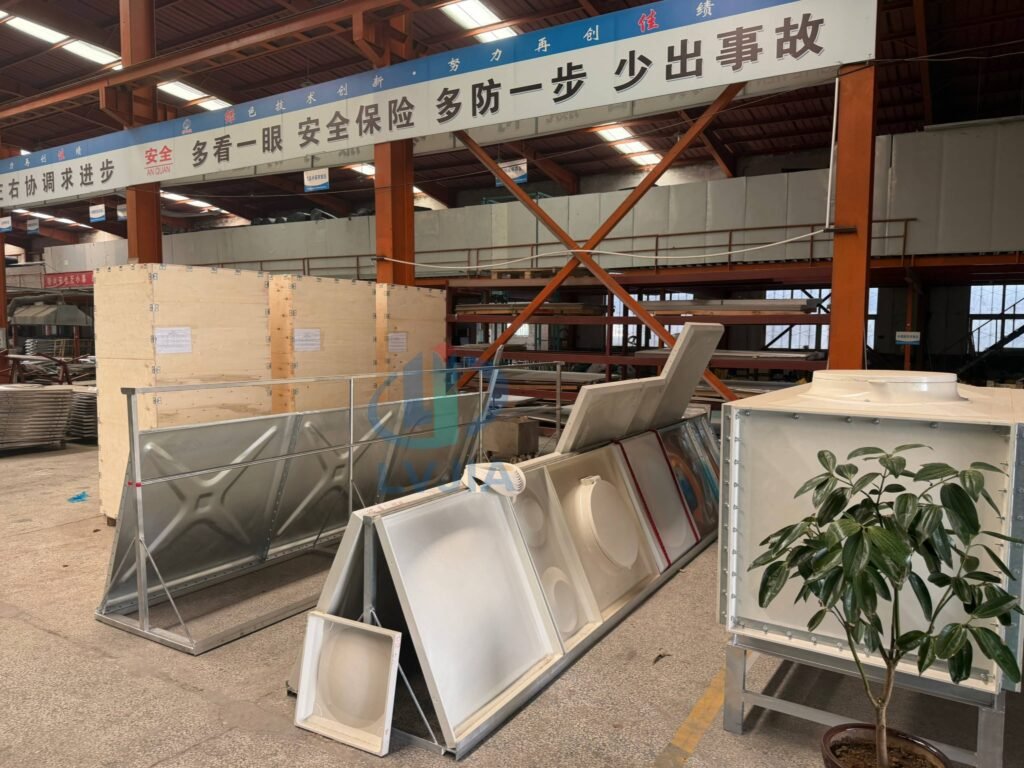
Our hot-dip galvanized panels are pressed from 2–5 mm Q235 plate and then galvanized, and our enamel tanks use bolted glass-fused-to-steel panels of 2–4.5 mm, both on our 1000 × 1000 mm standard panel. The general arrangement drawing lists panel thickness course by course, which also fixes the ISO 1461 zinc band for each course, so put the coating standard and reading plan in its notes at approval.
The hot-dip galvanized manufacturing and enameled steel water tank manufacturing pages walk through each route. Every tank is trial-assembled and held full for 48 hours at the works with the level logged, and the buyer’s inspector can hold any stage, including coating readings, written into the inspection and test plan.
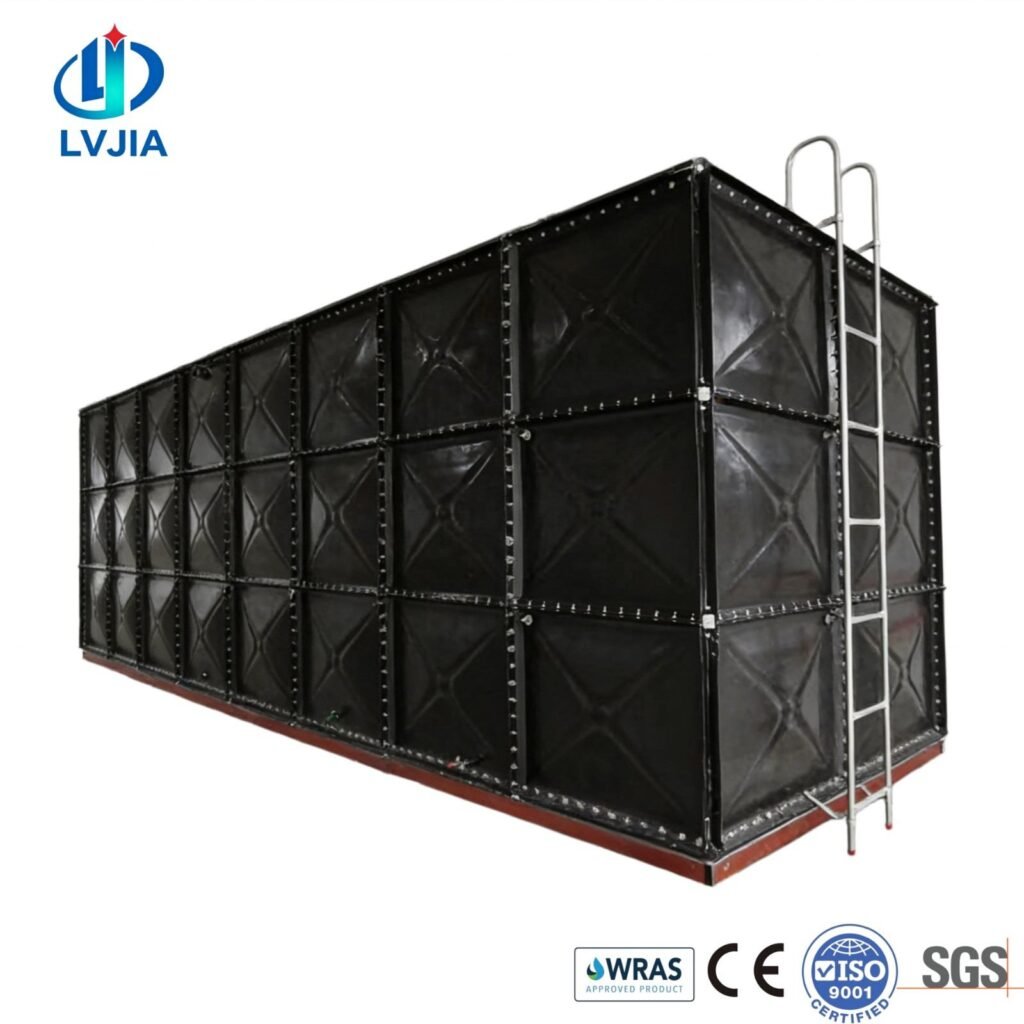
Both ranges carry GB/T 17219-2025 drinking-water contact reports, issued 18 May 2026: SP2630501 for hot-dip galvanized and SP2630500 for enameled steel, each passing 20 of 20 items, zinc and iron included. They are on our certifications page. LVJIA does not hold NSF/ANSI 61 certification or WRAS approval; where your market requires either, that is a separate route for the buyer.
For models, see the galvanized sectional water tank, the glass-fused-to-steel tank and the enamel sectional water tank, or the full galvanized water tank and enameled water tank ranges.
Checklist before you order
Send these with the inquiry and the galvanized vs enamel water tank question usually answers itself. The water analysis is the item most often missing.
- Water analysis: pH, total hardness as CaCO₃, chlorides, copper, temperature range.
- Duty and design life: fire reserve, irrigation, potable, process or effluent.
- Site corrosivity category for the outside faces, C2 to C5.
- For galvanized: batch galvanizing to ISO 1461 after pressing and punching, and a reading plan.
- For enamel: the standard (ISO 28765 or the AWWA D103 edition), the thickness range for each face, and the continuity test method and voltage.
- Hold points for coating readings and the water test in the inspection and test plan.
- Any potable approval your market requires, and who will obtain it.
Galvanized vs enamel water tank: frequently asked questions
Which lasts longer, a galvanized or an enamel water tank?
In aggressive water, enamel, because unbroken glass does not corrode. In hard, neutral water, a galvanized tank can last a long time and costs less. The answer depends on your water analysis and on whether the enamel stays undamaged through transport and erection, so send the analysis before choosing.
Can I store drinking water in a galvanized tank?
That depends on your local rules for materials in contact with drinking water. Our galvanized range passed all 20 items of GB/T 17219-2025, zinc included. Zinc still dissolves slowly, and faster in soft water, so confirm the water is not soft before choosing zinc for potable storage.
How do I measure galvanizing thickness on site?
With a calibrated magnetic coating gauge, checked on reference foils and zeroed on uncoated steel of similar thickness. Mark where each reading was taken on the panel or the drawing, so the next inspection reads the same spots and the trend means something.
What is a holiday test on enamel panels?
An electrical check for pinholes and cracks in the glass. A damp sponge at low voltage, or a spark probe at high voltage, is passed over the coating, and current reaching the steel through a flaw sets off the detector. Agree the method, voltage and number of defects accepted on the purchase order.
Can damaged enamel be repaired on site?
Small chips can be sealed with the maker’s approved repair coating after cleaning, and ISO 28765 includes a clause on on-site rectification. A site repair cannot be fired, so it is a coating patch rather than glass; record it, inspect it at every visit and keep repairs rare through careful handling.
Is galvanizing suitable for hot water tanks?
Generally not above about 60°C. In that range zinc can reverse polarity against steel, and in soft water no protective scale forms. For hot or warm water choose stainless steel, a BDF composite tank rated 0–100°C, or enamel within its maker’s temperature rating.
Why do the top panels of a galvanized tank carry less zinc?
ISO 1461 ties minimum zinc to steel thickness, and 2–3 mm top-course and roof panels fall in the 55 µm mean band rather than the 70 µm band. That zone also sees condensation, so put those panels first on the in-service reading plan.
Talk to an engineer
Send your water analysis and we will pick the coating
Our engineers send a first written reply within 2 hours and put the recommendation in writing, with the coating standard and hold points on the drawing.