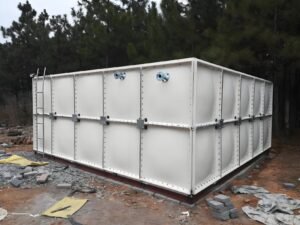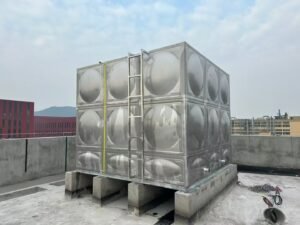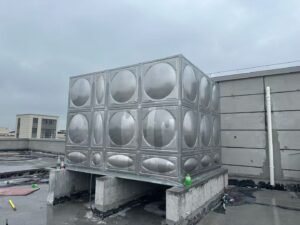



A water tank hydrostatic test fills an assembled sectional tank to its working level and holds it there long enough to prove every joint, gasket and fitting under full head. It is not a pressure-vessel test: the only load is the water itself. LVJIA’s works test holds for 48 hours with the level logged at the start and the finish. A site test should follow the same logic: fill in stages, hold, measure, correct for temperature and evaporation, and accept only dry joints.
At a glance
- Purpose
- Prove joints, gasket compression and fittings under full water head
- Load applied
- Hydrostatic head only, about 9.8 kPa per meter of water depth
- Fill
- In stages, with an inspection stop at each stage
- Hold at our works
- 48 h, level logged at start and finish
- Pass
- No visible leak or weep at any joint, fitting or panel face
- Weeping joint
- Drain below it, re-torque in pattern, replace the gasket if needed
- Record
- Signed hydrostatic test sheet that travels with the tank
What does a water tank hydrostatic test prove?
It proves that the assembled sectional tank holds water at its full working level without leaking at joints, gaskets, fittings or panel faces. It does not prove the tank will survive overpressure, because a vented sectional tank never sees any.
A bolted sectional tank is sealed by gasket compression between panel flanges. The bolts supply the clamping force, and the specified torque sets how much. A slack bolt leaves its gasket under-compressed; a high spot on the plinth lifts a panel and opens the joint beside it. Both faults are invisible while the tank is dry, which is the whole case for a water test.
The load is simple physics. Pressure at depth is density × gravity × depth, so 1 m of water gives about 998 × 9.81 × 1.0 ≈ 9.8 kPa, and the base of a 3 m tank sees about 29 kPa (roughly 4.3 psi). That is why our SMC panel thickness steps with water head across a 6–22 mm range, thinnest in the top course and heaviest at the base. Never blank the vent to add pressure: a vented tank’s design case is simply a full tank.
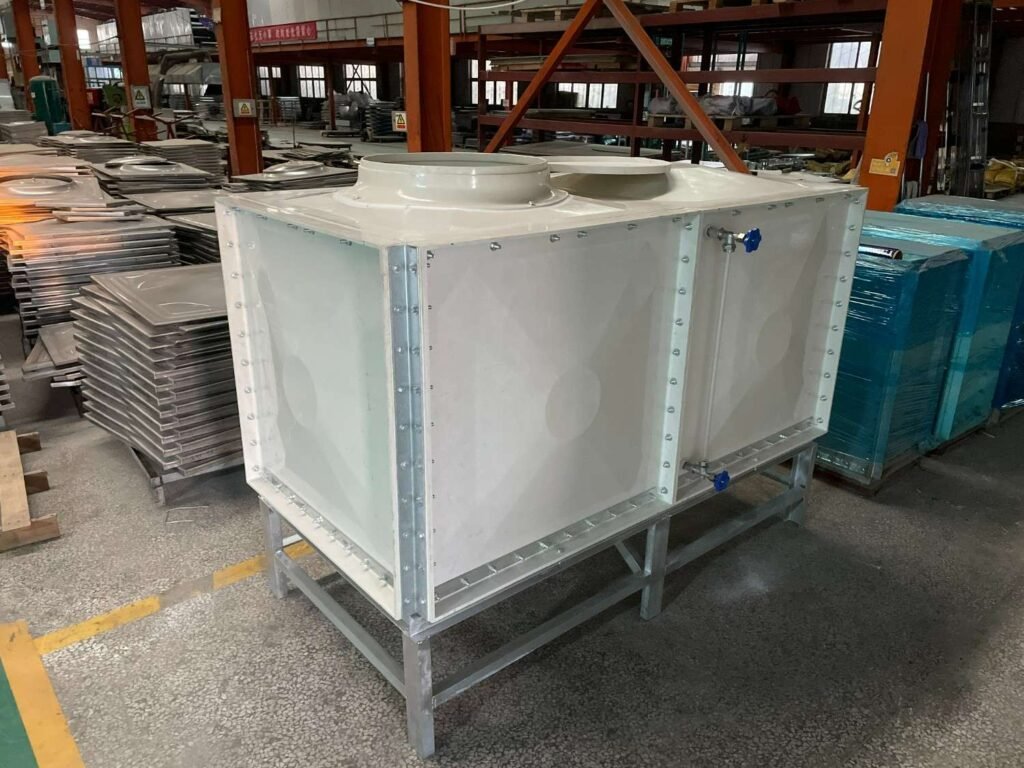
What must be in place before the tank is filled?
The foundation, the bolt torque, the fittings and the water source all need signing off before the first liter goes in. Filling a sectional tank that fails any of these turns a hydrostatic test into a repair job under load.
- Foundation. Plinths at the drawing centers, flat to 3 mm over any 3 m. A sectional tank will not correct a twisted base; it follows it.
- Bolts. Every bolt at the specified torque, tightened in pattern course by course and paint-marked once checked.
- Sealant and ties. Sealant cured to the product instructions; internal tie rods and stays fitted where the drawing shows them.
- Fittings. Every nozzle valved shut or blanked with a flange and a full gasket; drain valve closed and capped.
- Vent, overflow and water. Vent and overflow open so the tank can breathe; potable, metered water for a potable tank.
- Datum. A fixed level reference at the manway, thermometers for water and air, and an evaporation pan beside the tank.
- Access. A clear, lit walk-round on all four sides and, on plinths, under the floor. Nobody works inside the tank during the fill.
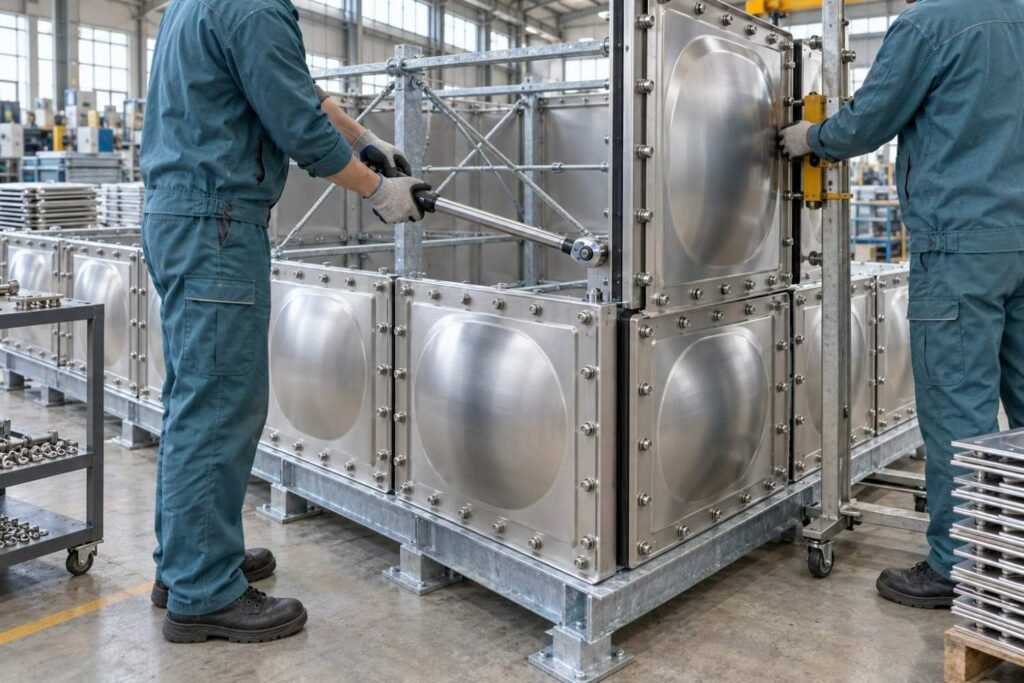
How should the tank be filled and held?
Fill in stages, stopping at each stage to walk every joint that has just gone under water before adding more head. Once at the test level, take the start reading, hold for the specified period, then take the finish reading and walk the tank again.
Record date, time, air temperature and drawing number. Zero the level reference and fill the evaporation pan.
Walk every floor and bottom-course joint, every corner and the drain. A weep found at this height costs a short drain.
Walk the tank again, including the second course and side nozzles.
Stop at the maximum working level on the drawing, just below the overflow invert. Record level, water temperature and pan reading.
Leave the tank undisturbed for the specified period, 48 hours at our works, walking it at intervals and logging any finding with the time.
Record the same readings, walk every joint again and sign the sheet. Then drain, or hand over for disinfection.
How long should the hold be? As long as your specification says; the free texts we could check leave the figure to the full standard or the project. Our 48-hour works hold spans two nights and two days, so a joint that only opens as the panels cool and warm has time to show.
| Document | Applies to | What it says about the test |
|---|---|---|
| LVJIA works test | Every tank, all five ranges | Trial assembly, 48 h hold, level logged at start and finish, test sheet travels with the tank |
| AWWA D103-19 | Cylindrical, factory-coated, bolted carbon steel tanks | Covers design, construction, inspection and testing; the test clauses are in the paid text |
| Texas TCEQ construction notes for water storage tanks (rev. 2019) | Water storage tanks in Texas | Bolted tanks tested in strict accordance with the current AWWA D103; disinfection to AWWA C652, dechlorination to AWWA C655 |
| AWWA D121-12 | Bolted aboveground FRP panel-type tanks | Separate clauses for testing, disposal of test water, repair of leaks and disinfecting |
| SS 245:2014, as stipulated by PUB | GRP sectional tanks in Singapore | A hydrostatic test (clause 10.1.3) and a leakage test (clause 10.2.1, Annex H) among the test requirements |
How do you turn a level drop into a volume loss?
Multiply the corrected level drop by the internal plan area: on a tank 6 m by 4 m inside, every millimeter is 24 liters. The correction matters, because a couple of degrees of cooling or a day of evaporation can move the level more than a small weep does.
Water contracts as it cools. The NIST Chemistry WebBook gives its density at atmospheric pressure as 997.995 kg/m³ at 21 °C and 998.408 kg/m³ at 19 °C, so the same water takes up about 0.041% less volume after a 2 K fall. Use the densities at your own start and finish temperatures. Evaporation is harder: an open pan loses more than the covered surface in a roofed tank, so treat its reading as an upper bound.
Worked example
Correcting a 48-hour level log on a 6 × 4 m sectional tank filled to 2.8 m
- Plan area and volume
6.0 m × 4.0 m = 24.0 m²; 24.0 m² × 2.8 m = 67.2 m³1 mm of level = 24 L - Measured level drop over the hold
2.0 mm × 24 L/mm = 48 Lapparent loss - Cooling correction, water 21 → 19 °C
67.2 m³ × (1 − 997.995 / 998.408) = 0.0278 m³27.8 L ≈ 1.16 mm - Evaporation, upper bound from the pan
0.6 mm × 24 L/mm = 14.4 L0 to 0.6 mm - Unexplained drop, as a range
2.0 − 1.16 − 0.6 = 0.24 mm; 2.0 − 1.16 − 0 = 0.84 mm5.8 to 20.2 L in 48 h - Reading resolution, ±0.5 mm at each end
±1.0 mm × 24 L/mm = ±24 Ldetection limit
Result: even with no credit for evaporation, the unexplained loss is at most about 20 L, inside the ±24 L the readings can resolve. The level log shows no measurable loss, and the verdict rests on the walk-round: dry joints pass.
The level log earns its place on the leak you cannot see. On a flat slab a floor joint weeping into the concrete only shows as a steady unexplained drop. A loss of 1 L per hour is 48 L over the hold, 2 mm on this tank, and the log will catch that.
What counts as a pass, and where does the criterion come from?
A pass is no visible leakage or weeping at any joint, fitting or panel face at the end of the hold, with any level change explained by temperature and evaporation. The criterion itself belongs in the specification the tank is bought against, written in those plain words.
The trap is condensation. Cold mains water in a tank on a humid day can bead the whole outer surface. A weep is local: it follows one joint or fitting and returns in the same place after wiping. Wipe, wait half an hour and look again.
| What you see | Verdict | Action |
|---|---|---|
| Dry joints, dry fittings, dry floor | Pass | Record and sign |
| Even moisture over all cold panel faces that returns everywhere at once | Condensation | Record air and water temperature; recheck when conditions settle |
| A moisture line or bead along one joint that returns after wiping | Weep: fail | Mark it, finish the walk-round, drain below the joint |
| A drip or trickle | Leak: fail | Stop filling and drain below the joint |
| A damp patch on a panel face away from any joint | Fail, possible panel damage | Drain, inspect the panel, replace it if damaged |
| Unexplained drop larger than the reading resolution, joints dry | Hidden leak | Check drain valve and pipework, inspect the floor from below, extend the hold |

What should you do about a weeping joint?
Mark it, finish the walk-round, then drain to below the joint before touching the bolts. Re-torque in pattern to the specified value, and if it still weeps, replace the gasket instead of tightening further.
- Note the level at which the weep started: low down points to head and foundation, higher up to a missed bolt.
- Drain to below the joint so the gasket is no longer loaded.
- Check every bolt on that joint and its neighbors against the torque value, in the assembly pattern.
- If the bolts were at torque, open the joint and look at the gasket: cut, twisted, pinched, or missing sealant at a three-panel junction.
- Fit a new gasket, torque in pattern and refill in stages.
- Restart the hold from a new start reading. A repaired joint earns a full hold.
Engineer’s note
The seal is made by the gasket, not by the bolt. Once a gasket is compressed to its design thickness, more torque does not make it tighter; it extrudes the rubber, crushes it at the bolt hole, and on a GRP panel can crack the laminate around the hole. On a pressed steel flange it can bow the flange between bolts and open the joint you were trying to close.

Where do water tests go wrong?
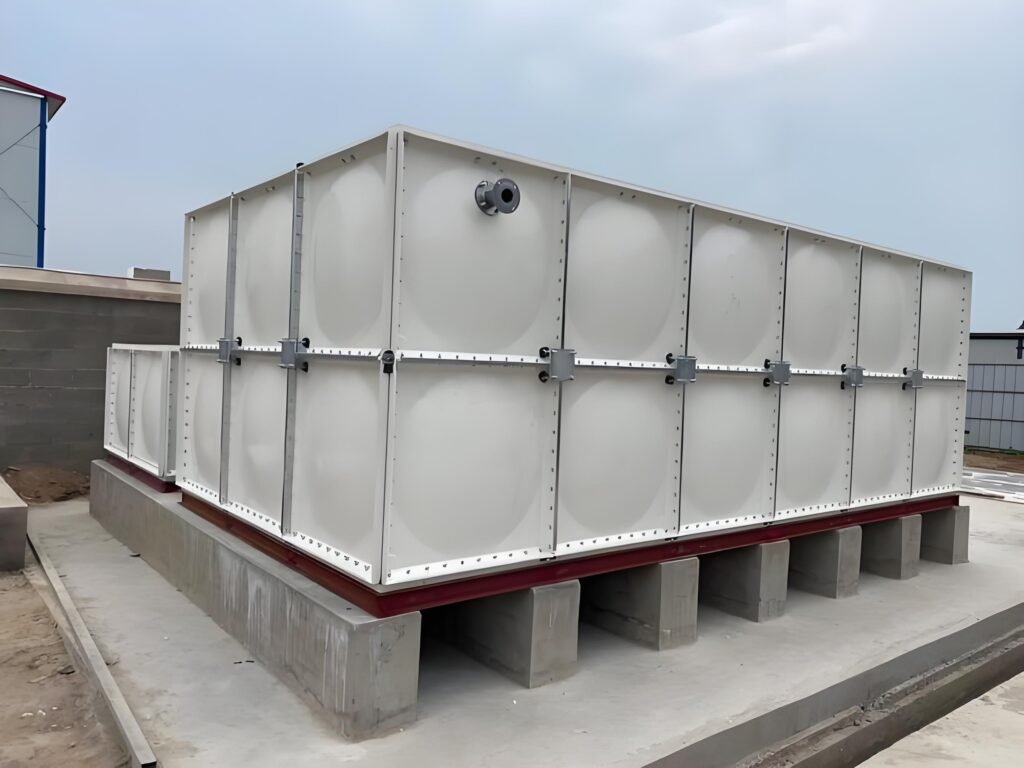
Water tests usually fail at the interfaces: the foundation under the tank, the bolts in its joints and the fittings through its walls. The table lists what each failure looks like and how to prevent it.
| Symptom | Likely cause | How to prevent it |
|---|---|---|
| Weep at bottom-course joints near one corner | Plinth out of level: a high spot lifts a panel, a low spot leaves a gasket under-compressed | Survey the plinths to 3 mm over any 3 m before the floor goes down |
| Weep along one whole course | That course was never brought up to torque | Torque course by course and paint-mark each checked bolt |
| Leak at a nozzle blank | Blank fitted without a full gasket, or its bolts left finger-tight | List every penetration on the test sheet and tick each one |
| Leak at the drain | Valve cracked open or debris on the seat | Flush the floor before filling; close and cap the drain |
Watch out
Never tighten a loaded joint beyond its torque value to chase a weep. It damages the gasket and panel and hides the real cause. Drain first. If the repair needs someone inside the tank, the UK Confined Spaces Regulations, as HSE summarizes them, start with avoiding entry by doing the work from outside, then require a safe system of work and emergency arrangements where entry cannot be avoided.
What do the standards say about a water tank hydrostatic test?
The bolted-tank standards we could read cover the water test, disposal of test water and repair of leaks, with the detailed clauses in their paid texts. The free material is still enough to write a sound specification: fill to working level, hold for a stated period, accept no leaks and dispose of the water responsibly.
AWWA D103 covers new cylindrical, factory-coated, bolted carbon steel tanks, so a rectangular pressed-panel tank sits outside its scope. AWWA D121 covers bolted aboveground thermosetting FRP panel-type tanks and has been revised as AWWA D121-24. Its 2012 foreword says the purchaser may require a written report stating that the required testing was performed and any leaks repaired, a clause worth borrowing for any material.
In Europe, BS EN 13280:2001 is the specification for GRP cisterns of one-piece and sectional construction, and the standard behind our CE Verification of Conformity for the GRP/SMC range. We could not confirm a site water-test clause from free sources, so if your project runs under it, write the hold period and acceptance criterion into your own specification.
Where does the test water go?
Once the tank has been chlorinated, the test water becomes a discharge problem. AWWA C652-19 says that where a chlorinated discharge could harm fish, plant life, installations or other downstream uses, a reducing agent should be applied to neutralize the chlorine residual, and it refers to AWWA C655 for field dechlorination. Local limits can be very low: the fact sheet for a Wisconsin general permit for water system maintenance explains a total residual chlorine limit of 19 µg/L, daily maximum, where chlorine is present. Check before draining to a storm sewer.
How does LVJIA test at the works, and why test again on site?
Every tank we build is trial-assembled at our works and held full of water for 48 hours, with the level logged at the start and the finish, before it is stripped, dried and crated. The site hydrostatic test is still needed, because the tank on your plinth is a new assembly on a different foundation, bolted by a different crew.
The route starts with the general arrangement drawing, approved by the buyer before anything is pressed, and panels are checked against that drawing rather than against the last batch. Our GRP water tank manufacturing page follows the route for SMC panels, and the factory tour walks through the plant.

After the hold the tank is drained, stripped, dried and kitted, one crate per tank. The hydrostatic test sheet, material certificates, approved drawing and assembly manual (EN/中文) travel with it. Standing documents for each range are on our certification register, and range drawings are with the datasheets and CAD downloads.
Factory trial assembly versus the site test
The works water test proves the parts: holes line up, gaskets seat, fittings sit where drawn. It cannot prove your plinth, your crew’s torque or your pipework blanks. A tank that passed at the works and weeps on site points to the foundation or the assembly, which narrows the search.
Third-party inspection hold points
If your inspector wants to witness, we write the hold points into the inspection and test plan for your order. Points buyers often choose: incoming material against its certificate, pressed panels against the approved drawing, trial assembly, the start and finish of the hold, and the kit count at packing.
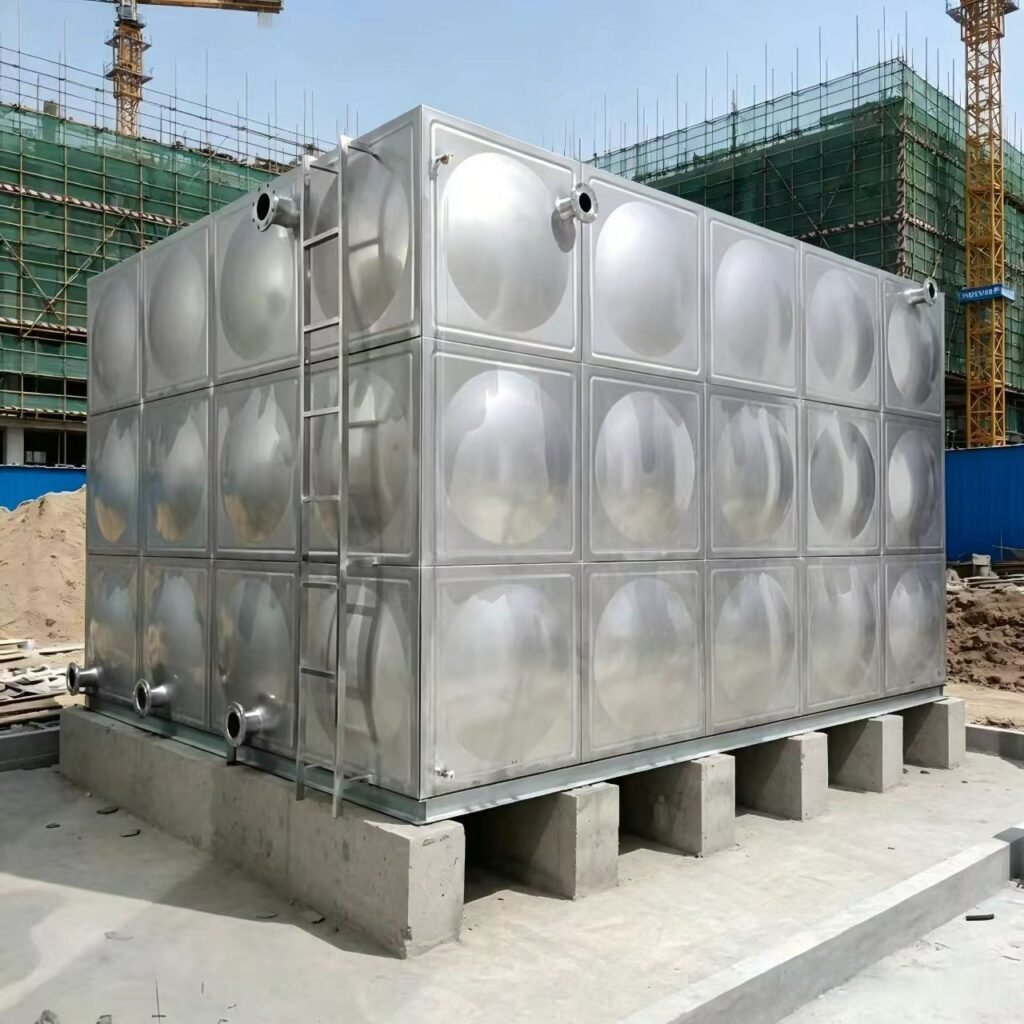
The same test applies to a GRP sectional water tank, a bolted stainless steel water tank, or a galvanized bolted water tank for fire reserves; see the SMC water tank and stainless steel water tank ranges for panel options.
Water tank hydrostatic test checklist
Walk this list with the test sheet. The sheet should let someone who was not there judge the result.
- Plinths surveyed flat to 3 mm over any 3 m, centers as drawn
- All bolts torqued in pattern to the specified value and paint-marked
- Sealant cured; tie rods and stays fitted as drawn
- Every penetration listed, valved or blanked with a full gasket; drain closed and capped
- Vent and overflow open; potable fill water for a potable tank, volume metered
- Level datum fixed, thermometers placed, evaporation pan filled
- Staged fill with a walk-round at each stage
- Start and finish readings logged, corrected for temperature and evaporation
- Every weep marked, drained, repaired and re-held, with times
- Test water disposal agreed, with dechlorination if the tank was chlorinated
- Sheet signed by tester, installer’s supervisor and client’s representative
Water tank hydrostatic test: frequently asked questions
How long should a water tank hydrostatic test last?
Whatever the contract states, and never less than the time a slow weep needs to show. Our works hold is 48 hours, covering two cooling and warming cycles. If the contract is silent, agree a duration in writing before the fill starts, so the hold cannot be cut short on the day to suit the program.
Can a drinking-water tank be tested with non-potable water?
Avoid it. Whatever goes in touches every wetted surface and has to be cleaned out before disinfection, which costs a second fill. Use metered water from the potable supply, so the same fill can move straight into disinfection if the tank passes.
Should the tank be disinfected before or after the water test?
After it has passed, or combined with it if your procedure allows. There is little point chlorinating a tank that may have to be drained for a gasket change. Once chlorinated, the water has to be neutralized before discharge, so agree disposal with the site and the authority first.
Is a small weep acceptable if it seems to stop?
Record it as a fail and find the cause. A joint that seems to dry may only have been wet from condensation, or the weep slowed as the water cooled. Drain below it, check the bolts and the gasket, and run the hold again.
Will a partial fill do if water is scarce on site?
No. Joint load rises with depth, so a half-full tank loads the bottom course at half its design head and leaves the upper courses untested. If supply is short, stage the fill over several days, but take the hold readings only once the water stands at the maximum working level.
Can a tank be water tested in freezing weather?
Only with precautions. Ice in the drain, overflow or vent pipework can crack fittings or block the vent, and a weep that freezes is easy to mistake for frost. Postpone the test, heat the enclosure, or keep the water above freezing, and never leave a filled, unheated tank standing through a hard frost.
Talk to an engineer
Send us your test procedure or specification
We will check the hold period, the acceptance wording and the torque schedule against your tank drawing and send back a marked-up PDF.