

Potable water tank standards differ by market because each country answers two questions its own way: what the tank does to the water, and whether the tank itself is fit for service. The UK leans on the Water Fittings Regulations and WRAS approval, North America on NSF/ANSI/CAN 61, Singapore on PUB’s stipulated standards, Australia on AS/NZS 4020 and China on GB/T 17219-2025. Below is what each covers, who issues it, what to ask a supplier for, and exactly which of these documents we hold.
Key takeaways
- Ask for the approval your market recognizes, by name and number. “Food grade” and “non-toxic” are claims, not approvals.
- Most markets judge drinking-water contact separately from the tank’s structural standard. You usually need evidence for both.
- The EU is moving from national schemes to one EU framework; DVGW CERT in Germany can issue no new UBA-based hygiene certificates from 31 December 2026.
- We hold GB/T 17219-2025 drinking-water test reports for all five ranges, a CE Verification of Conformity to EN 13280:2001 for GRP/SMC, and ISO 9001, 14001 and 45001. WRAS, NSF/ANSI/CAN 61, Kiwa and the other market approvals below are not held: none is in our certificate register.
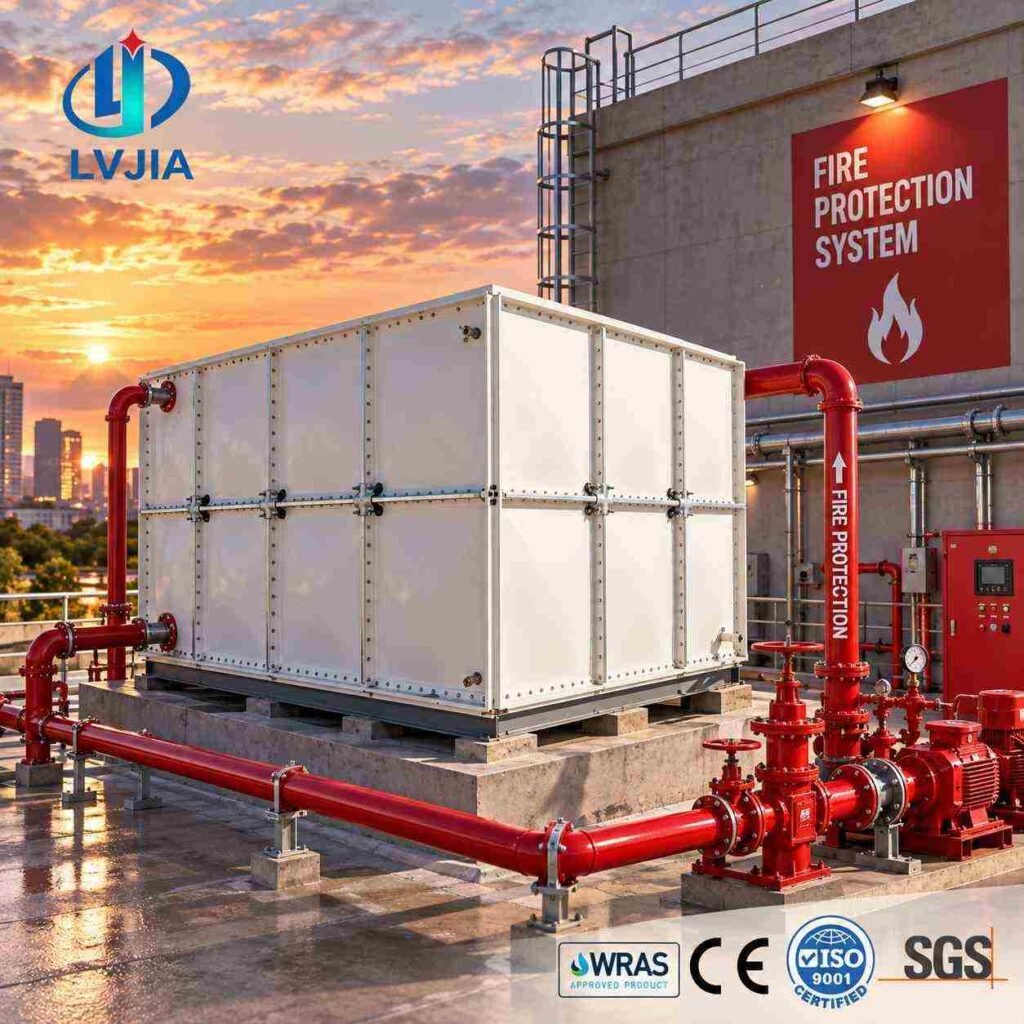
Why is there no single standard for a drinking water tank?
Because a drinking water tank is judged on two separate things: whether its wetted materials leach anything into the water, and whether the tank is built to hold that water safely. Each market covers those two questions with its own mix of law, approval scheme and product standard.
The first question is about chemistry. Resin, gel coat, gaskets, sealant, coatings and metals all sit in the water for years, and regulators want evidence that they do not add taste, odor, color or harmful substances. That evidence usually comes from a soak or exposure test on the finished material, run by an independent laboratory.
The second question is about the product: panel thickness, joints, access, overflow, insulation. Product standards such as EN 13280 for GRP cisterns or SS 245 for GRP sectional tanks cover that. A tank can meet a product standard and still lack the hygiene approval a country asks for, which is why a good drinking water tank specification names both.
Potable water tank standards market by market
The table is the short version of potable water tank standards in nine markets; the sections below explain each row. Confirm the current requirement with whoever signs off your project, because schemes change and some are local.
| Market | Water-contact requirement | Tank product standard | Ask the supplier for |
|---|---|---|---|
| UK (England and Wales) | Water Supply (Water Fittings) Regulations 1999; WRAS approval; BS 6920 for non-metallic materials | BS EN 13280:2001 for GRP cisterns (replaced BS 7491) | WRAS approval number, or BS 6920 reports for each wetted non-metallic material |
| Germany | UBA evaluation criteria; hygiene conformity certificates from bodies such as DVGW CERT | EN 13280 for GRP | Hygiene conformity certificate; plan for the EU rules |
| Netherlands | Regulation on materials and chemicals; Kiwa Water Mark | EN 13280 for GRP | Kiwa Water Mark certificate |
| USA and Canada | NSF/ANSI/CAN 61, required by most states and provinces | AWWA D103 (bolted steel), AWWA D121 (bolted FRP panel) | NSF/ANSI/CAN 61 listing covering the tank and its wetted parts |
| Singapore | PUB stipulated standards; SS 375 for non-metallic and AS/NZS 4020 Appendix H for metallic wetted materials | SS 245:2014 for GRP sectional; stainless grade 316 or better | Test reports from an SAC or ILAC-MRA accredited laboratory |
| Malaysia | SPAN listing and registration under Act 655 | Confirm with SPAN and your consultant | Product conformity certificate from a recognized certification body |
| Australia and New Zealand | AS/NZS 4020, called up by the WaterMark scheme for drinking-water contact | Check the WaterMark Schedule of Products for your tank type | AS/NZS 4020 test report for each wetted material |
| Gulf states | Set authority by authority | BS EN 13280 named in Dubai’s healthcare guideline | Whatever the signing authority names, in writing |
| China | GB/T 17219-2025 hygienic safety evaluation (a recommended national standard) | Depends on the tank type; ask the specifier | GB/T 17219-2025 report from a CMA-marked laboratory, for your tank’s material |
What does the UK require?
In England and Wales, the Water Supply (Water Fittings) Regulations 1999 ban materials that contaminate water and set out how storage cisterns must be built. WRAS approval is one way to show that a product meets them, and GRP cisterns are specified to BS EN 13280.
The materials rule is Schedule 2, paragraph 2: no material likely to cause contamination may be used in a fitting that carries water for domestic or food production purposes. Paragraph 16 of the same schedule covers the cistern itself: an overflow with a warning of impending overflow that excludes insects, a cover that excludes light and insects, and thermal insulation against freezing or undue warming.
WRAS product approval combines mechanical and any necessary water-quality testing. Each non-metallic material must carry a WRAS materials approval number or a valid BS 6920 test report, and a listing expires five years after the approval meeting. For a sectional potable water tank that means the panels, the gaskets and the sealant.
BS 7491 is no longer the reference. The NBS record for BS EN 13280:2001 shows it as current and as the replacement for BS 7491 Parts 1 to 3. It covers one-piece GRP cisterns from 500 L to 100,000 L and rectangular sectional tanks of 500 L and larger for above-ground water storage.
What does the EU require, and what changes after 2026?
Today, most of the hygiene evidence is national: Germany works to UBA evaluation criteria, the Netherlands to its own regulation, certified by Kiwa. A single EU framework under the Drinking Water Directive is taking over, and in Germany the UBA criteria give way to it in 2027.
In Germany, a hygiene conformity certificate confirms that a product intended for drinking-water contact is hygienically suitable. DVGW CERT states that no new certificates of this kind to the UBA criteria may be issued from 31 December 2026, that the UBA criteria are replaced by uniform EU requirements in 2027, and that a transition period runs from 2027 to 2032 inclusive.
In the Netherlands, the Drinking Water Act, the Drinking Water Decree and the regulation on materials and chemicals set the requirements. According to RIVM, the national public health institute, Kiwa Nederland is currently the only certifying body whose mark the ministry recognizes for this purpose. That mark is the Kiwa Water Mark, formerly the ATA.
EN 13280 sits alongside all of this as the product standard for GRP cisterns. It does not replace the hygiene route. A buyer shipping a GRP drinking water tank into the EU after 2026 should ask which evidence the new EU framework, or the national transition rules, will accept for that project.
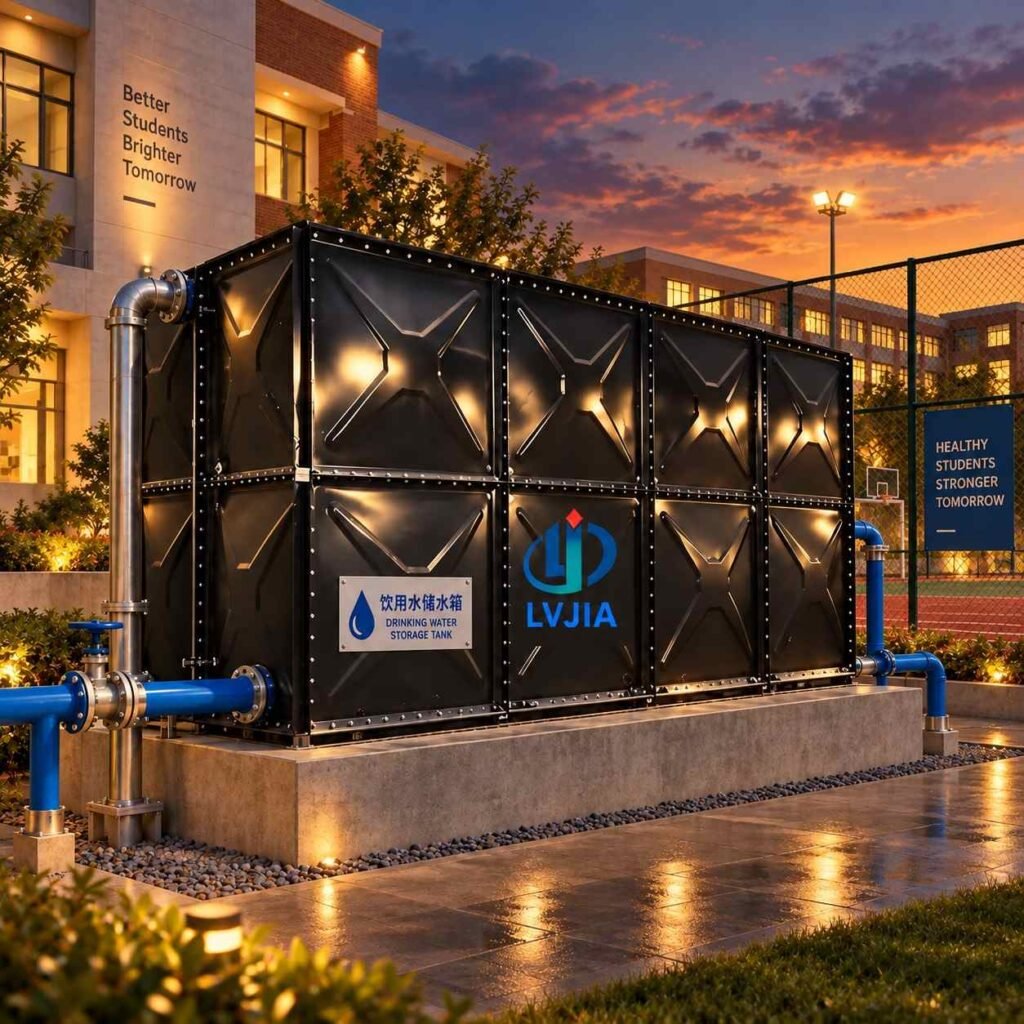
What do the USA and Canada require?
For drinking-water contact, the requirement is NSF/ANSI/CAN 61, which most US states and Canadian provinces require. For the tank structure, the AWWA standards are the reference: D103 for bolted carbon steel and D121 for bolted FRP panel tanks.
NSF/ANSI/CAN 61 is a health-effects standard. UL Solutions explains that products are exposed to test water for a sequence of times set in the standard, the water is analyzed under a test program built around the materials of construction, and detected contaminants are compared with pass/fail levels. It adds that the major model plumbing codes require certification for water supply and distribution products in buildings.
AWWA D103 is scoped for cylindrical, factory-coated bolted carbon steel tanks, and D121 for bolted aboveground FRP panel-type tanks; we set out what each says about testing in our guide to the water tank hydrostatic test. For a potable water tank in North America, an engineer will expect NSF/ANSI/CAN 61 evidence covering the panels and every wetted part, gaskets and coatings included.
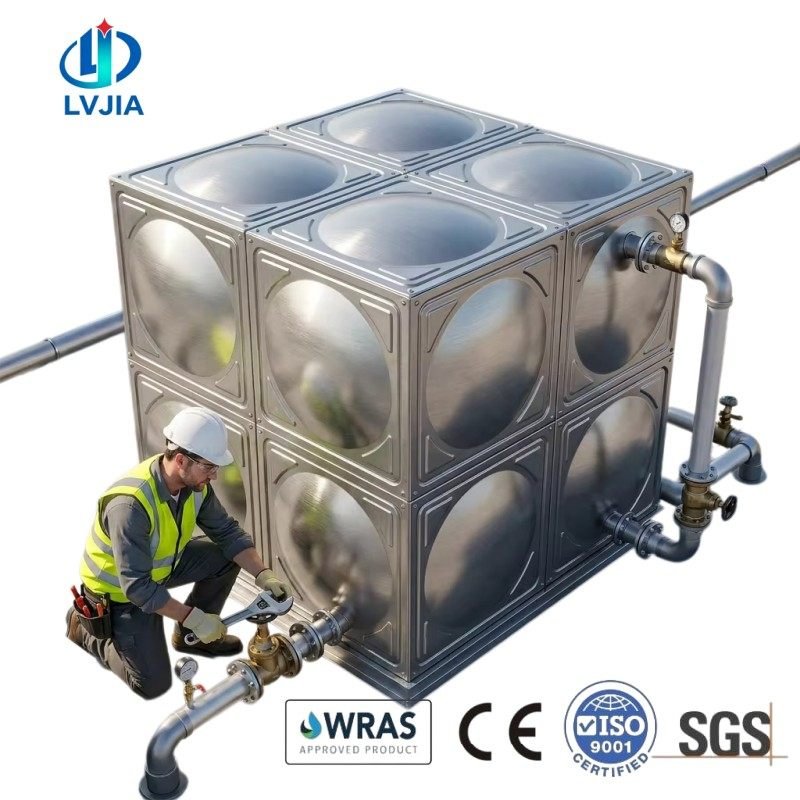
What do Singapore and Malaysia require?
Singapore is the most prescriptive market in this guide: PUB names the tank standard, the material tests and the laboratory accreditation. Malaysia works through SPAN, which requires suppliers of water-supply products to be listed and registered with a product conformity certificate.
PUB’s stipulated standards for water fittings require GRP sectional tanks to be tested to SS 245:2014, including hydrostatic and leakage tests, with wetted materials meeting SS 375 (or BS 6920 plus clause 8 of SS 375) for non-metallic parts and AS/NZS 4020 Appendix H for metallic parts. Stainless sectional tanks must be grade 316 or better and entirely stainless steel. Tests count only from a laboratory accredited by the Singapore Accreditation Council or one of its MRA partners, with the SAC-SINGLAS or ILAC-MRA logo on the report.
A SUS 304 tank that suits many markets is not acceptable for a stainless sectional tank in Singapore, so specify 316 or 316L from the start.
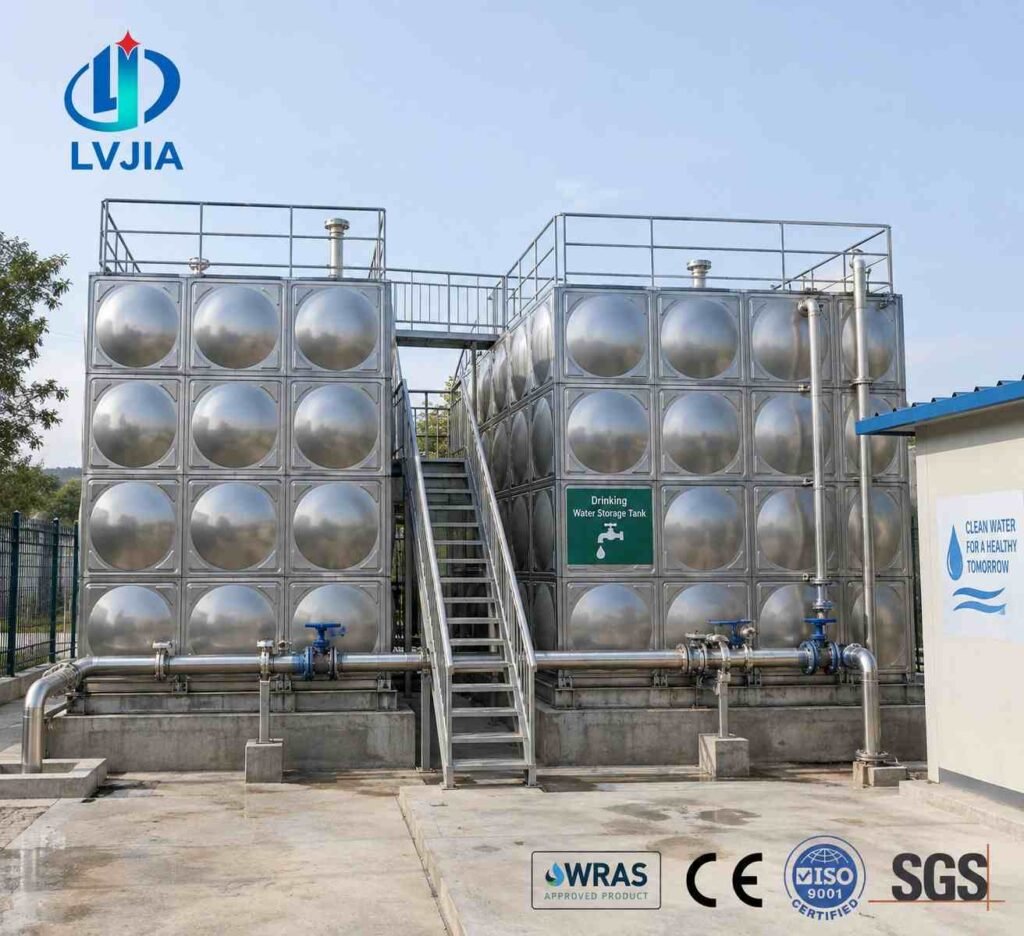
In Malaysia, SGS summarizes the SPAN requirement: under the Water Services Industry Act 2006 (Act 655), manufacturers and suppliers of equipment and materials for water supply must list and register with SPAN, and a product conformity certificate from a recognized certification body is a mandatory part of registration. Confirm with SPAN which product category your tank falls under before you order.
What do Australia and New Zealand require?
The drinking-water contact test is AS/NZS 4020. In Australia, the WaterMark scheme requires materials and products in contact with drinking water to comply with it, under Part A of the National Construction Code Volume Three.
The WaterMark Schedule of Products, published by the Australian Building Codes Board, lists the plumbing and drainage products in the scheme and the specification each can be certified to, and it states the AS/NZS 4020 requirement for drinking-water contact. Check where your tank type sits on it, and ask the supplier for an AS/NZS 4020 report on every material that touches the water: panels, gaskets, sealant and any coating. For New Zealand, confirm the route with your building consent authority.
What applies in the Gulf states?
We could not find one Gulf-wide approval for drinking-water tanks, and we did not confirm a Saudi SASO tank regulation, so we do not name one. Requirements are set by each authority, and the consultant on the project usually names them.
Dubai gives a useful example. The Dubai Health Authority’s water systems design guideline for healthcare facilities asks for above-ground tanks in GRP to BS EN 13280. It requires materials in contact with wholesome water to conform to BS 6920 for non-metallic materials, or to equivalent international standards such as fittings with WRAS approval, with DEWA approval as well, and gives local DEWA standards precedence where they clash. It asks for a product standard and a materials test, the same two-part pattern that runs through potable water tank standards in the UK and Singapore.
What does China require?
China’s national standard for this question is GB/T 17219-2025, in force since 1 March 2026. It is a recommended national standard for the hygienic safety evaluation of distribution equipment, protective materials and water treatment materials in drinking water systems.
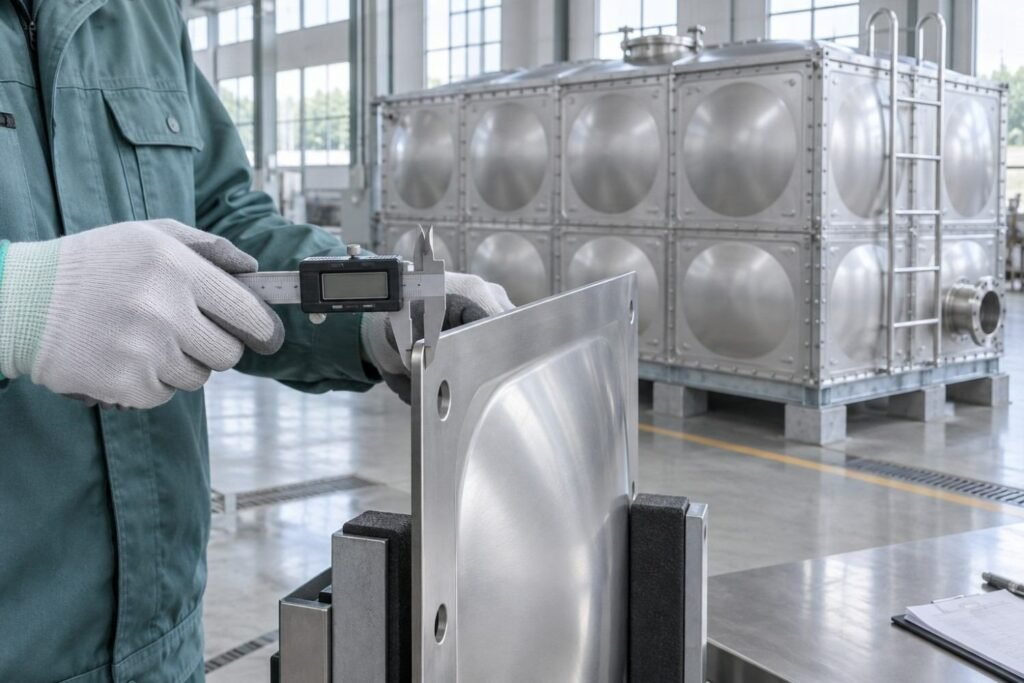
The 2025 edition replaced the 1998 edition in full and widened its scope to water treatment materials. A sample of the material is soaked and the soak water analyzed; our news article on GB/T 17219-2025 explains the test and the official records behind it. The report you want comes from a laboratory carrying the CMA mark, China’s legal qualification for inspection and testing bodies, and names your supplier and the material of your tank.
What does LVJIA hold, and what does it not?
We hold GB/T 17219-2025 drinking-water contact test reports for all five of our ranges, a CE Verification of Conformity to EN 13280:2001 for the GRP/SMC range, and three ISO management system certificates. WRAS approval, NSF/ANSI/CAN 61 certification, the Kiwa Water Mark and the other market approvals in the table above are not held: none of them is in our certificate register.
| Document | Status | What it covers |
|---|---|---|
| GB/T 17219-2025 test reports SP2630498 to SP2630502 | Held, one per range | Drinking-water contact; the GRP/SMC report SP2630502 passed 20 of 20 items |
| CE Verification of Conformity ICR/VC/HS2506113 | Held, to 23 June 2030 | GRP/SMC range assessed against EN 13280:2001 |
| ISO 9001, ISO 14001, ISO 45001 | Held, issued by ZRX (CNAS accredited) | Management systems at the factory, all ranges |
| WRAS approval | Not held (not in our register) | UK water fittings route |
| NSF/ANSI/CAN 61 | Not held (not in our register) | North American health effects |
| Kiwa Water Mark, UBA hygiene conformity | Not held (not in our register) | Netherlands, Germany |
| AS/NZS 4020, SS 245, SPAN registration | Not held (not in our register) | Australia and New Zealand, Singapore, Malaysia |
| Food contact material declaration | Not held (not in our register) | Beverage and process duty |
Where your project needs an approval we do not hold, we say so before you order, not after. That approval then has to come through the scheme’s own route, and your consultant or authority decides whether our test evidence helps. We do not describe a GB/T 17219 report as equivalent to WRAS approval or NSF/ANSI/CAN 61 certification: the schemes, test methods, limits and recognition are different.
A naming point: an enamel model in our catalog carries “WRAS Type” in its product name. That is only a product name, not an approval, and it does not change the answer above.
Watch out
“Food grade” in a product name, ours included, is a description, not a certificate. If the water will be drunk, ask for the named test report or approval your market recognizes, with its number and issuer, and check it with the issuer.
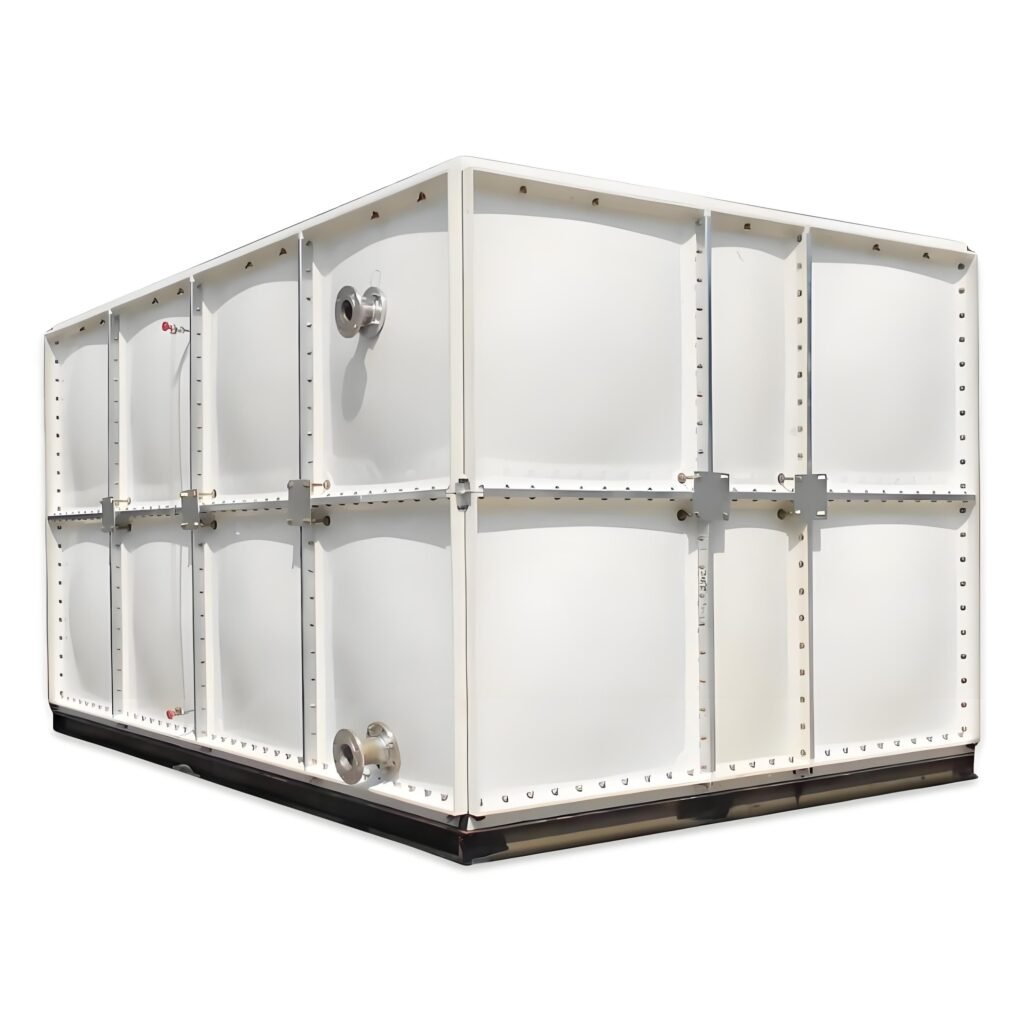
For drinking-water duty our usual starting points are the GRP potable water tank, the stainless steel drinking water tank and the enamel drinking water tank. The full GRP panel water tank, stainless steel water tank and enameled water tank catalogs show every model, and the GRP water tank manufacturing page shows how the tested SMC panels are pressed.
How do you check that a certificate is real?
Read the document, then confirm it with the body that issued it, never only with the supplier. A genuine certificate names an issuer, a number, a holder, a scope and dates, and each of those can be checked.
Issuer, number, holder, holder’s address, product or material in scope, standard and edition, issue and expiry dates. A document missing any of these is not evidence.
The holder should be the company making your tank. Ours name Shandong Lvjia Air Conditioning Equipment Co., Ltd.; a certificate held by a gasket maker covers the gasket, not the tank.
A CE document for GRP does not cover stainless, and a report for one material does not cover another. Check the range and the material, not only the logo.
A report to a superseded edition, or an approval past its expiry, does not answer today’s specification.
Use the issuer’s public register where one exists, or quote the number to the issuer directly and ask for confirmation in writing.
A test report is valid with the laboratory’s seal and the signatures of inspector, checker and signatory. Scans are for comparison; stamped copies are for your file.
| Document | Verify with | Quote |
|---|---|---|
| WRAS approval | WRAS online approvals directory | Approval number, company |
| NSF/ANSI/CAN 61 | NSF online listings for drinking water system components | Manufacturer, product type |
| Kiwa Water Mark | Kiwa, the certifying body | Certificate number |
| ISO 9001, 14001, 45001 from a Chinese body | The certification body, and CNCA’s national certification result query | Certificate number |
| GB/T 17219 test report | The issuing laboratory; check its CMA mark | Report number, CMA number |
| CE Verification of Conformity | The issuing body named on it | Certificate number, standard, scope |

Every document we hold is on our certification register with its issuer, number and dates, and a note on how to verify each one with its issuer, so you can check them without us.
Potable water tank standards: frequently asked questions
Is a GB/T 17219 report accepted in place of WRAS or NSF/ANSI/CAN 61?
Not automatically, and we never present it that way. Whether a Chinese report helps your project is for the authority or consultant who signs it off to decide, so ask them before you choose a supplier, not after the tank arrives. If they need WRAS or NSF/ANSI/CAN 61 by name, only that document will do.
Does a CE mark mean a tank is approved for drinking water?
No. Our CE Verification of Conformity confirms the GRP/SMC range was assessed against EN 13280:2001, a product standard for GRP cisterns. Hygiene approval for water contact is a separate national route today and an EU route in future. A good specification asks for evidence of both.
Can a tank be approved if only its panels are tested?
Usually not. Approval schemes look at every wetted material, which on a sectional tank includes gaskets, sealant, fasteners inside the tank and any coating. Ask the supplier for evidence on each, or for an approval that names the complete tank.
Which stainless grade should I specify for a potable water tank?
SUS 304 serves many potable duties, but chloride levels, water temperature and local rules can push you to 316 or 316L, and some authorities set a minimum grade outright. Send us a water analysis and the destination, and we will recommend a grade in writing with the reasons behind it.
Does a tank for fire or irrigation water need a drinking water approval?
Not usually, because these approvals protect water people drink. The catch is a shared tank: if any draw-off feeds a drinking or food use, it is a drinking water tank and every wetted material must meet the potable rules. A fire reserve answers to the fire authority or insurer instead; we hold no fire protection tank approval, so that sign-off comes from them.
Can LVJIA get WRAS or NSF approval for my project?
We do not hold either today, and we will not suggest otherwise. If your project needs one, tell us at inquiry stage. We will set out in writing what we can supply, such as our GB/T 17219-2025 reports and the material certificates for your order, and your consultant can judge whether the approval route fits your program.
Talk to an engineer
Tell us the market and the standard your specification names
We will confirm in writing which documents we can supply for it, and which we cannot, before you order.