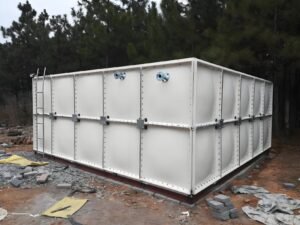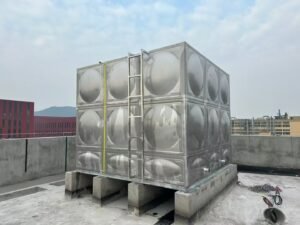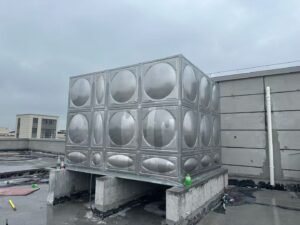


In the GRP vs stainless steel water tank decision, GRP/SMC wins for cold potable and general water at a lower cost than stainless, and stainless steel wins where the water is warm, a hygiene audit applies or the owner wants a metal shell. The other three materials we build fill the gaps: hot-dip galvanized for large non-potable reserves, glass-fused enamel for aggressive water, and BDF composite for tanks that go underground. Water chemistry, temperature and location decide which one you need.
Key takeaways
- GRP/SMC is the default for cold drinking and general water up to 5 m high; it is inert in water and needs no coating.
- Stainless steel earns its cost for warm water, food and hygiene audits; choose 316L over 304 once chlorides or chlorine residuals climb.
- Galvanized steel is the economical steel shell for fire and irrigation reserves in hard, neutral water.
- Enamel suits soft, aggressive or chloride-rich water; BDF composite is the one to bury.
- All five LVJIA ranges hold a GB/T 17219-2025 drinking-water report; none holds WRAS approval or NSF/ANSI 61 certification.
GRP vs stainless steel water tank: which is better for drinking water?
Both are good for drinking water when the right grade and details are chosen, and both of our ranges passed all 20 items of GB/T 17219-2025. GRP/SMC is the lower-cost answer for cold water; stainless steel is the answer when the water is warm, the building is a hospital or food plant, or the owner simply wants metal.
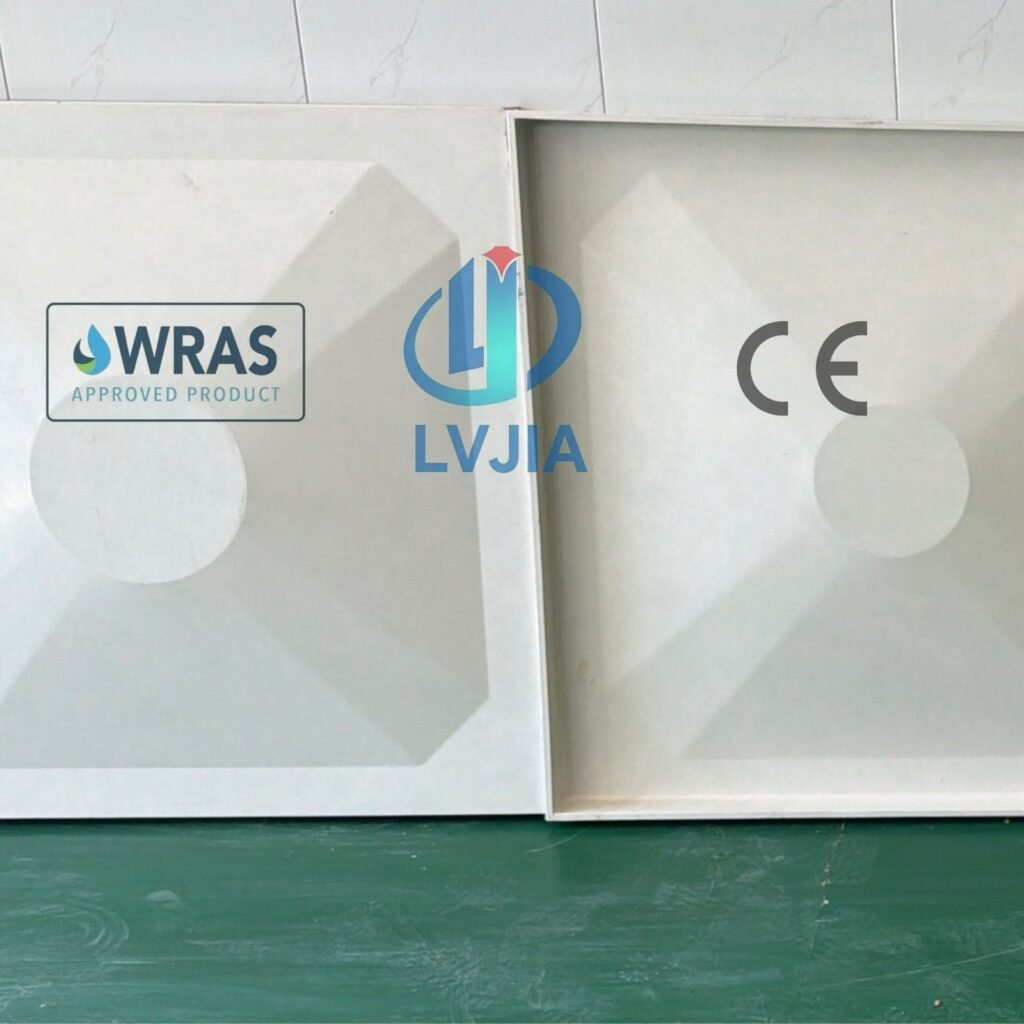
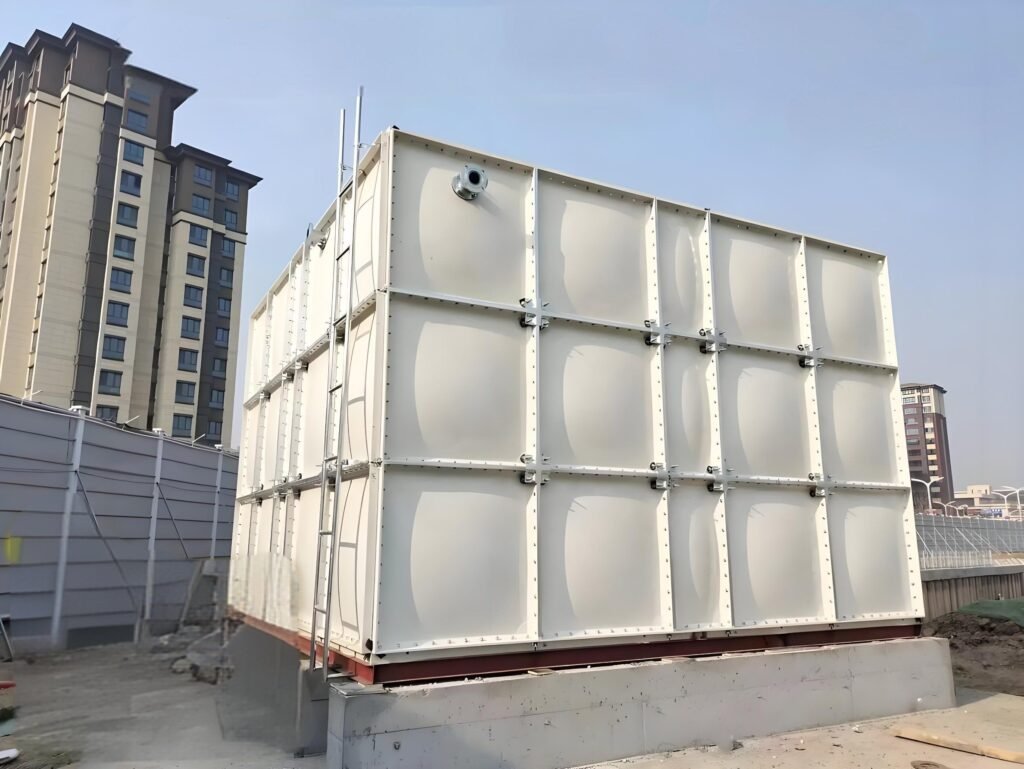
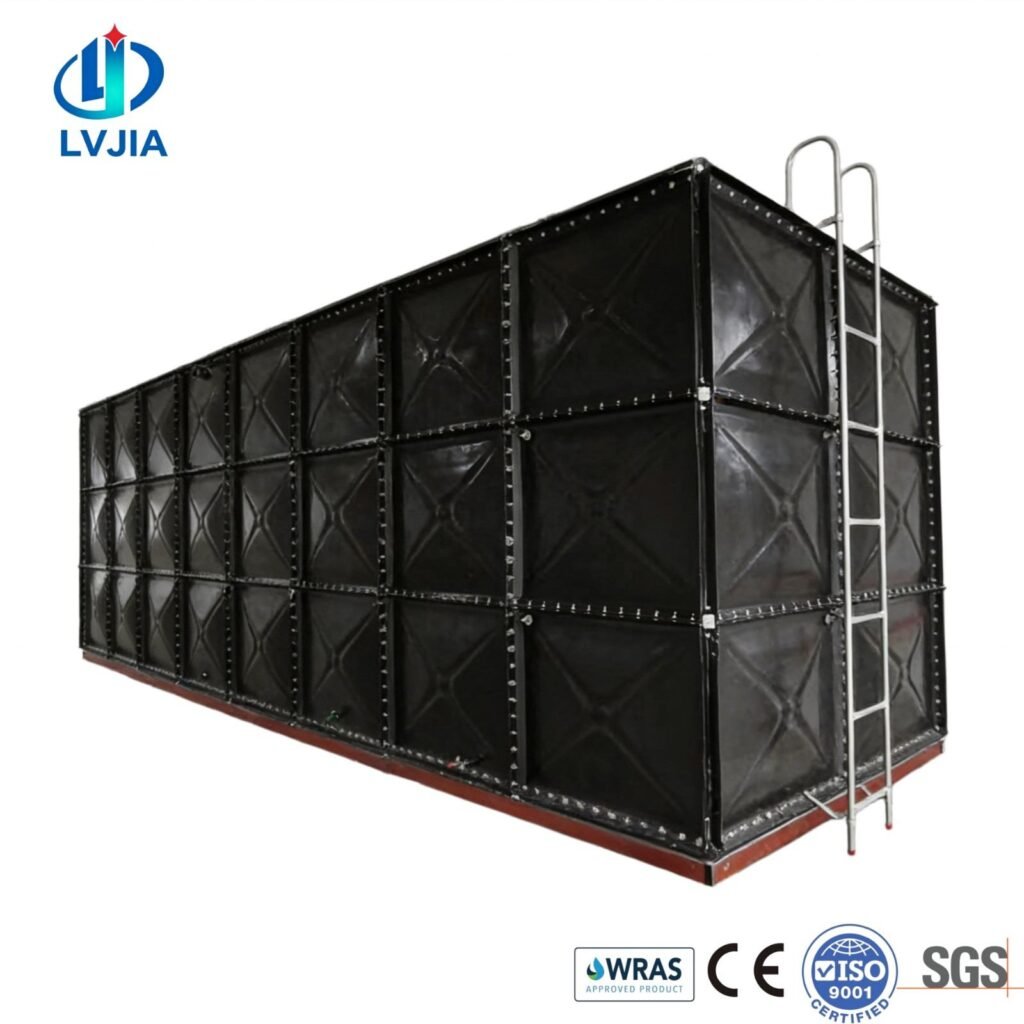
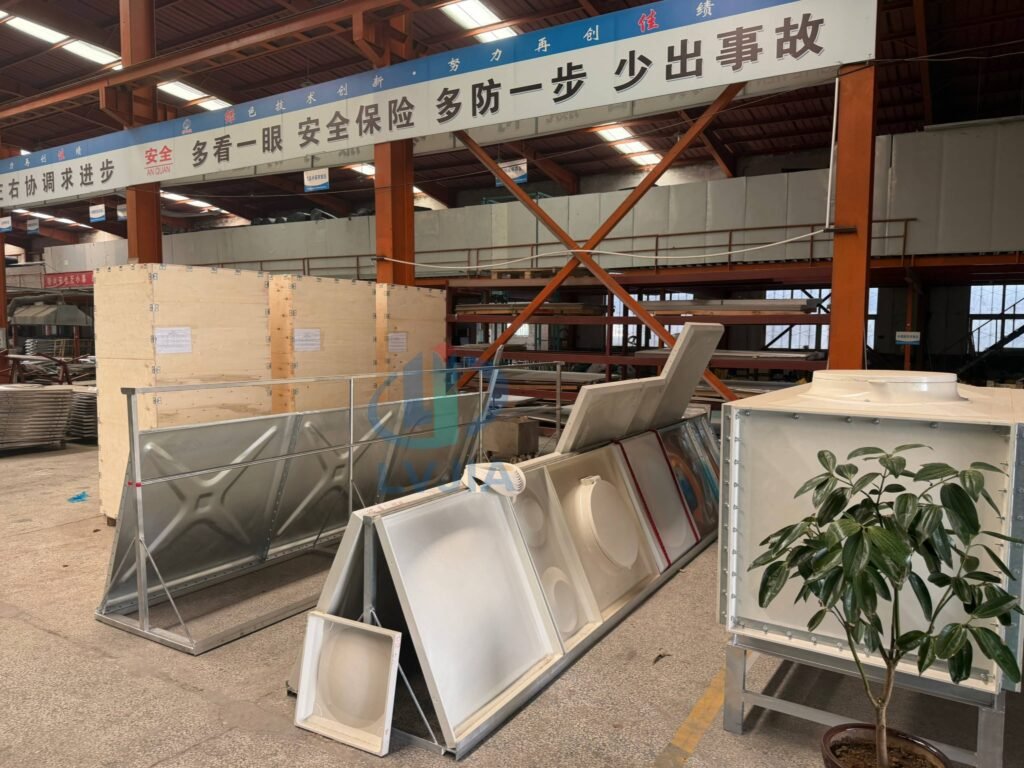
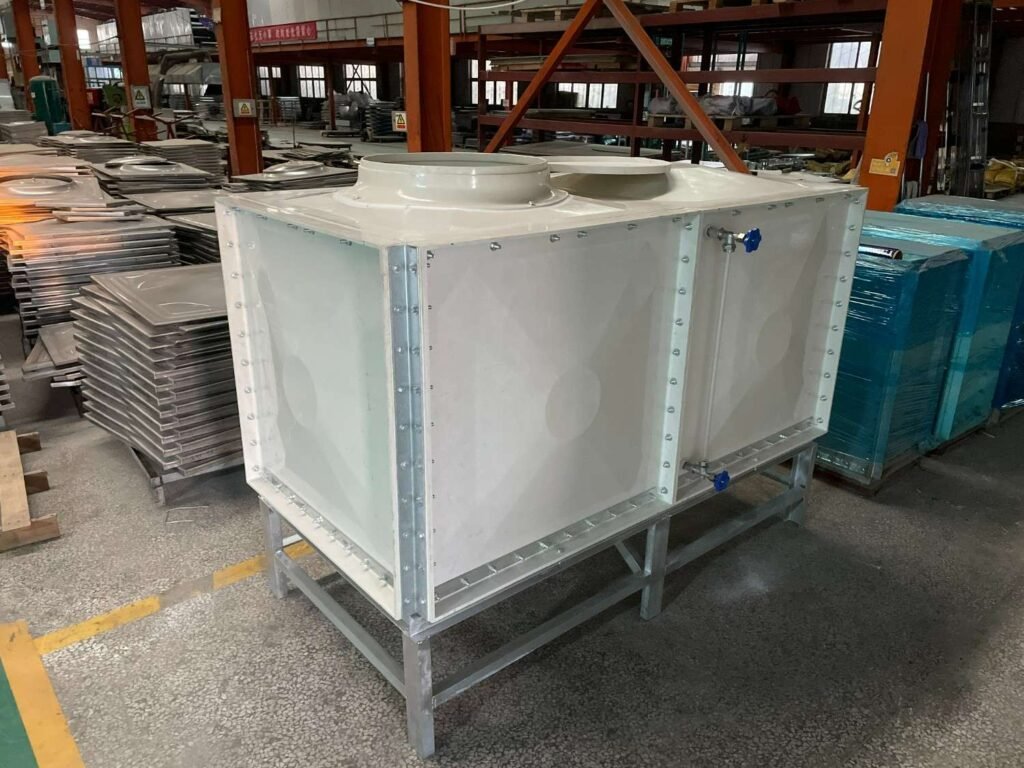
Our SMC panels are hot compression-molded, 6–22 mm thick, stepped by water head, and bolted with stainless fasteners, gaskets and internal stainless tie rods. The range carries a CE Verification of Conformity to EN 13280:2001, the European specification for GRP one-piece cisterns and rectangular sectional tanks for storing water above ground, for domestic and industrial use. The standard’s title limits it to cold water, which is the first boundary of GRP.
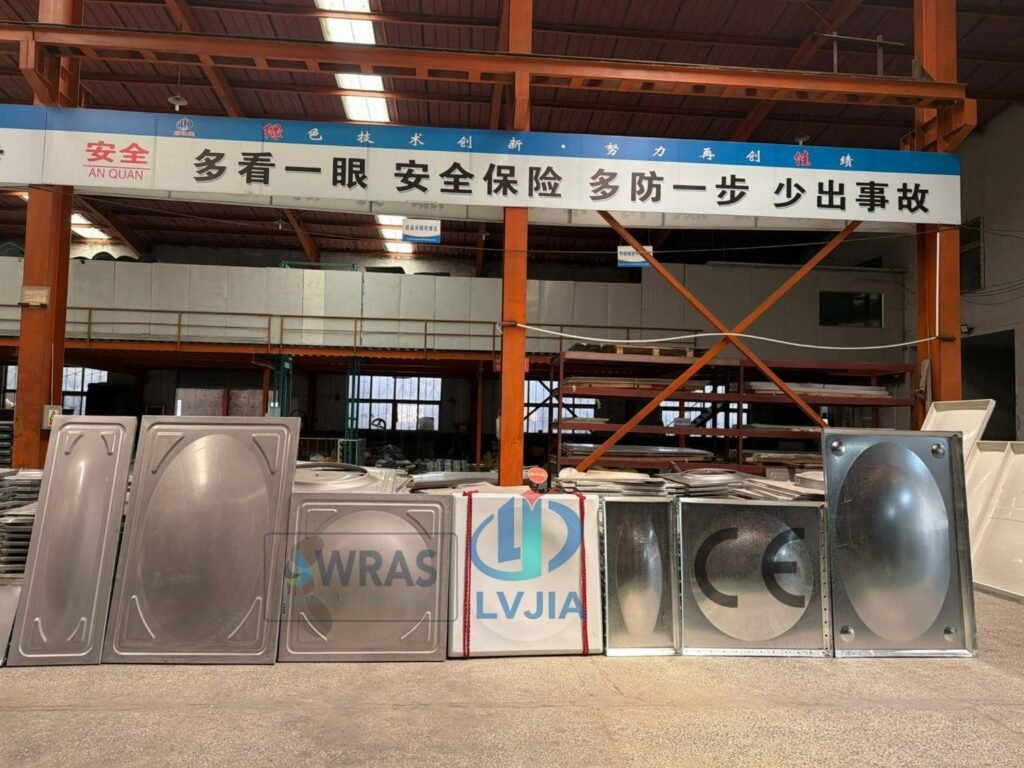
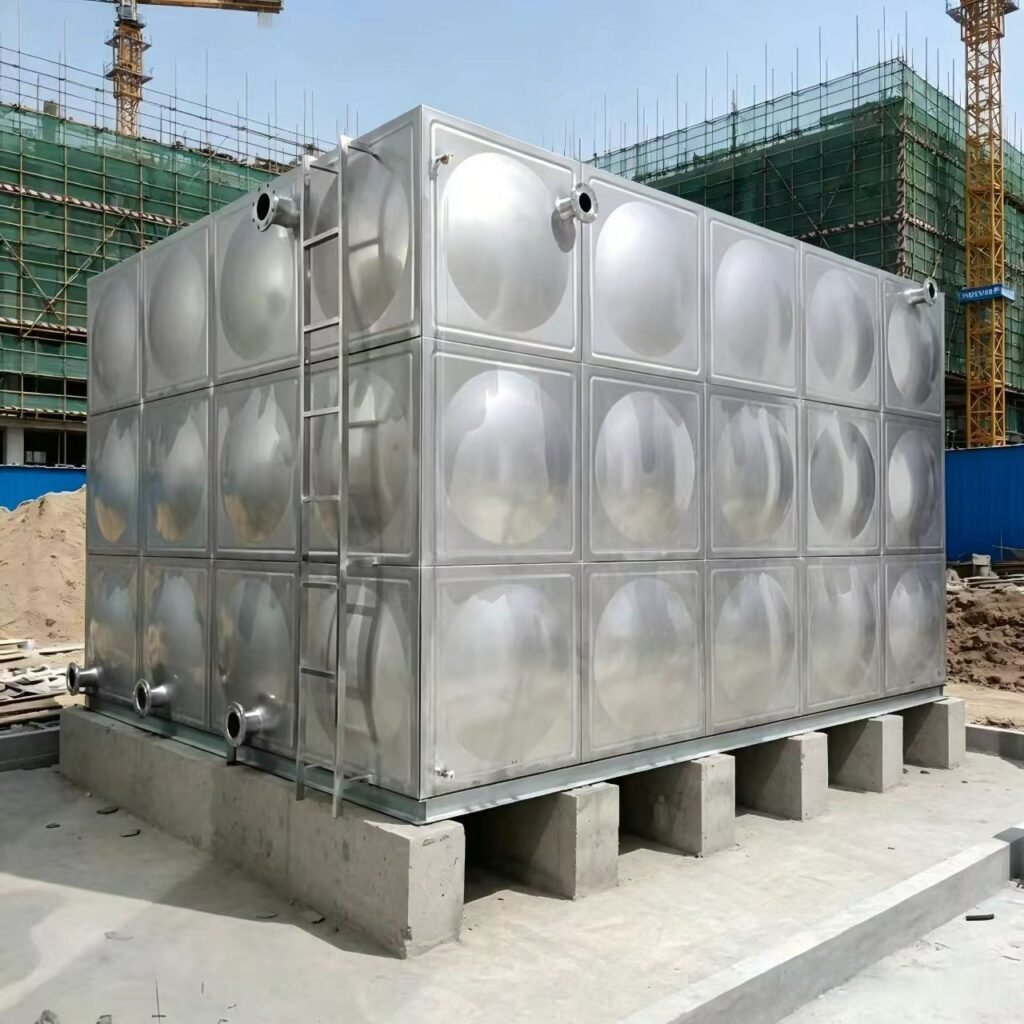
Our stainless tanks come in SUS 304, 316 and 316L, in 1.5–4 mm (standard; up to 8 mm by design) plate, either bolted from pressed panels with stiffeners or argon-arc welded, from 150 L to 200 m³ and above. Stainless has no coating to fail and tolerates heat, but it is not immune to chlorides, so chloride is the first number to check.
How do the five tank materials compare?
On most jobs two or three materials would work, and the table narrows the list quickly. Read across the rows that matter on your site; nobody needs every row.
| Point | GRP/SMC | Stainless 304/316L | Hot-dip galvanized | Glass-fused enamel | BDF composite |
|---|---|---|---|---|---|
| Shell | SMC panels 6–22 mm | SUS 304/316/316L, 1.5–4 mm (standard; up to 8 mm by design) | Q235 steel, 2–5 mm, zinc coated | Enameled steel, 2–4.5 mm | Bimetallic stainless and galvanized plate, 2–5 mm |
| Build | Bolted | Bolted or welded | Bolted | Bolted | Bolted, sealed with rubber strip |
| Our capacity range | 0.125–5,000 m³ | 150 L to 200 m³ and above | 1–3,000 m³ | Sized to order | 1–1,000+ m³ |
| Height | Maximum 5 m | Set on the drawing | Set on the drawing | Set on the drawing | 1–5 m |
| Water chemistry | Inert | Watch chlorides and chlorine | Needs hard, near-neutral water | Resists acidic and neutral water; not fluorides or hot, strong alkalis | No welded parts in contact with the water |
| Temperature | Cold water | Cold to hot | Keep below 60°C | Set by the glass; ask for the rating | 0–100°C |
| Light and algae | Specify opaque panels and a sealed roof | Opaque | Opaque | Opaque | Buried |
| Fire exposure | Resin is combustible above the water line | Non-combustible | Non-combustible | Non-combustible | Buried |
| Repair | Replace the panel | Replace the panel, or weld | Zinc touch-up or panel | Repair coating or panel | Replace the panel on site |
| Main cost driver | Panel count | Grade and plate thickness | Steel weight | Enameling | Excavation and plate |
Every range is sold in 13 models, 65 in all, and each tank is laid out to your footprint rather than picked from a shelf. The catalog pages for the SMC water tank, stainless steel water tank, galvanized water tank, enameled water tank and underground water tank ranges list them all.
What does your water chemistry do to each tank material?
Chloride and chlorine decide the stainless grade, hardness and pH decide whether zinc survives, and fluoride or strong alkali would rule out enamel. GRP/SMC is the least sensitive of the five, which is a large part of why it is the default.
Stainless steel: chlorides and chlorine
The Australian Stainless Steel Development Association gives rough limits for continuous exposure at about 20°C and neutral pH: 304 copes with about 200 ppm chloride and 2 ppm chlorine, 316 with about 1,000 ppm chloride and 5 ppm chlorine, and chlorine in droplets just above a still water surface can run higher than in the bulk water. That last point is why the roof space of a chlorinated stainless tank deserves attention.
Watch out
A 304 tank that is shock-chlorinated often, or dosed with a high chlorine residual, can stain or pit in the air space even when the water itself is well inside the chloride limit. If the water is chlorinated or the chloride figure is anywhere near 200 ppm, specify 316L and ask for good ventilation of the roof space.
Galvanized steel: hardness, pH and heat
Zinc lives or dies by the water. The American Galvanizers Association reports that zinc corrodes least between pH 5.5 and 12, that soft water below 17 ppm hardness is much more corrosive than hard water, that chloride above 50 ppm is aggressive, and that between 60 and 82°C zinc can stop protecting the steel. Hard, neutral mains water suits a galvanized tank well; soft rainwater does not.
Enamel, GRP and BDF
Enamel is glass fused to steel, and a peer-reviewed review of porcelain enamels notes that they resist most acids and neutral solutions but are attacked by fluorides and by strongly alkaline boiling solutions above pH 12, which leaves ordinary waters well inside their range. GRP/SMC resin does not corrode in water. Our BDF tanks use a bimetallic plate of stainless and galvanized steel, with no welded parts in contact with the water.
Which tank handles warm water, sunlight and algae?
For warm or hot water, stainless steel or BDF composite; for cold water in sunlight, any opaque tank with a sealed lid. Algae needs light, so the practical rule is to keep light out, whatever the material.
BDF composite is rated 0–100°C. Stainless handles warm water and hot rinse duties; the chloride limits above apply at about 20°C, so warmer water needs more margin. Galvanizing should stay on cold water, and enamel’s limit is set by the glass, so ask for it in writing. GRP to EN 13280 is a cold water product, so we do not recommend it for heated storage.
Light is a hygiene issue, not only a materials one. The UK’s water fittings regulations require storage cisterns to have a cover positioned to exclude light and insects, an overflow that excludes insects and warns of an impending overflow, and thermal insulation against freezing or undue warming. Specify opaque panels, a sealed roof, screened vents and overflow, and insulation where the site needs it, and they go on the drawing.
How heavy is a full tank, and what can the roof carry?
A full tank weighs about 1,000 kg for every cubic meter of water, whatever it is made of, so the shell material changes the load far less than the footprint does. Halving the water depth by doubling the footprint halves the pressure on the roof.
Worked example
Floor pressure of a 20 m³ rooftop tank in two layouts
- Mass of water
20 m³ × 1,000 kg/m³ = 20,000 kg20 t ≈ 44,100 lb - Layout A: 5 × 2 m, 2 m water depth
p = 2.0 m × 9.81 kN/m³ = 19.6 kPa≈ 410 psf - Layout B: 5 × 4 m, 1 m water depth
p = 1.0 m × 9.81 kN/m³ = 9.8 kPa≈ 205 psf - Load per inner plinth line, layout B, plinths at 1 m centers
9.8 kPa × 1 m = 9.8 kN/mwater only, along each 4 m line
Result: the same 20 t of water loads the roof at 19.6 kPa or 9.8 kPa depending on the layout. Give your structural engineer the pressure and the plinth positions, not just the tank volume.
Shell weight still matters when panels are lifted onto a roof, so ask for the dry weight and panel sizes of your layout before planning the lift. For roof duties, the rooftop GRP water tank is the usual starting point.
Height is the other limit. Our GRP tanks go to a maximum of 5 m and our BDF tanks from 1 to 5 m. Beyond 5 m of water a GRP store has to grow sideways, so if the footprint is fixed, ask our engineers to check a steel layout for the height you need.
Fire, wind and earthquakes: what do we actually know?
Steel shells do not burn; GRP resin does, so exposed fire reserves and tanks in fire-rated plant rooms are better in steel. For wind and earthquakes we do not publish ratings: the structural engineer checks anchorage, sloshing and the supporting structure for the actual site.
The water inside a tank protects the wetted wall in a fire; the roof and the dry wall above the water line have no such protection, and on GRP that is resin. For a fire reserve standing in the open, we would choose galvanized or enamel steel, or bury a BDF tank. Fire tank approval is a separate matter: LVJIA does not hold FM Approval, a UL listing or any fire approval, and acceptance sits with the local authority and the insurer.
For earthquakes, EN 1998-4, the part of Eurocode 8 that deals with tanks, is the European seismic design reference, and ISO 28765, the standard for enamel bolted tanks, lists it among its normative references. Whatever the material, an empty tank in high wind and a full tank in an earthquake load the base differently, so both cases belong in the foundation design.
Cleaning, repair and service life: what wears out first?
On a bolted tank, check the gaskets and fasteners first, and on steel tanks the coating next. Every bolted material can have a damaged panel replaced, and only a welded stainless tank needs a welder for repairs.
For drinking water, the UK Health and Safety Executive’s HSG274 Part 2 advises an annual inspection of the cold water storage tank, inside and out, with cleaning, disinfection and repair of any faults. Smooth surfaces make that visit shorter: SMC, stainless and glass wipe clean, while galvanizing should be cleaned gently so the protective scale is not scrubbed off.
Service life is driven by different things per material: water chemistry for zinc, continuity of the glass for enamel, chloride and chlorine for stainless, and weather on the outer face for GRP. For BDF, a damaged panel is replaceable on site, so the tank is never scrapped for one dent. The plate is tested at 405 MPa tensile, 296 MPa yield and 24% elongation.
What drives the cost of each material?
Material grade is the largest lever: 316L stainless against SMC on the same volume is a different order of cost. After grade come height, special features and how well the flat-packed tank fills a container.
- Grade. 316L costs more than 304, and both more than SMC or galvanized steel for the same volume.
- Height. Every meter of height means thicker base panels and more internal ties.
- Coating. Enamel costs more than zinc to apply; it buys life in aggressive water.
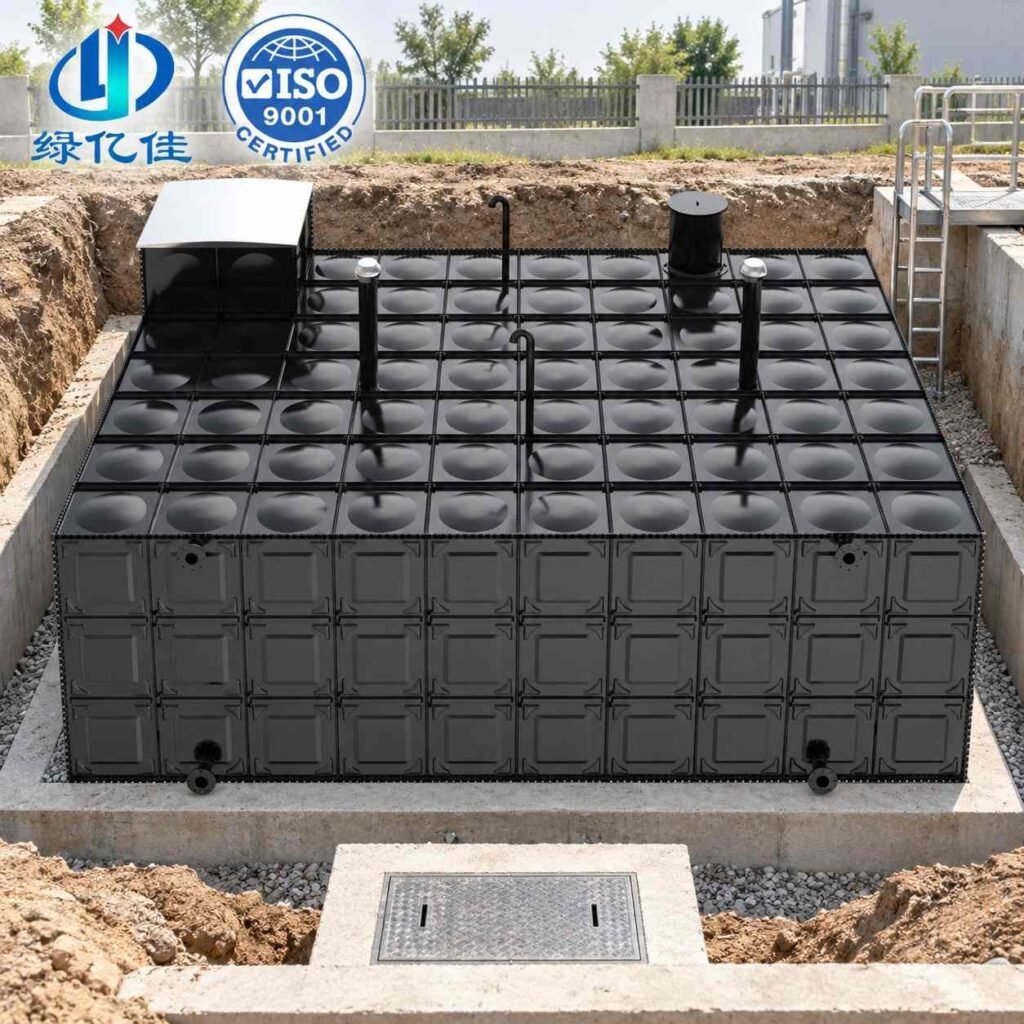
- Ground works. A BDF tank saves yard space but adds excavation, backfill and a buoyancy check.
- Freight. Every tank ships as a kit in its own crate, so a layout drawn to fill a container lands cheaper.
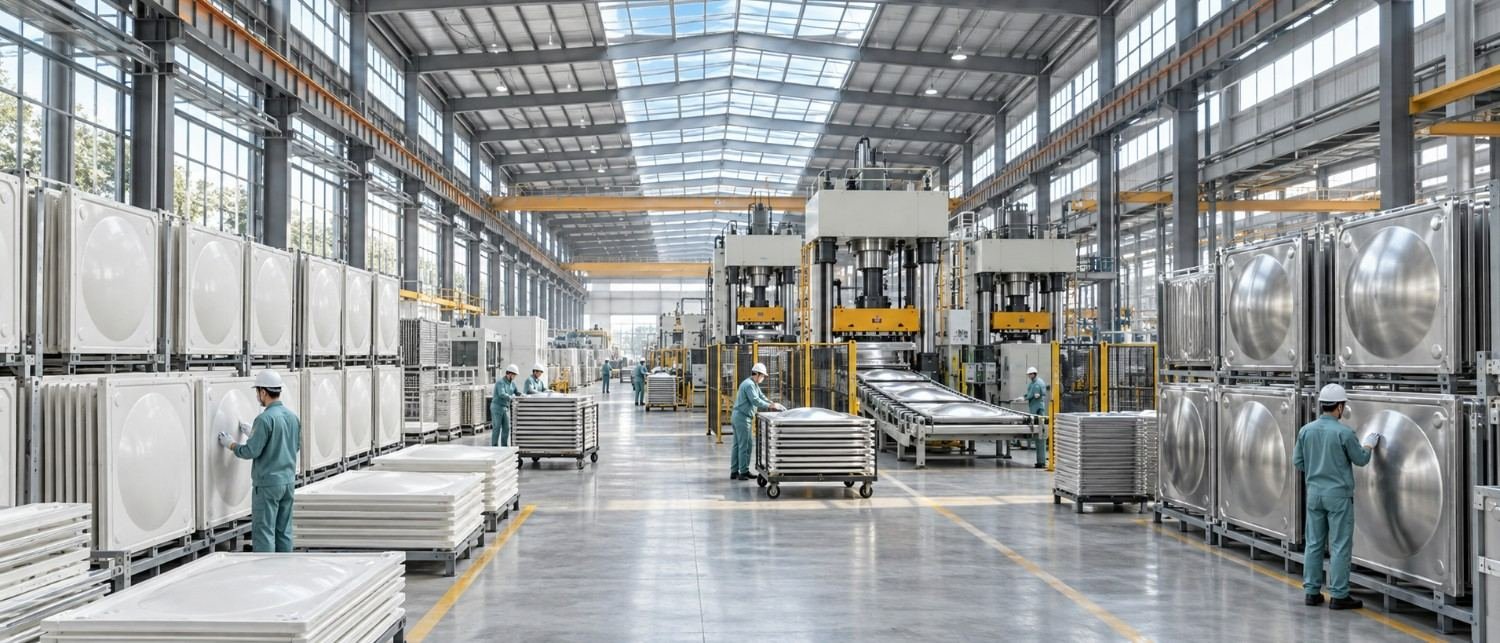
When the GRP vs stainless steel water tank choice is close, ask for both materials priced on the same layout, so the difference is a number rather than a guess. The GRP panel manufacturing and stainless steel tank manufacturing pages show where those costs arise on the line.
Which certificates can each material carry?
Each of our five ranges has its own GB/T 17219-2025 drinking-water contact report, and the GRP/SMC range also carries a CE Verification of Conformity to EN 13280. Market approvals such as WRAS in the UK or NSF/ANSI 61 in North America are separate schemes that we do not hold.
| Material | LVJIA document | What some markets also ask for |
|---|---|---|
| GRP/SMC | GB/T 17219-2025 report SP2630502; CE to EN 13280:2001 (ICR/VC/HS2506113) | WRAS approval, NSF/ANSI 61 |
| Stainless steel | GB/T 17219-2025 report SP2630498 | WRAS approval, NSF/ANSI 61 |
| BDF composite | GB/T 17219-2025 report SP2630499 | Local drinking-water approval |
| Enameled steel | GB/T 17219-2025 report SP2630500 | WRAS approval, NSF/ANSI 61 |
| Hot-dip galvanized | GB/T 17219-2025 report SP2630501 | Local drinking-water approval |
Each report was issued on 18 May 2026 by the Dezhou Institute of Product Quality Standards and Metrology, and each passed 20 of 20 items. NSF/ANSI 61 sets health-effects requirements for contaminants that products pass into drinking water, and a WRAS product approval shows compliance with the UK water fittings regulations and Scottish byelaws. If your project needs either, plan that route with the buyer’s certifier from the start. The full register is on our certifications page.
GRP vs stainless steel water tank: the decision table
Start from the duty, not the material. If two rows fit your job, the cheaper material in either row is usually the right one.
| If your duty is… | Choose | Why |
|---|---|---|
| Cold drinking water in a building or on a roof | GRP/SMC | Inert, lower cost than stainless; see the GRP potable water tank |
| Hospital, food plant or hygiene audit | Stainless 304, or 316L if chlorinated | Metal shell, cleanable, tolerant of warm water; see the stainless steel drinking water tank |
| Chloride-rich or coastal water in stainless | 316L | Higher chloride and chlorine tolerance; see the stainless steel 316 water tank |
| Warm or hot water to 100°C | Stainless or BDF | GRP to EN 13280 is for cold water; zinc suffers above 60°C |
| Large fire or irrigation reserve, hard water | Hot-dip galvanized | Economical steel shell for large volumes, bolted, repairable |
| Soft, acidic or aggressive water, effluent | Glass-fused enamel | Inert glass barrier; no reliance on a scale layer |
| No space above ground, or frost | BDF underground | Buried, 1–1,000+ m³, 0–100°C |
| Water deeper than 5 m | Not GRP | GRP stops at 5 m; ask our engineers to check a steel layout |
Tip
Send a water analysis with the inquiry: pH, hardness, chlorides, chlorine residual and temperature. With those five numbers our engineers can rule materials out in writing, which is faster than debating them.
Frequently asked questions
Is GRP or stainless steel better for a rooftop tank?
Usually GRP/SMC for cold water: it is inert, needs no coating and costs less. Choose stainless if the roof tank will hold warm water, or if a hygiene audit calls for a metal shell. Either way, a bolted tank arrives flat in one crate and is assembled on the roof, so the lift plan is for crates and loose panels, not a finished tank.
Does a GRP tank make water taste of plastic?
Our GRP/SMC range met every one of the 20 test items in GB/T 17219-2025, odor and taste among them, on report SP2630502. New tanks should be flushed and disinfected before first use, which also removes any residue from assembly. In older tanks, stagnant water and poorly fitted lids are the first things to check.
When is 304 stainless not enough?
When the chloride figure is high, when the tank is shock-chlorinated often, or when the water runs warm; in any of those cases, move to 316L. Crevices under deposits and water that sits still for weeks make matters worse, so design the pipework to keep the tank turning over.
Can one site mix tank materials?
Yes. A typical split is a GRP tank on the roof for drinking water and a galvanized or BDF tank at ground level for fire reserve. All five ranges are made on one site in Dezhou, so the drawings, fittings and shipment stay with one supplier.
Which material lasts longest?
There is no single answer. Stainless in low-chloride water, enamel with unbroken glass and GRP kept out of harsh sun can all serve for decades; galvanized life is set by hardness and pH. Ask for a life estimate against your water analysis rather than a general claim.
Do any LVJIA tanks hold WRAS or NSF/ANSI 61?
No. We hold GB/T 17219-2025 reports for all five ranges and CE to EN 13280 for GRP/SMC. If your market requires WRAS or NSF/ANSI 61, that has to be obtained through the relevant scheme; the product name “Enamel Household Water Tank, WRAS Type” is a name, not an approval.
Talk to an engineer
Not sure which material fits your water?
Send the water analysis, the volume and the footprint. Our engineers send a first written reply within 2 hours and put the material recommendation in writing.