

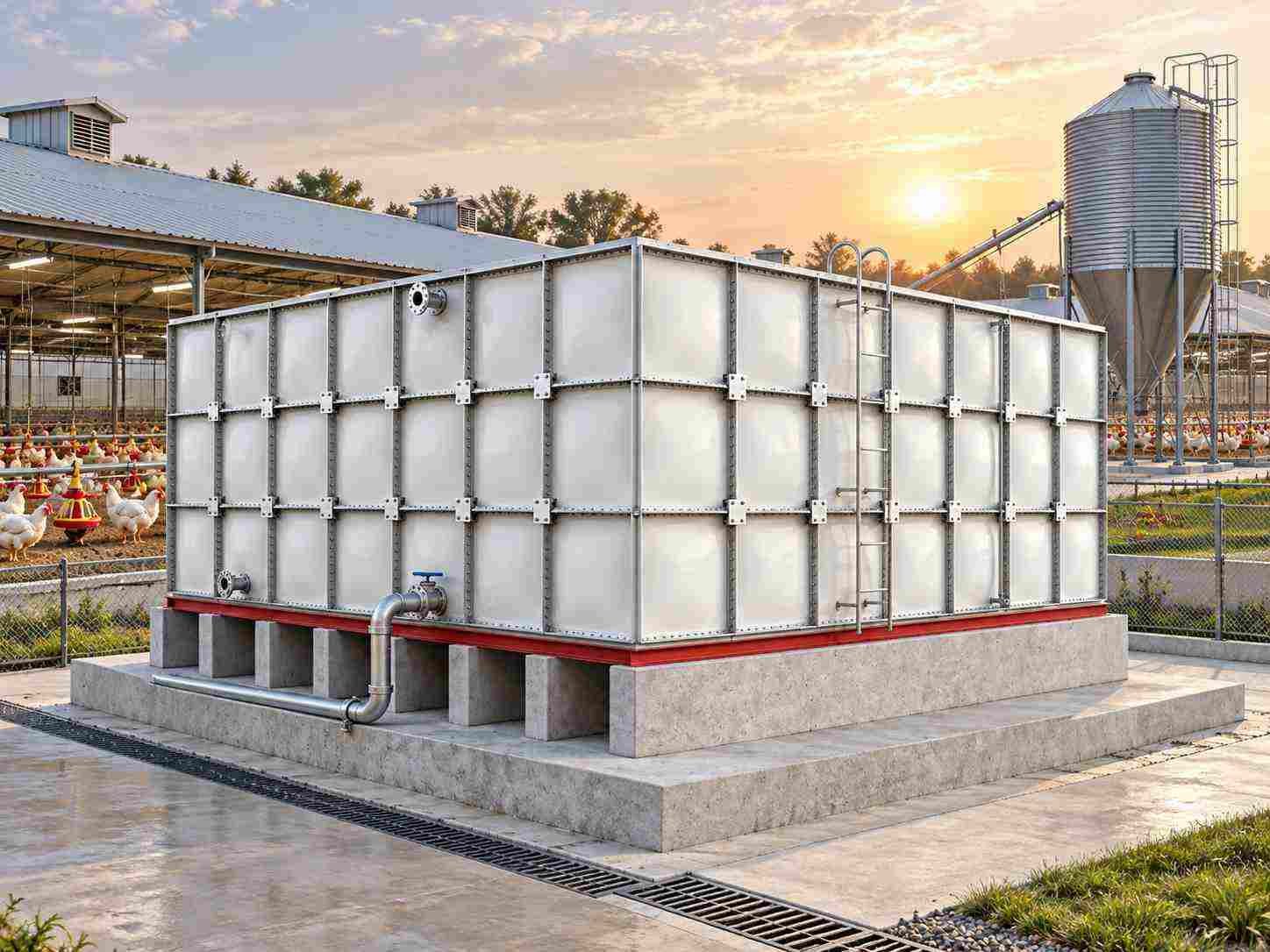
A livestock water storage tank for a 500-cow dairy has to cover the herd’s summer drinking, the parlor washdown and at least two days without the borehole. Using Ontario ministry and university extension data, that demand comes to about 95 m³ (25,100 US gal) a day. Our design meets it with a two-compartment GRP/SMC bolted sectional tank, 14 × 6 × 3 m nominal, holding 218 m³ of effective storage on raised concrete plinths: a water reserve of 2.3 days at peak summer demand.
Engineering case study. This is a design worked through end to end with LVJIA‘s standard GRP/SMC bolted sectional system for a typical dairy drinking-water and washdown duty. The figures are design figures for that duty, not measured results from a named customer. Send us your own numbers and we will run the same exercise on your site.
Project file
- Duty
- Livestock drinking water for the herd, plus parlor wash water
- Sector
- Dairy, free-stall housing with a milking parlor
- Design herd
- 500 lactating cows, 90 dry cows, 350 heifers, 100 calves
- Tank type
- GRP/SMC bolted sectional, two compartments
- Capacity
- 252 m³ nominal, 218 m³ effective
- Nominal size
- 14 × 6 × 3 m (L × W × H)
- Panels
- 2 × 1 m module; thickness stepped by course within 6–22 mm
- Standards referenced
- EN 13280:2001 (CE); GB/T 17219-2025 contact test
- Documents
- GA drawing, test sheet, material certificates, manual
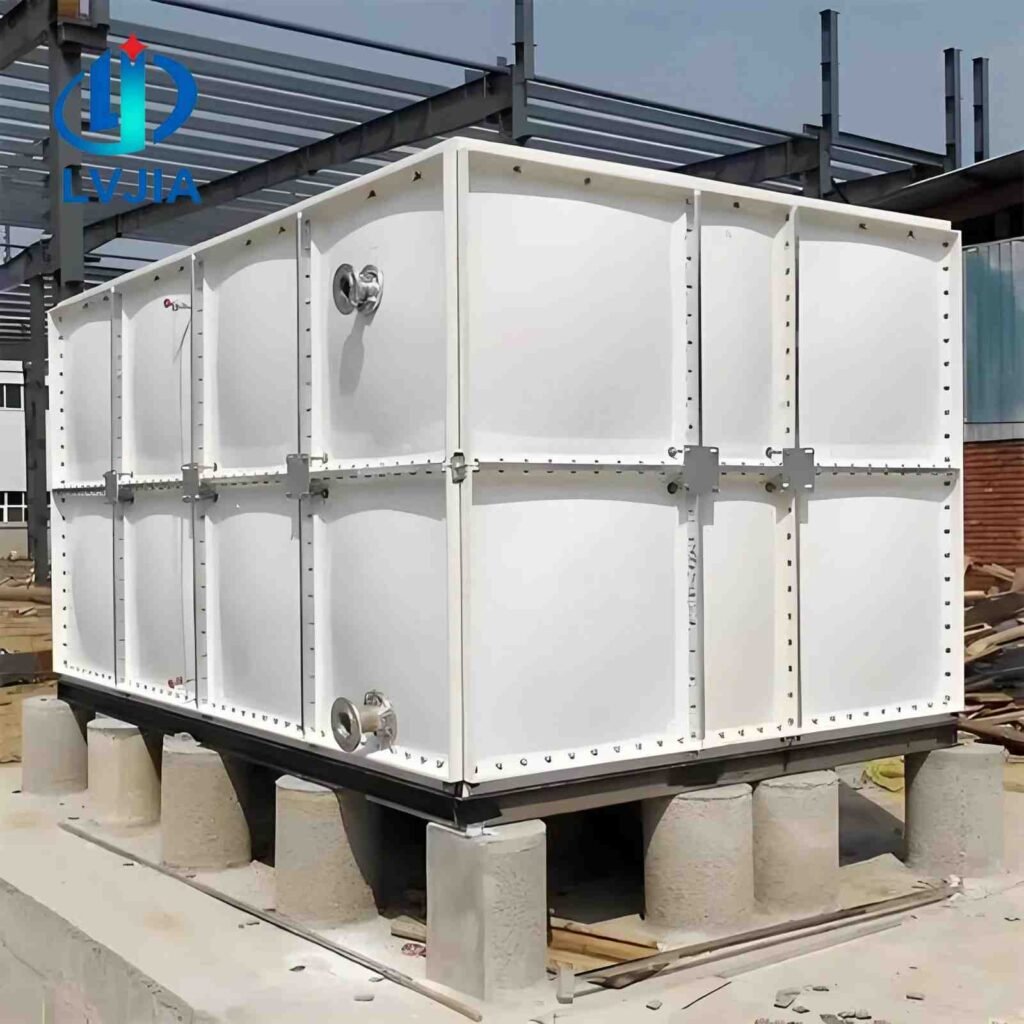
What does a livestock water storage tank on a dairy have to do?
It has to keep every trough full through the busiest hour after milking and keep the parlor washing when the borehole pump or the power fails. The compartments, screens and plinths in this design all follow from those two jobs.
The typical brief: a free-stall barn with a parlor, two milkings a day and a single borehole. One water reserve feeds the troughs in the cow barn, dry-cow shed and heifer unit, and supplies the parlor wash. Three needs are rarely written down: the livestock drinking water must stay palatable in summer, the livestock water storage tank must be cleanable without cutting off the herd, and it must survive yard traffic and barn air.
Which site constraints shape a dairy farm water tank?
A dairy farm water tank is shaped by the single borehole, the drinking surge after milking, the barn air and the winter. Water chemistry matters too, judged against livestock limits rather than human ones.
One source, no second well
A guide by Kansas State University specialists to water system design for modern dairies is direct: with a single well, it recommends a storage tank holding at least a two- to three-day supply. That sets our floor at two days of peak demand.
Cows drink in surges
Nebraska Extension notes that cows often seek water after milking and can drink 10–30 lb (4.5–13.6 kg) a minute. The tank absorbs that surge, so the borehole pump is sized for the day, not the minute.
Barn air attacks metal coatings
U.S. Steel’s own bulletin on steel panels in animal confinement buildings explains that condensation absorbs corrosive gases and bacteria-laden dust from the barn air, and the resulting solution severely attacks the metal coating. A tank beside the barn lives in that air.
Livestock drinking water limits
The Ontario ministry’s water quality guidelines for dairy cattle set the values below. A tank cannot fix a salty or nitrate-rich borehole, but it must not make good livestock drinking water worse through light, warmth or dirt getting in.
| Parameter | Band | Ontario interpretation |
|---|---|---|
| Total dissolved solids | <1,000 ppm | Low salinity; no health problems |
| Total dissolved solids | 5,000–6,999 ppm | Avoid for pregnant and lactating cattle |
| Nitrate (nitrate-N) | 0–44 ppm (0–10 ppm) | Safe for dairy cattle |
| Nitrate (nitrate-N) | 133–220 ppm (20–40 ppm) | Potentially harmful over the long term |
| Coliform bacteria | >1 per 100 mL | Can cause scours in calves |
Which options did we compare?
We compared four ways to build a dairy farm water tank of more than 200 m³. GRP/SMC panels won on light, corrosion and cleaning; a buried BDF tank is the real alternative where yard space or frost rules out an above-ground one.
| Option | For | Against | Verdict |
|---|---|---|---|
| GRP/SMC bolted sectional on plinths | Opaque; no corrosion; ships flat; built to the footprint | Needs level plinths and frost protection | Chosen |
| Hot-dip galvanized bolted sectional | Stiff panels; suits big irrigation and fire reserves | Zinc coating exposed to barn condensation | Better for irrigation away from housing |
| Stainless steel, bolted or welded | Hygienic and strong | Usually costs more than SMC; its hygiene margin is not needed for stock water | Not justified here |
| BDF underground | Dark, protected from frost when buried deep enough, out of yard traffic | Excavation, buoyancy check, slower access for cleaning | Alternative where space or frost demands it |
If a buried water reserve suits the yard better, our BDF underground irrigation tank can sit below the frost line, at the cost of a pit and a buoyancy check. For a heifer-rearing satellite, the 75,000-liter GRP farm tank holds more than a week’s drinking for 250 heifers. Under a low eave, a low-profile horizontal GRP tank spreads the volume wider, and on an awkward footprint a modular GRP water tank built to size follows the space in 0.5 m and 1 m steps.
How is a livestock water storage tank sized for 500 cows?
Add drinking water by animal class at the top of the summer range, add milking-center wash water, then multiply by the days of supply the site needs without its source. The peak hour and the plate cooler size the pipework and pump, not the tank.
Drinking figures come from the Ontario ministry’s water requirements of livestock, with a range for each class and milk yield. We design to the top of each range because the livestock water storage tank must cover the hottest week. Wash water comes from the milking-center washwater factsheet: 17 L per cow per day for a free-stall parlor.
Worked example
Daily demand and storage for a 500-cow dairy
- Lactating cows at 36.3 kg milk/day
500 × 136 L = 68,000 L/daytop of Ontario’s 114–136 L - Dry cows, top of 34–49 L
90 × 49 L = 4,410 L/day≈15% of 590 milking-age cows - Heifers, 5–24 months
350 × 36.3 L = 12,705 L/daytop of 14.4–36.3 L - Calves, 1–4 months
100 × 13.2 L = 1,320 L/daytop of 4.9–13.2 L - Drinking subtotal
68,000 + 4,410 + 12,705 + 1,320 = 86,435 L≈ 86.4 m³/day - Parlor wash water
500 × 17 L = 8,500 L/dayfree-stall parlor - Design daily demand
86.4 + 8.5 = 94.9 m³/day≈ 25,100 US gal/day - Two-day reserve required
2 × 94.9 = 189.8 m³ effectivesingle-borehole rule - Effective depth
3.00 − 0.25 freeboard − 0.15 dead water = 2.60 moverflow and outlet levels - Effective volume
14 × 6 × 2.60 = 218.4 m³252 m³ nominal - Days of reserve
218.4 ÷ 94.9 = 2.30 days≈ 57,700 US gal stored
Result: a 14 × 6 × 3 m livestock water storage tank, split into two 7 × 6 m compartments, gives 218 m³ of usable water, 2.3 days at peak summer demand.
With the overflow 250 mm below the roof and outlets 150 mm above the floor, sizing to the nominal 252 m³ would overstate the water reserve by 15%. As a sense check, 95 m³ is 190 L (50 US gal) per milking cow, at the top of the 40–50 gal Kansas State gives as a working dairy’s minimum. Nebraska’s half gallon per pound of milk gives 150 L a cow and 2.1 days: still above the floor.
Worked example
Plate cooler, peak hour and refill
- Milk per day
500 cows × 36.3 kg = 18,150 kgdesign yield - Plate cooler water
18,150 kg × 1 to 2 = 18.2–36.3 m³/dayK-State: 1–2 lb water per lb milk - Peak-hour drinking (our assumption: 15% of the day)
0.15 × 86.4 = 13.0 m³hour after a milking - Parlor wash in the same hour
8.5 ÷ 2 milkings = 4.25 m³one wash cycle - Peak-hour draw
13.0 + 4.25 = 17.25 m³/h≈ 4.8 L/s - Taken from storage
17.25 − 10 m³/h borehole = 7.25 m³3% of the reserve - Net refill rate, herd still drinking
10 − 94.9 ÷ 24 = 6.05 m³/hborehole minus average draw - Refill after a two-day outage
189.8 ÷ 6.05 = 31 h28.6 m³ still in the tank - Refill from empty (worst case)
218.4 ÷ 6.05 = 36 hfull effective volume
Result: the peak hour barely dents the water reserve. It sizes the outlet main; the outage sizes the tank; the borehole yield (10 m³/h assumed) sets the recovery.
The AHDB’s guidance on plate heat exchangers for milk pre-cooling expects up to twice the milk volume in water and recommends re-using it in drinking systems or washdown. We return it to the tank through its own nozzle; at 18–36 m³ a day against 86 m³ of drinking, the herd uses all of it within the day.
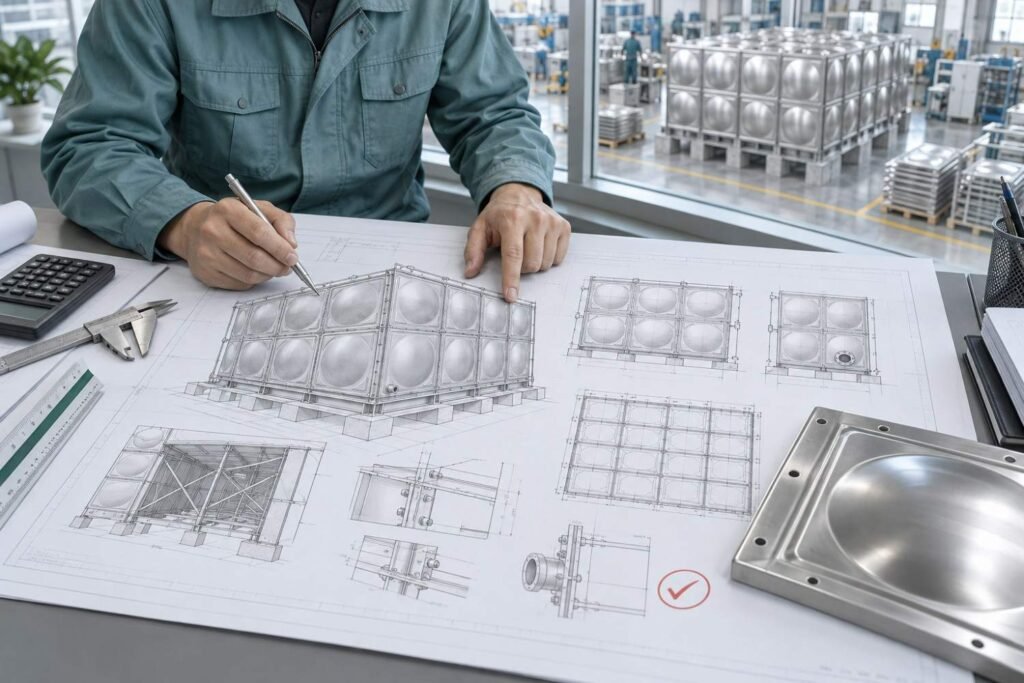
What goes into the livestock water storage tank specification?
An opaque, non-corroding shell on raised plinths, split into two compartments, with every opening screened and every pipe protected from frost. That is the whole dairy farm water tank specification in one sentence; the table gives the detail.
| Item | Specification | Why |
|---|---|---|
| Shell | Hot compression-molded SMC panels, 2 × 1 m module; thickness stepped by course within 6–22 mm | Opaque; no corrosion |
| Layout | Two 7 × 6 m compartments, 3 m high, internal partition | One side cleaned while the other supplies |
| Fasteners and bracing | Stainless steel bolts, gaskets and sealant; internal stainless tie rods | Walls held against water pressure |
| Base | Concrete strip plinths, centers on the GA drawing, level to 3 mm over any 3 m | Underside bolts reachable; drain can fall |
| Inlets | Borehole main with level-controlled valve per compartment; separate plate-cooler return | Refill and reuse |
| Outlets | 150 mm above floor in each compartment, isolating valves, cross-connection | Leaves sediment behind |
| Overflow and vent | 24-mesh non-corrodible screens; overflow over a splash plate with an air gap | Keeps birds, rodents and insects out |
| Access | Roof manhole per compartment, external and internal ladders | Safe cleaning |
| Frost | Roof and walls insulated where winters stay below freezing; lagged, trace-heated pipes | No ice in valves |
Why opaque panels protect livestock drinking water
Alabama Extension’s advice on livestock water tank maintenance names the recipe for algae: warm summer temperatures, abundant sunlight and nutrients. An opaque SMC panel removes the sunlight, and a closed, screened roof keeps out dust and droppings. Our SMC water tank range also carries a drinking-water contact test report to GB/T 17219-2025 (SP2630502), with all 20 items passed.
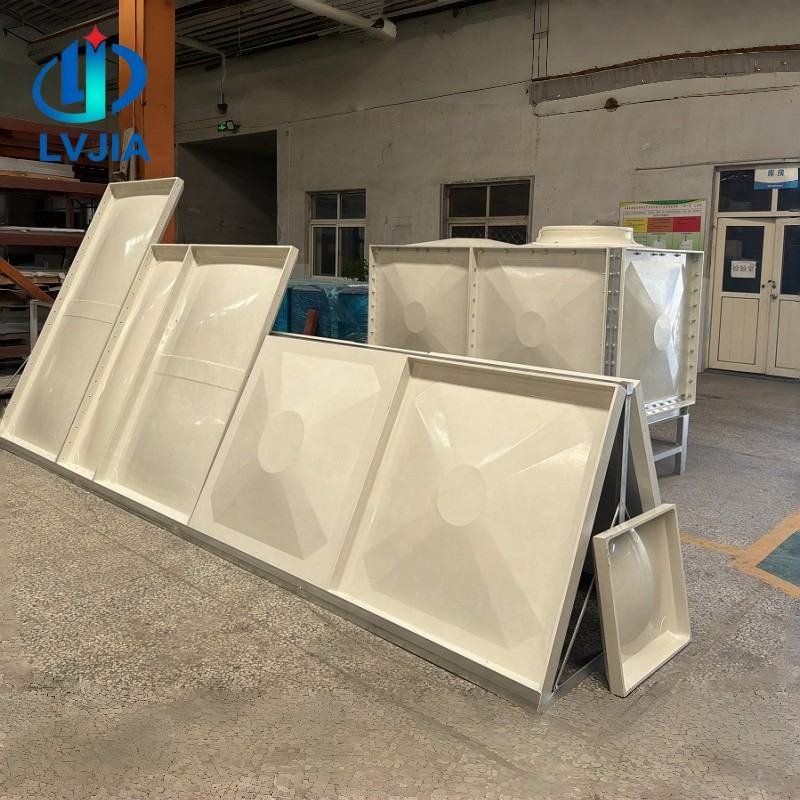
Raised plinths, not a ground slab
On raised strip plinths a fitter can reach the underside bolts, see a weep early and open the drain with a fall to a gully. A tank on the ground sits in whatever the yard scraper leaves. The plinths must be flat to our rule of 3 mm over any 3 m, or the base course will not seal evenly.
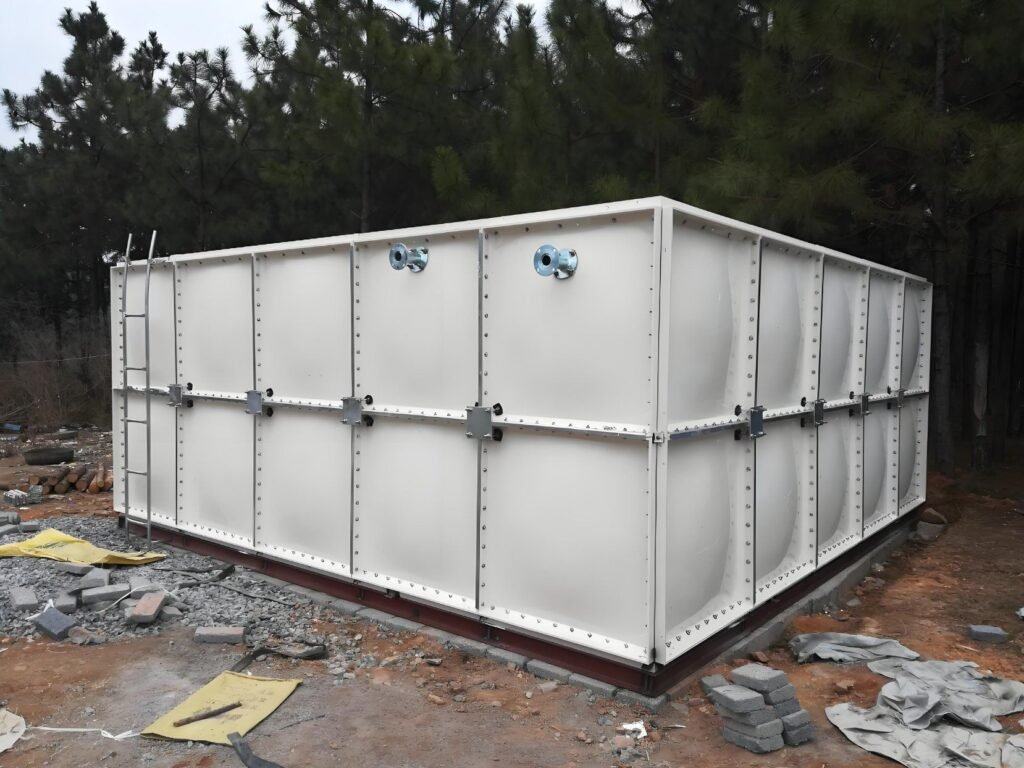
Frost, vents and overflows
A 218 m³ body of water freezes slowly; the surface, valves and pipes are the weak points. Insulation stops the surface skinning over, and heat-traced pipework keeps the valves open. Turnover helps: at 95 m³ a day the water reserve is replaced about every 2.3 days.
Openings follow the US EPA Region 8 tech tip on tank vents, drains and overflows: 24-mesh non-corrodible screens on vents; a 24-mesh screen or a sealed flapper or duckbill valve on the overflow and drain; an overflow that ends 12–24 in (300–600 mm) above ground over a splash plate or rocked area; and no direct connection to a sewer or storm drain without a properly designed air gap.
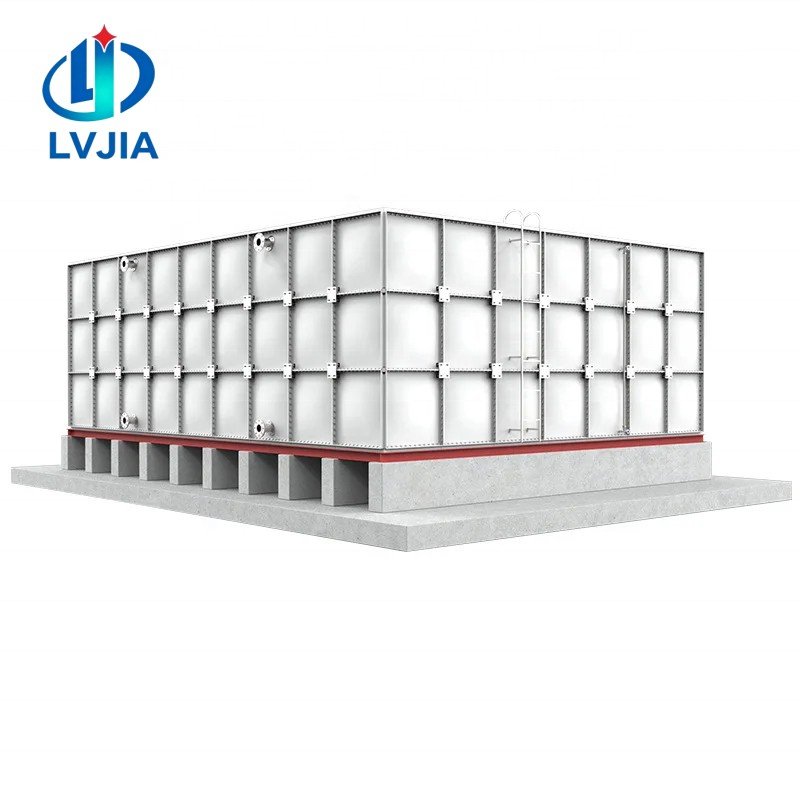
How is the tank made?
Every panel is hot compression-molded from SMC sheet in our Wucheng works, punched, and checked against the approved drawing. Nothing is pressed until the buyer has approved that drawing.
The GA drawing fixes the panel schedule, thickness by course, nozzles, manholes, ladders and plinth centers. Panels are pressed, punched and checked dimensionally against that drawing rather than the last batch, with flatness checked to ±1.5 mm. The full route for this livestock water storage tank is on our GRP water tank manufacturing page.

Which inspections and documents come with the tank?
The tank is trial-assembled and water-tested for 48 hours at the works, with the level logged at start and finish, then stripped, dried and packed as one crate per tank. The test sheet, material certificates, approved drawing and assembly manual (EN/中文) travel with it.
Witness points for your inspector are written into the inspection and test plan before production. The GRP/SMC range holds a CE Verification of Conformity to EN 13280:2001 (ICR/VC/HS2506113, valid to 23 June 2030), and the works is certified to ISO 9001:2015; numbers and dates are on our water tank certifications page. Our guide to the hydrostatic water test for sectional tanks explains what the 48-hour record proves.
LVJIA does not hold WRAS approval or NSF/ANSI 61 certification. If the same tank will also supply a farmhouse or a regulated potable supply, ask the local authority which approval it expects before ordering.
How is the dairy farm water tank installed?
The farm’s crew or contractor builds it from the crate, course by course, with no cutting or hot work. Plinths come first.
Flatness to 3 mm over any 3 m and centers as drawn, before a crate is opened.
One crate is one tank: count panels by course and thickness, then the bolts, gaskets and fittings.
Gaskets on clean flanges, bolts run up snug until the course is square.
Course by course, fitting the stainless tie rods as each course goes up.
Manholes, screened vents, ladders, pipework, drain and level gauge.
Bolts to torque in a pattern, then a slow fill with the level logged.
Chlorinate, flush and test before the troughs are connected.
What does the livestock water storage tank design deliver?
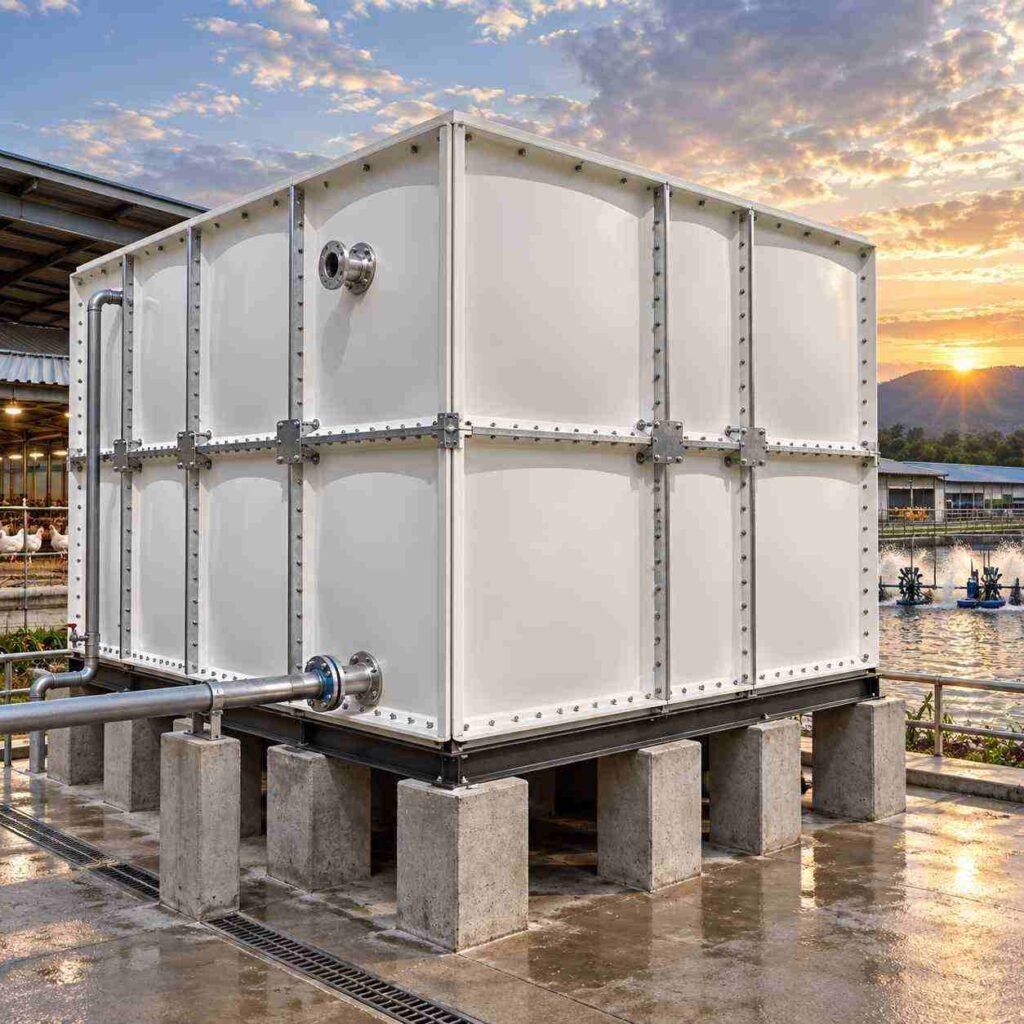
On paper it gives the dairy 2.3 days of peak-summer water with the borehole down, and even an empty tank refills in about 36 hours once the pump restarts. With one compartment out for cleaning, the other half of the water reserve still holds about 109 m³, more than a full day.
These are design outcomes, so check them: re-run the table with your own head counts, milk yield and test-pumped borehole yield. After commissioning, log the level of the livestock water storage tank morning and evening through a hot week; a falling evening level means demand is above design or the borehole is weaker than assumed.
Ontario’s guidelines suggest testing about four times a year. Sample at the borehole and at the furthest trough, so a problem added between source and cow shows up as a difference. More design cases are on our water tank case studies page.
What mistakes do we see on dairy water storage?
Most failures of a livestock water storage tank are sizing errors made on paper or hygiene errors at the openings. Both are avoidable at the design stage.
- Sizing to the annual average. Ontario’s “average typical use” column is a year-round figure of 115 L for every milking cow; at 36.3 kg of milk the range tops out at 136 L.
- Forgetting the youngstock. Dry cows, heifers and calves drink 18.4 m³ a day here, 21% of the herd total.
- Plate cooler water to drain. Ontario’s washwater factsheet adds 45 L per cow when the cooler water is not re-circulated: about 22.5 m³ a day for this herd.
- One compartment only. Cleaning then takes the whole reserve offline, so it gets postponed.
- Rough gravel or rubble bases. Uneven support leaves gaskets under-compressed and joints weep on first fill.
Watch out
Never pipe the overflow or drain into the slurry store or a washwater pit without a visible air gap. A blocked outfall can back up into the livestock drinking water, and a direct connection gives rodents and flies a route inside.
Livestock water storage tank FAQ
How much water does a 500-cow dairy use in a day?
On this design basis, about 95 m³ in summer: roughly 86 m³ drunk by milking cows, dry cows, heifers and calves, plus about 8.5 m³ for the parlor wash. A wash pen can push use towards 100 US gallons per cow per day, according to Kansas State.
How many days should a water reserve cover?
With one borehole, plan for two to three days of peak demand. A second well or standby generator can justify less. Count only the usable volume between outlet and overflow, not the nominal size, and check how fast the source can refill it.
Is an SMC panel safe for cattle drinking water?
Our GRP/SMC panels passed all 20 items of the Chinese contact test GB/T 17219-2025 (report SP2630502, May 2026). The test soaks the material in water, then checks that water for color, turbidity, odor, pH, metals such as lead and arsenic, and organic compounds. Livestock drinking water quality still depends more on the source.
Will a GRP tank freeze solid in winter?
Not while the herd draws from it every day. Exposed pipes, float valves and the top layer are what freeze first. Where sub-zero spells last for weeks, specify roof and wall insulation and heat-traced pipework, and do not leave a compartment standing full and unused through the winter.
Should a dairy farm water tank go underground?
A buried BDF tank stays dark, is frost-protected when deep enough and keeps the yard clear, so it suits tight or very cold sites. The costs are excavation, a flotation check in high groundwater and slower cleaning access. Above ground is easier to inspect, so it is our default.
How often should the tank be cleaned and tested?
We suggest an internal inspection and clean once a year, one compartment at a time, so the herd never loses supply. Check gaskets, tie rods and the vent and overflow screens on the same visit, and file the water results with the cleaning record.
Talk to an engineer
Send your herd numbers and borehole yield
We will run the same demand table for your livestock water storage tank and reply in writing within two hours; drawing reviews come back as a marked-up PDF within one working day.