

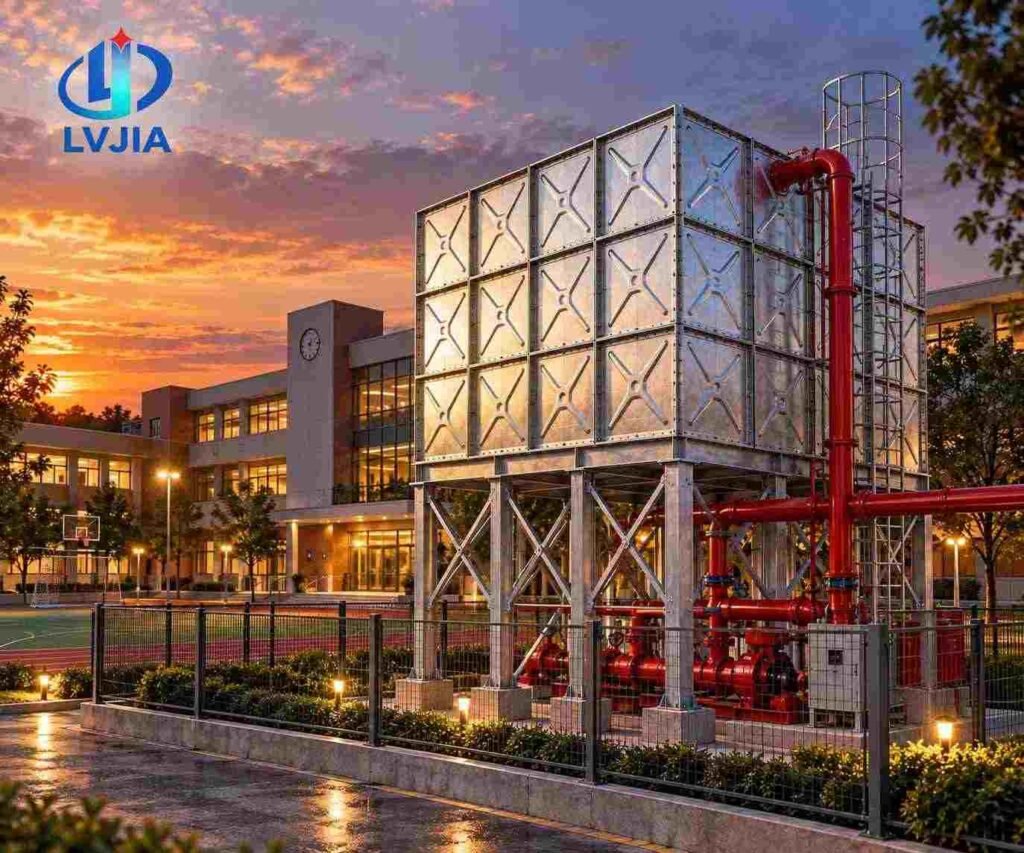
A warehouse fire water tank must hold the full sprinkler demand plus the hose allowance for the whole duration, measured between the lowest permitted water level and the anti-vortex plate, not from floor to roof. For a 24,000 m² ambient logistics warehouse with ESFR sprinklers and 6.4 m racking, that is 349.3 m³ (92,280 US gal) for 60 minutes. Our hot-dip galvanized bolted design, 12 × 9 × 4 m on LVJIA‘s standard 1 m panel grid, holds 365.9 m³ of usable fire volume.
Engineering case study. This is a design worked through end to end with LVJIA’s standard hot-dip galvanized bolted sectional system for a typical ambient logistics warehouse duty. The figures are design figures for that duty, not measured results from a named customer. Send us your own numbers and we will run the same exercise on your site.
Project file
- Duty
- Sprinkler and hose-stream reserve, sole fire water supply
- Sector
- Single-story ambient logistics warehouse, 24,000 m², Class I cartoned goods
- Tank type
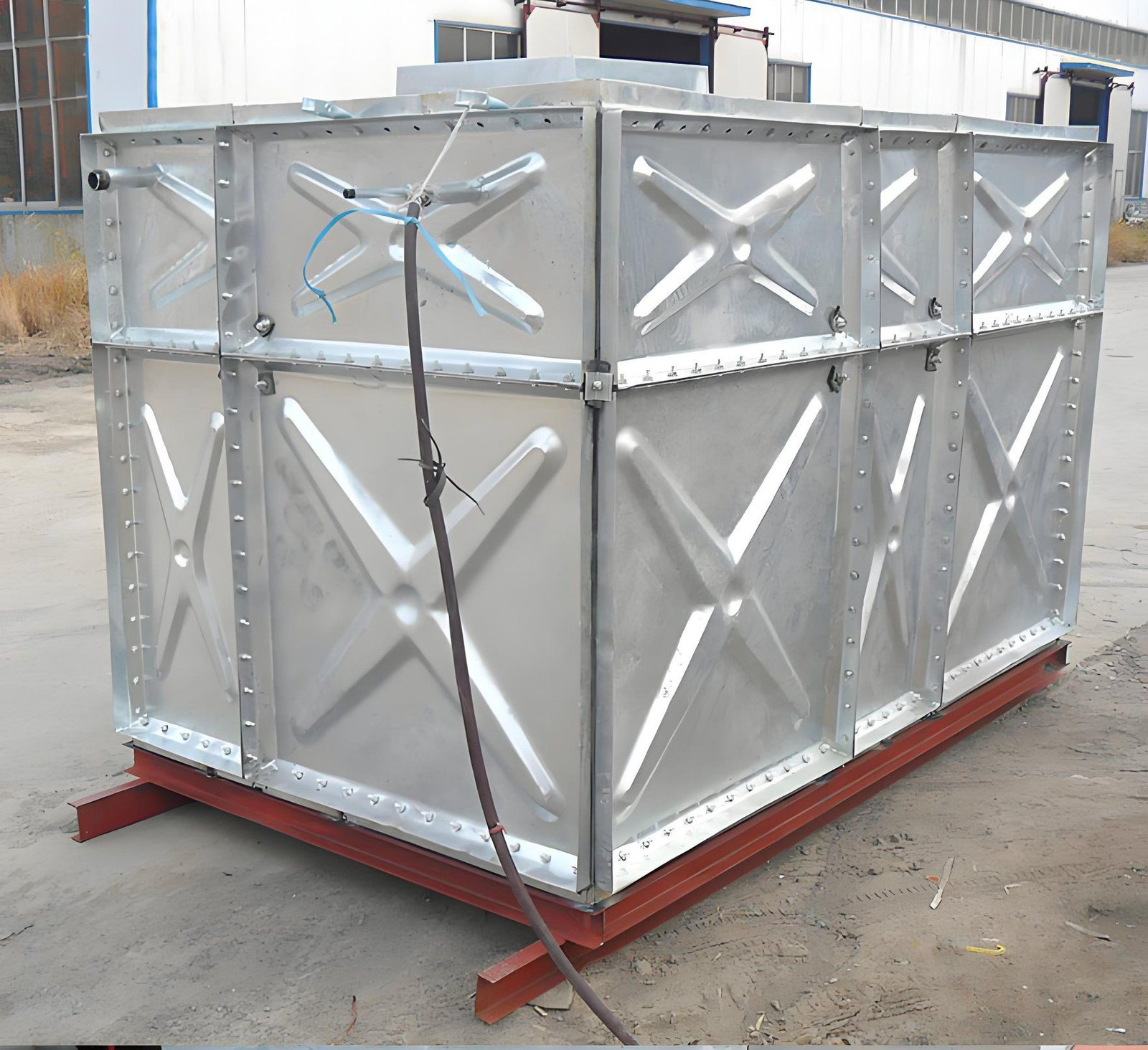
- Hot-dip galvanized bolted sectional, Q235 pressed panels
- Capacity
- 432 m³ nominal · 365.9 m³ usable fire volume
- Internal size
- 12 × 9 × 4 m, 1000 × 1000 mm standard panels
- Panel thickness
- 5 mm floor and base course to 3 mm top course, 2 mm roof
- Standards referenced
- NFPA 13, NFPA 22, NFPA 25, ISO 1461
- Water
- Mains water, non-potable; tank heated against freezing
- Design life target
- 25 years, checked against the water analysis
- Documents supplied
- Approved GA drawing, level schedule, material certificates, 48 h water test sheet, assembly manual
The brief: what does a warehouse fire water tank have to do?
It has to deliver the full sprinkler flow and the hose allowance for the whole design duration, with no help from the town main. It also has to stay full, unfrozen and inspectable for decades.
The duty is a typical modern ambient warehouse: one story, a ceiling of about 8.7 m (28 ft 8 in), selective pallet racking to 6.4 m (21 ft) and cartoned goods that the sprinkler designer classes as Class I. The main cannot feed the sprinklers directly, so a fire pump draws from a tank in the yard. The brief asks for four things: a stated margin, winter operation, levels an insurer’s inspector can read, and the documents the authority having jurisdiction (AHJ) will want.
The constraints: site, water, climate and regulation
Four things shaped the warehouse fire water tank before any panel was drawn: what is stored, how the sprinklers work, how cold the site gets and who signs the system off. What is stored moves the fire volume most.
Commodity classification drives the fire water tank size
NFPA 13 sorts stored goods into Class I to IV commodities and plastics groups, and the amount of plastic decides whether a load is Class III, Class IV or a Group A plastic. Class, storage height and ceiling height pick the sprinkler criteria, and the criteria set the flow. So we never size a fire water tank from floor area: we size from the sprinkler designer’s criteria, and any assumption goes on the drawing in writing.
Sprinklers: density and area, or ESFR?
Control-mode sprinklers are sized by density multiplied by design area. Since the 2022 edition, NFPA 13 gives new control-mode systems a choice of two fixed design points instead of any point on a density/area curve. ESFR sprinklers work differently: the Fire Protection Contractor article linked above notes that NFPA 13 requires at least 12 sprinklers in an ESFR design area, four on each of three lines, each at a minimum pressure.
This warehouse uses ESFR. A published design with the same geometry, Class I cartoned goods in 6.4 m (21 ft) racks under an 8.7 m (28 ft 8 in) ceiling, used K-25.2 ESFR sprinklers at a 1.03 bar (15 psi) minimum from NFPA 13 (2019) Table 23.3.1, with a 946 L/min (250 gpm) hose allowance for 60 minutes. We size on that basis, and re-check the tank when the sprinkler designer’s hydraulic calculation is issued.
Climate, water and approval
The site sees hard frosts, so the tank is insulated and heated. The fill is moderately hard mains water, which suits zinc. The regulatory point matters most: NFPA 22, the standard for private fire protection tanks, has a chapter for factory-coated bolted steel tanks that calls for design, materials, fabrication and installation to AWWA D103, and AWWA D103 covers cylindrical bolted tanks. None of NFPA 22’s tank chapters describes a rectangular pressed-panel steel tank.
Engineer’s note
LVJIA does not hold FM Approval, a UL listing or any fire protection approval. Acceptance of this tank as a sprinkler water supply is a decision for the AHJ and the insurer. We supply the evidence they ask for: the approved drawing, the level schedule and volume inputs, material certificates and the signed water test sheet. If your insurer accepts only an approved tank, tell us when you inquire and we will say plainly that this is not that product.
Options we compared
We compared five ways to build this warehouse fire water tank. Galvanized bolted steel won on cost for non-potable water, on freight and on bolted assembly; the table shows where each alternative would win instead.
| Option | For | Against | Verdict |
|---|---|---|---|
| Hot-dip galvanized bolted sectional | Steel shell, flat-packed panels, bolted on site, 1–3,000 m³ | Zinc life depends on water chemistry | Chosen |
| GRP/SMC sectional | Corrosion-free, CE to EN 13280 | Resin shell above the water line is combustible | Better for potable or indoor storage |
| Enameled (glass-fused-to-steel) | Inert glass surface, long coating life | Higher first cost; chips need careful repair | Pick it for soft or chloride-rich water |
| Stainless steel 304/316L | Excellent in clean water | Highest cost per m³ for non-potable water | Over-specified here |
| BDF underground | Buried, frost-free, frees yard space; 1–1,000+ m³ | Excavation, flotation check, confined-space inspections | Best where the yard is full |
On a tight site, our BDF underground water tank covers this volume and removes the heating load, at the cost of excavation and a buoyancy check.
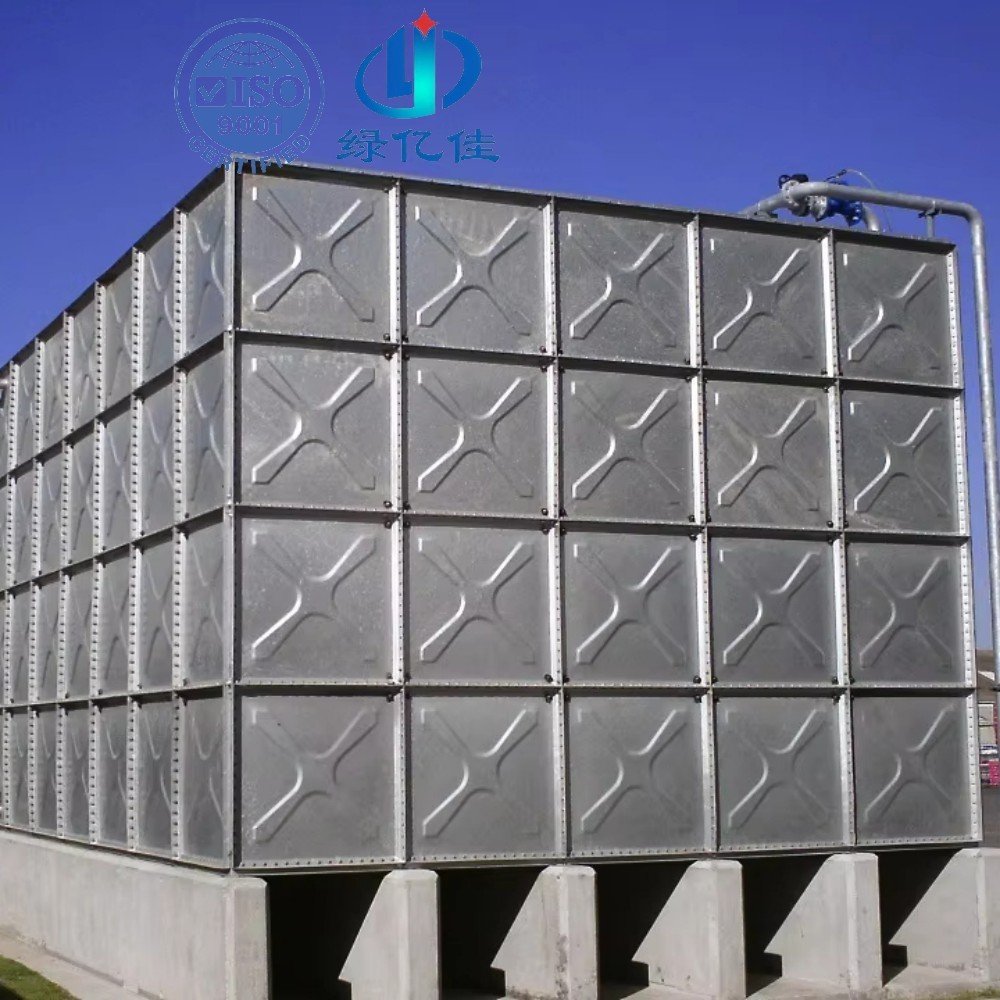
Sizing it: the warehouse fire water tank calculation
The required volume is the combined flow multiplied by the duration: twelve ESFR heads at minimum pressure, an imbalance allowance and the hose stream, for 60 minutes. The answer is 349.3 m³, and every step is shown so your fire engineer can check it.
Flow from one head is its K-factor multiplied by the square root of its pressure. A K-25.2 head passes 25.2 gpm per √psi (362.9 L/min per √bar), so we work in US units and convert.
Worked example
Fire volume for 12 K-25.2 ESFR heads at 15 psi plus hose stream
- Flow per head
q = K√p = 25.2 × √15 = 25.2 × 3.873 = 97.6 gpm≈ 369 L/min at 1.03 bar - Design area of 12 heads
12 × 97.6 = 1,171 gpm≈ 4,433 L/min - Imbalance allowance (ours, 10%)
1,171 × 1.10 = 1,288 gpm≈ 4,876 L/min - Add hose stream
1,288 + 250 = 1,538 gpm≈ 5,822 L/min - Multiply by duration
1,538 gpm × 60 min = 92,280 US gal≈ 349.3 m³ - Refill rate for 8 hours
349.3 m³ ÷ 8 h = 43.7 m³/h≈ 12.1 L/s (192 gpm)
Result: the tank must hold 349.3 m³ (92,280 US gal) above the anti-vortex plate at the lowest permitted level, and the fill must deliver at least 43.7 m³/h.
The 10% is ours, not a code figure. Heads nearer the riser run above minimum pressure, so a hydraulic calculation normally returns more than the simple product. We replace the allowance with the calculated sprinkler demand once it is issued.
Nominal volume versus effective volume
Nominal volume is length × width × height; effective volume is what a fire pump can use, and here it is 85% of nominal. The NFPA 22 committee document linked above quotes the standard’s net capacity for a suction tank: the volume between the overflow inlet and the vortex plate. Water below the plate and air above the overflow do not count. A fire district’s cistern rules put it plainly: usable capacity is the water above the anti-vortex plate.
We go one step further. NFPA 22 requires the water level never to fall more than 102 mm (4 in) below the designated fire service level, and the supply to refill the minimum fire volume within 8 hours. So we count the fire volume from 102 mm below the float shut-off down to the plate.
| Band | Height above floor | Depth | Volume |
|---|---|---|---|
| Dead water below the top of the anti-vortex plate | 0–0.16 m | 0.16 m | 17.3 m³ |
| Usable fire volume | 0.16–3.548 m | 3.388 m | 365.9 m³ |
| Permitted draw-down below fire service level | 3.548–3.65 m | 0.102 m | 11.0 m³ |
| Float band to the overflow inlet | 3.65–3.70 m | 0.05 m | 5.4 m³ |
| Freeboard to the roof | 3.70–4.00 m | 0.30 m | 32.4 m³ |
| Nominal volume | 0–4.00 m | 4.00 m | 432.0 m³ |
The 365.9 m³ beats 349.3 m³ by 16.6 m³, or 4.8%, and that margin is written on the drawing so nobody adds a second one. Net capacity from overflow to plate is 382.3 m³. At 43.7 m³/h a DN100 (4 in) fill line runs at about 1.5 m/s; the real check is a mains flow test at the connection.
The specification
The warehouse fire water tank is 12 × 9 × 4 m, galvanized and bolted, with an anti-vortex plate and insulated, heated walls. Panel thickness follows the pressure at the bottom of each 1 m course with the tank full to the roof: 39.2 kPa (5.7 psi) at the floor, then 29.4, 19.6 and 9.8 kPa up the wall.
| Item | Specification |
|---|---|
| Panels | Q235 steel, pressed 1000 × 1000 mm, hot-dip galvanized after pressing; zinc thickness to ISO 1461 |
| Thickness | Floor 5 · course 1 5 · course 2 4 · course 3 3 · course 4 3 · roof 2 mm |
| Stiffening | Pressed ribs and flanges; galvanized tie rods at the 1, 2 and 3 m seams on 1 m centers; angle stiffeners on courses 1 and 2 |
| Joints | EPDM gasket strip and sealant; galvanized bolts, or stainless where the water allows |
| Suction | DN250 (10 in) outlet; anti-vortex plate 600 × 600 × 6 mm at 152 mm |
| Fill and overflow | DN100 float valve closing at 3.65 m; DN150 screened overflow at 3.70 m, discharging outside the pump room |
| Vents and drain | Two screened DN150 vents; DN100 locked drain at the floor |
| Level | Gauge with fire service level marked; transmitter with low and high supervisory alarms |
| Access | Two Ø600 mm roof manholes, caged external ladder, internal ladder |
| Freeze protection | 50 mm insulated cladding, thermostatic immersion heater, low-temperature alarm, heat trace on exposed pipes |
| Foundation | Concrete plinths at 1 m centers, flat to 3 mm over any 3 m |
Anti-vortex plate, vents and overflow
NFPA 22 shows the anti-vortex plate and its dimensions in an annex figure tied to the net-capacity clause quoted above. Our drawing shows a 600 × 600 × 6 mm plate set 152 mm (6 in) above the floor over the DN250 outlet, for the fire engineer to confirm against the edition the AHJ has adopted. The plate stops the pump drawing air through a whirlpool, which is what lets the design count water down to it.
Vents are sized for the pump, not the fill: at 5,822 L/min, 0.097 m³ of air must enter every second, and two DN150 vents admit it at about 2.7 m/s. The overflow is sized for a float valve stuck wide open.
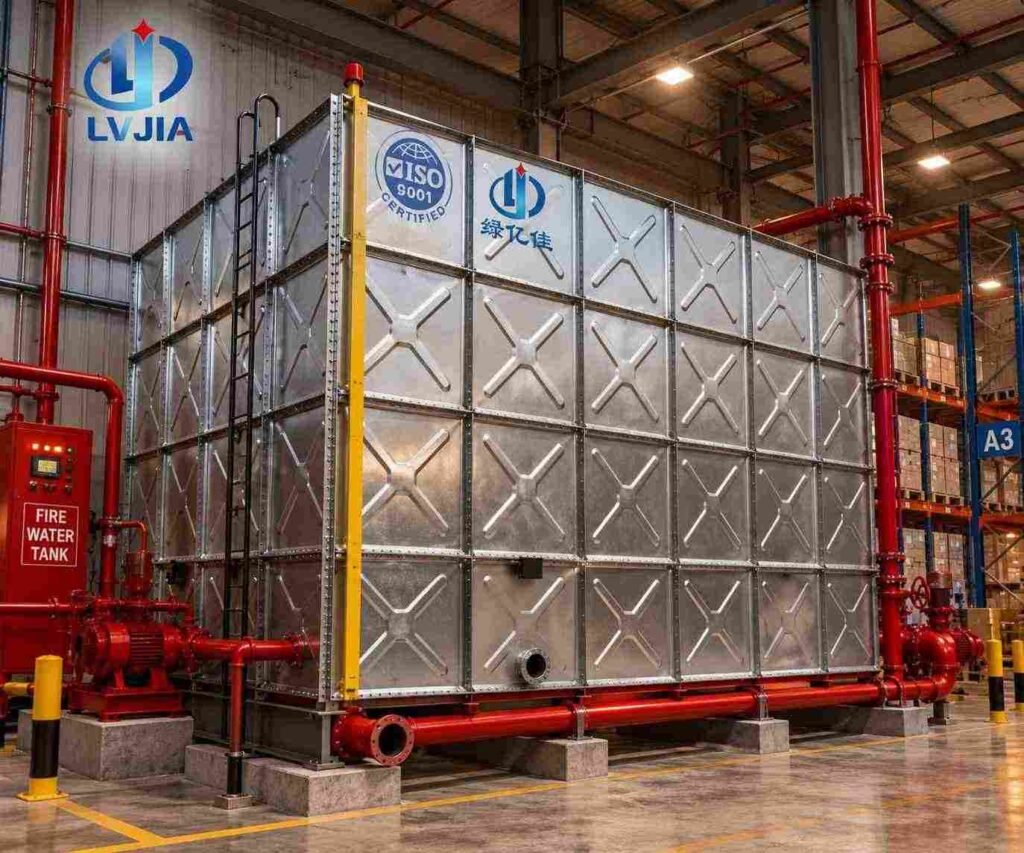
Metals in the water, and heating
Tie rods resist the outward wall load, and everything on the water side is galvanized or stainless. The American Galvanizers Association advises against galvanized steel in contact with other metals, except aluminum and stainless steel where salt water and high-chloride air are absent. That rules out brass float valves and copper fittings.
The annex to NFPA 22, quoted in the same committee document, advises keeping the coldest water above 5.6°C (42°F). The heater thermostat sits above that, with a low-temperature alarm to the fire panel. Bolted flanges conduct heat, so the cladding covers every flange line.
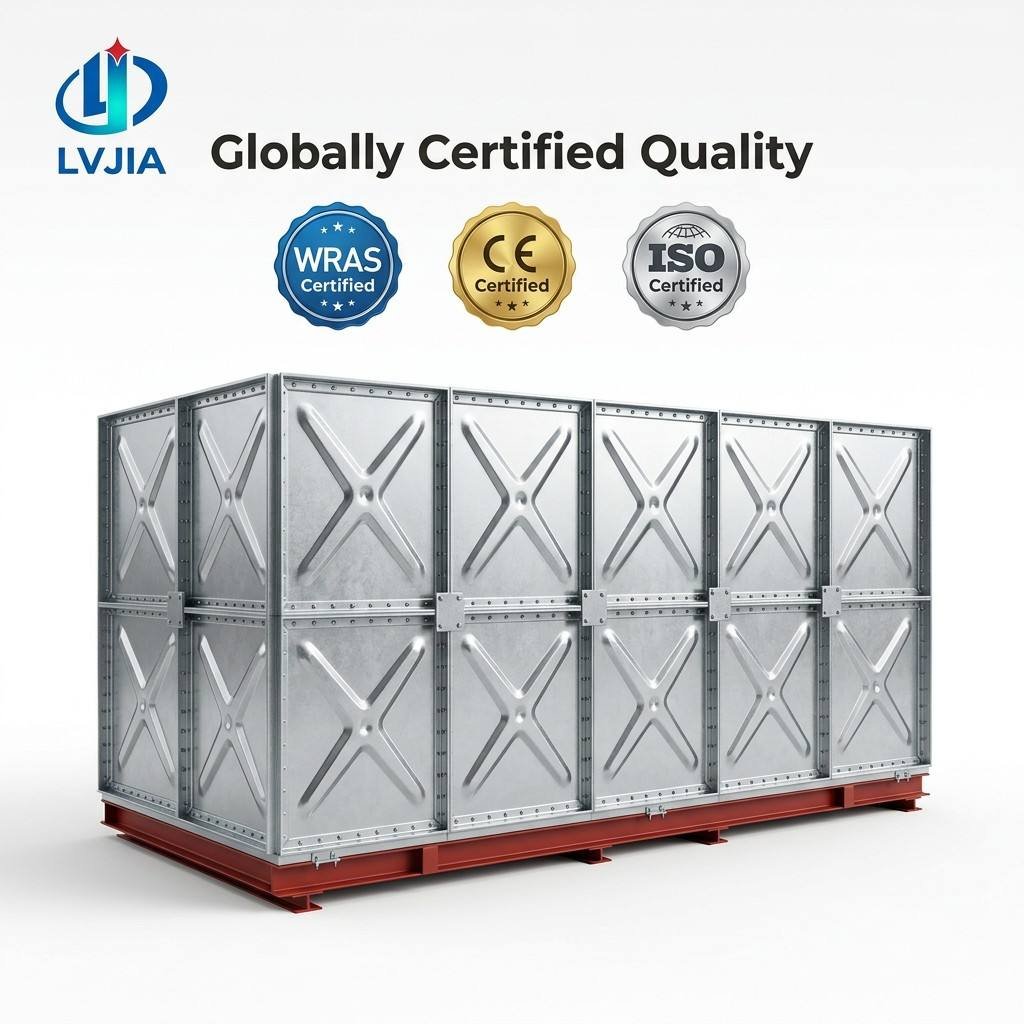
How it is made
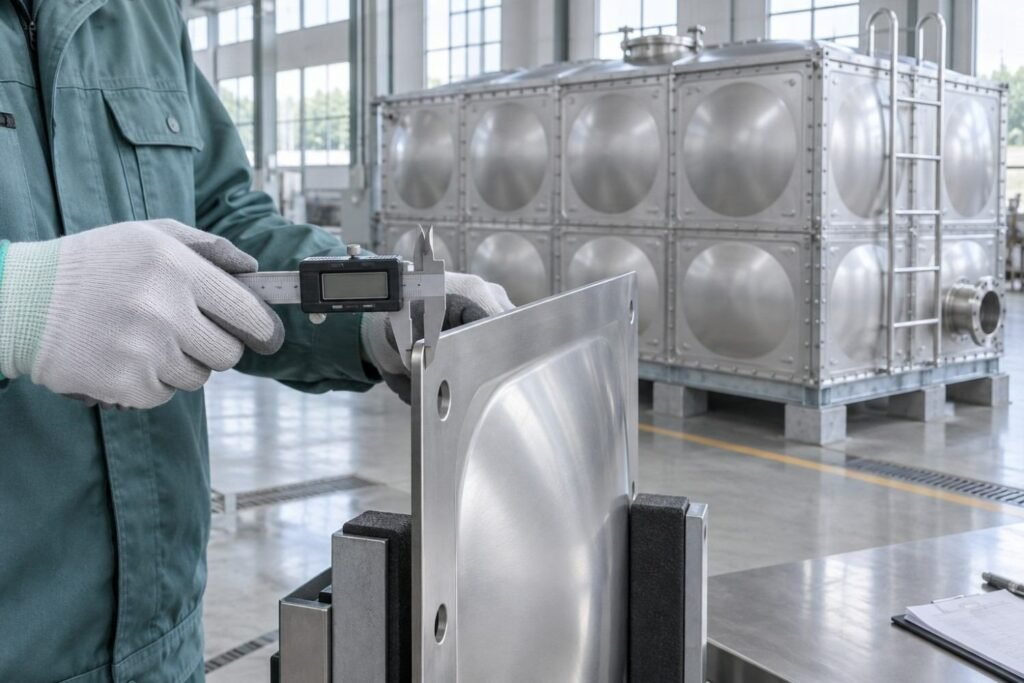
The panels are pressed, punched and formed from Q235 plate, hot-dip galvanized and checked against the approved drawing at our works in Wucheng County, Dezhou. Nothing is pressed before the buyer approves that drawing, and nothing ships before the trial-assembled tank has held water for 48 hours.
Our hot-dip galvanized water tank manufacturing route uses the factory’s three production lines and 25 machines, from hydraulic presses and laser cutting to automatic punching, in one 11,000 m² building. Each tank is kitted in its own crate with bolts, gaskets, sealant and fittings, and ships flat-packed through Tianjin or Qingdao.


Inspection and documents
The inspection and test plan is written around the buyer’s hold points, and third-party inspectors are welcome. For a warehouse fire water tank we recommend three: incoming material, zinc thickness readings and the 48-hour water test.
Panel size and hole positions are checked against the approved drawing, not the last batch, and flatness is held to ±1.5 mm. The trial-assembled tank holds water for 48 hours with the level logged at start and finish. The test sheet, material certificates, approved drawing and assembly manual (EN/中文) travel with the tank. Our ISO 9001, 14001 and 45001 certificates are listed with their numbers on the certifications register; none of them is a fire approval.
Installation and commissioning
Installation is bolting only. The plinth check and the floor torque pattern decide whether the fire water tank holds water.
Survey against the drawing; anything outside 3 mm over 3 m is corrected first.
Bolt the 5 mm floor panels with gasket strip from the center out, torquing in a pattern.
Erect course by course, fitting tie rods at each seam and angle stiffeners on courses 1 and 2.
Fit roof panels, manholes and the two screened vents.
Suction and anti-vortex plate at 152 mm, overflow, drain, fill valve and level instruments; mark the fire service level at 3.65 m.
Fill to the overflow, hold, walk every joint and set the float valve.
Clad the tank, commission heater and alarm, heat trace exposed pipes.
Give the owner the drawing, level schedule, test sheet and an NFPA 25 calendar.
What the design delivers
This warehouse fire water tank gives 365.9 m³ of usable fire volume against 349.3 m³ required, and an 8-hour refill at 43.7 m³/h. These are design outcomes, and your engineer can check each one.
- Replace our 1,538 gpm with the hydraulic calculation’s figure; if it is higher, the tank grows before anything is pressed.
- Check the plate at 152 mm, the overflow at 3.70 m and the fill flow from a mains test against the level schedule.
After handover, a fire department’s NFPA 25 checklist sets level checks monthly or quarterly, level alarm tests semiannually and an interior inspection every three to five years, with daily or weekly temperature checks in cold weather. Draining impairs the only supply, so a two-compartment layout keeps half the volume in service during an interior inspection.
Mistakes we see on this duty
A fire tank can be right on the calculation sheet and still wrong on the drawing. The usual gap is that the volume is correct but the levels defining it are missing.
- Nominal sold as effective. A 432 m³ tank against a 432 m³ requirement is 15% short.
- Hose allowance forgotten. When the tank is the only supply, the 946 L/min (250 gpm) comes out of it too.
- Brass in a zinc tank. Dissimilar metals attack the galvanizing around the fitting.
- Overflow into the pump room. A stuck float valve floods the room that makes the tank useful.
Watch out
If the warehouse later stores different goods, or the sprinklers change from ESFR to in-rack protection, the sprinkler demand and duration can both change. Treat a change in stored goods as a change to the fire water tank, and send us the new criteria before panels are pressed.
Frequently asked questions about a warehouse fire water tank
Can a bolted galvanized tank be the only sprinkler water supply?
Only where the authority having jurisdiction and the insurer accept it. NFPA 22 deals with bolted steel through AWWA D103, which is written for cylindrical tanks, so a rectangular pressed-panel tank is judged case by case on engineering evidence. LVJIA holds no FM Approval, UL listing or fire approval; we supply the drawing, levels, certificates and water test record the reviewer asks for.
Why is the tank bigger than the calculated fire volume?
Because a fire pump cannot empty it. Dead water under the plate, the permitted draw-down and the air space above the overflow all count in the nominal size but not in the fire volume; on this layout they add up to 66 m³ of the 432 m³.
How fast must a fire water tank refill?
NFPA 22 allows up to 8 hours to restore the minimum fire volume, so the connection must supply one-eighth of it every hour. Ask the water utility for a flow test at the connection early: a weak main can force a larger service pipe or a booster set, and that changes the site plan.
Does a galvanized fire tank need heating?
Only where the water could freeze, but then it is not optional: a frozen tank supplies nothing, and ice damages panels and fittings. Size the heater for the coldest week on record, clad every flange line, heat trace exposed pipes and wire the low-temperature alarm to a panel that someone watches.
What do you need from us to size one?
The sprinkler criteria or hydraulic calculation, hose allowance and duration, yard dimensions, lowest winter temperature, a water analysis and the mains flow at the connection. From those our engineers lay the tank out, mark every level on the drawing and state the margin in writing.
For ready specifications, see the galvanized fire water tank, the warehouse reservoir tank and the sealed, covered galvanized tank. The full galvanized water tank range, the datasheets and CAD drawings and more design case studies are one click away.
Talk to an engineer
Send your sprinkler criteria and we will size the tank
Our engineers send a first written reply within 2 hours, then return a GA drawing with a level schedule and a stated margin. Drawing review is free.