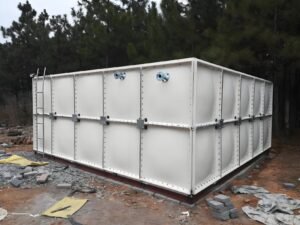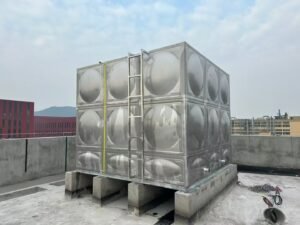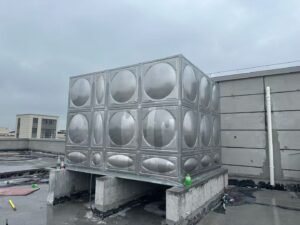


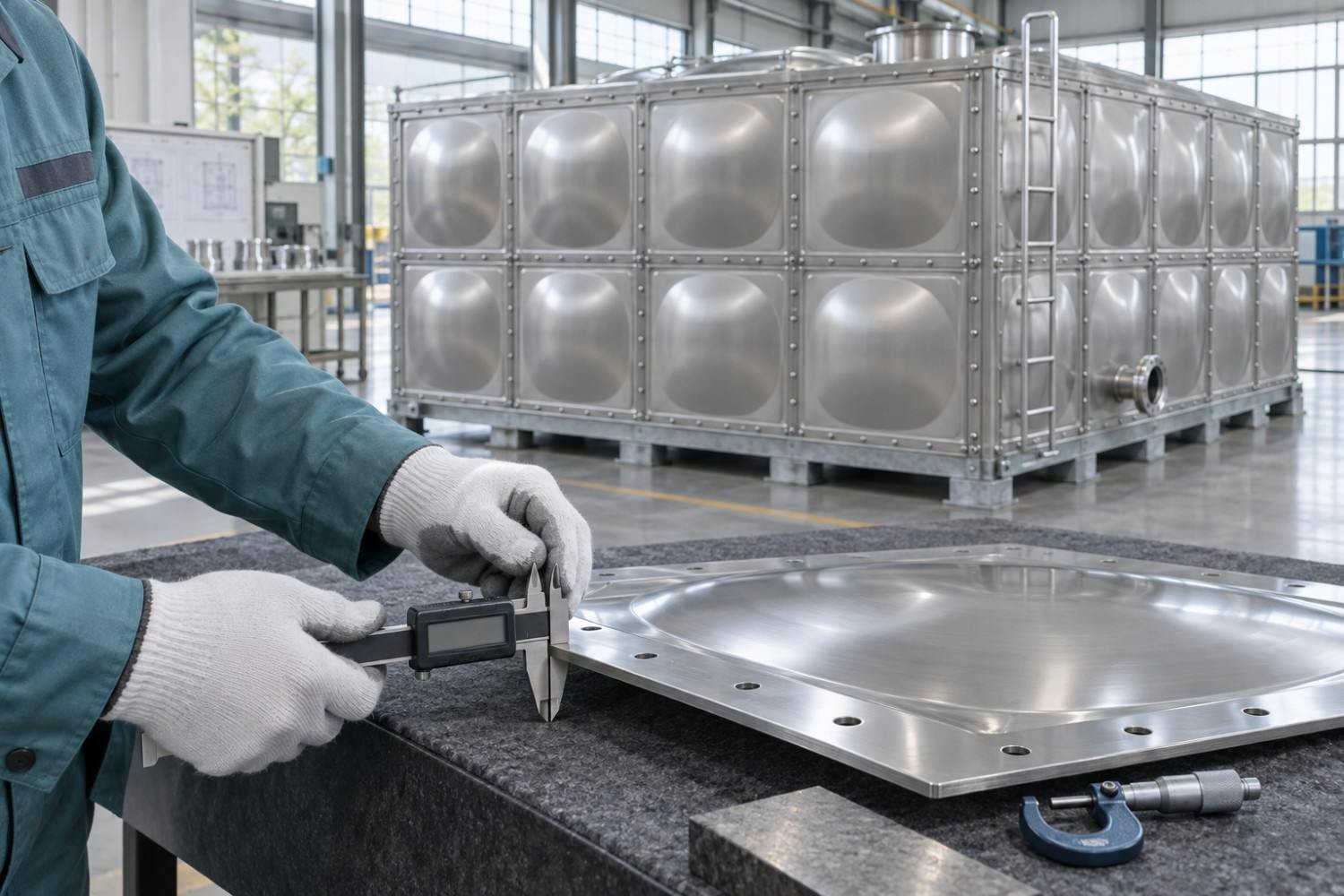
All five LVJIA water tank ranges now hold drinking-water contact test reports to GB/T 17219-2025, China’s revised standard for the hygienic safety evaluation of drinking-water distribution equipment, protective materials and treatment materials. The reports, SP2630498 to SP2630502, were issued by the Dezhou Institute of Product Quality Standards and Metrology, one for each material. The GRP/SMC report, SP2630502, was issued on 18 May 2026 with 20 of 20 items passed. Below: what was tested, what the new edition changed, and how to check a report yourself.
Key takeaways
- Five drinking water test reports, one per range: GRP/SMC, stainless steel, hot-dip galvanized, enameled steel and BDF underground.
- GB/T 17219-2025 was released on 29 August 2025 and took effect on 1 March 2026, replacing the 1998 edition in full. Its scope now takes in water treatment materials.
- The test soaks the material and analyzes the water it leaves behind. NSF/ANSI/CAN 61 and WRAS ask a similar question through separate schemes; a GB/T 17219 report substitutes for neither, and we hold neither.
- Check any report through its CMA mark, its number and the issuing laboratory, not through the supplier.
What happened, and which reports were issued?
Samples from each of our five ranges were tested by the Dezhou Institute of Product Quality Standards and Metrology against GB/T 17219-2025, and each range now has its own report. The GRP/SMC report is the one we quote item by item: sample received 27 April 2026, testing from 28 April, report issued 18 May 2026, all 20 items passed and none marginal.
The institute is a state testing institute, accredited for inspection and testing under CMA number 231520118043. It tested the GRP/SMC sample by the methods of GB/T 5750-2023, the national standard examination methods for drinking water. The other four reports carry their full issue dates on the stamped copies, which we send on request.
| Report | Range | Issuer | What we quote here |
|---|---|---|---|
| SP2630502 | GRP/SMC sectional | Dezhou Institute of Product Quality Standards and Metrology | Issued 18 May 2026; 20 of 20 items passed, none marginal |
| SP2630498 | Stainless steel | Same institute | Report number and range; full date on the stamped copy |
| SP2630499 | BDF underground | Same institute | Report number and range; full date on the stamped copy |
| SP2630500 | Enameled steel | Same institute | Report number and range; full date on the stamped copy |
| SP2630501 | Hot-dip galvanized | Same institute | Report number and range; full date on the stamped copy |
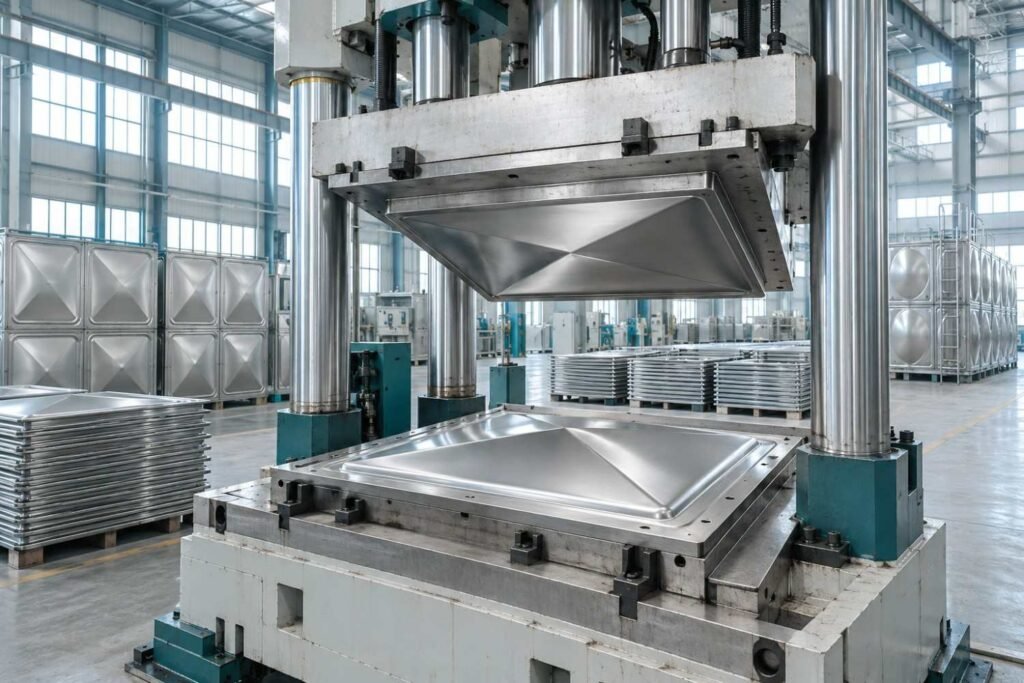
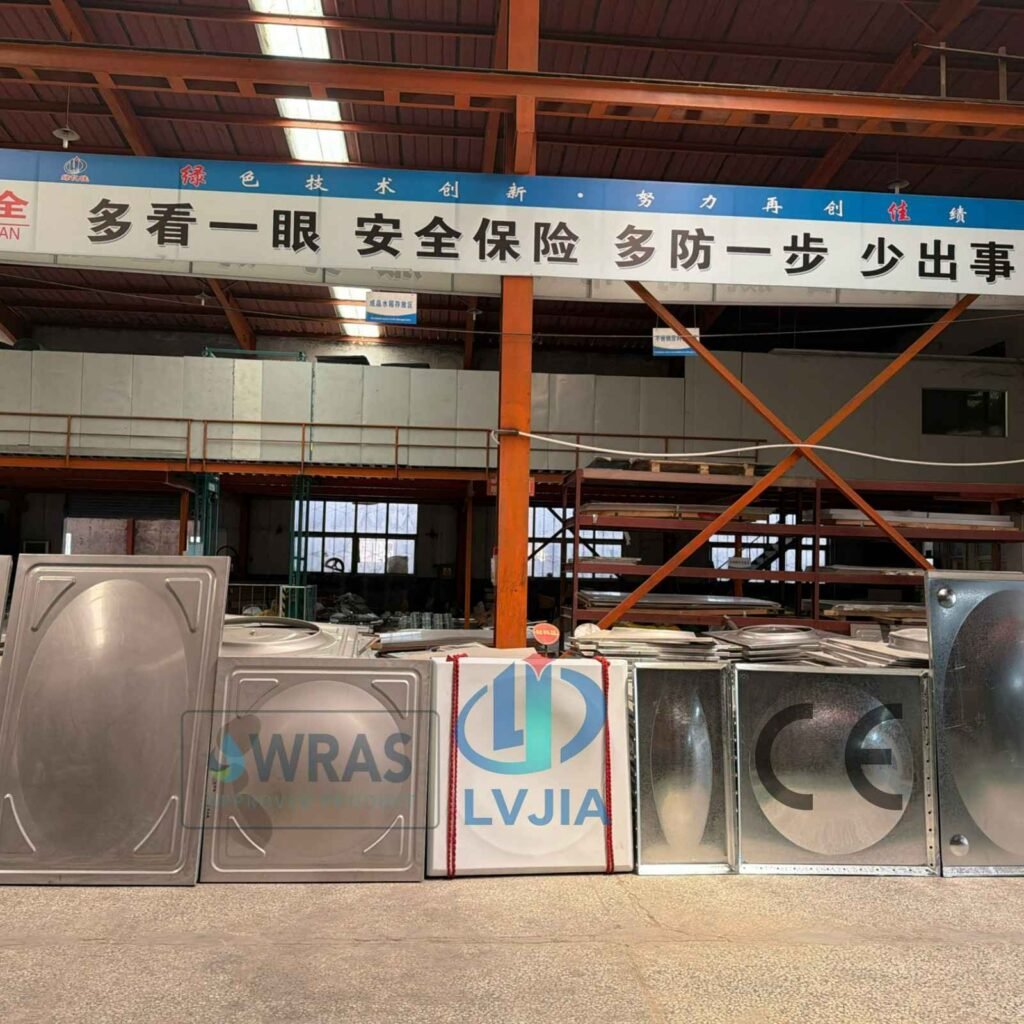
Each report covers one material, so between them they cover every range we build: the SMC water tank, the stainless steel water tank, the galvanized water tank, the enameled water tank and the BDF underground water tank. Choose the report that matches the material you are buying. A report for one material says nothing about another.
What is GB/T 17219-2025?
It is China’s national standard for the hygienic safety evaluation of distribution equipment, protective materials and treatment materials used in drinking water systems. It was released on 29 August 2025, took effect on 1 March 2026 and replaced GB/T 17219-1998 in full.
The official record on the national standards information platform lists it as a current, recommended national standard, the T in GB/T, under the National Disease Control and Prevention Administration. Its title names the three things it evaluates: distribution equipment, protective materials and, new in this edition, treatment materials.
The edition it replaced had stood for more than 27 years. The national standard catalog shows GB/T 17219-1998 released on 21 January 1998, in force from 1 October 1998 and now abolished, and its own record gives the abolition date as 1 March 2026, the day the new edition took effect. For a water tank, the groups that matter are equipment and, where steel is coated or lined, protective materials. Our GRP/SMC report is run on the finished panel material rather than a raw resin sample, which is the version of the question a buyer cares about.
What changed from the 1998 edition?
Comparing the two official records shows the change in scope and title: the 2025 edition adds water treatment materials to distribution equipment and protective materials, and it is now framed as a hygienic safety evaluation. The indicator-by-indicator changes sit in the standard’s foreword, which we could not confirm from an official source, so we do not list them here.
The revision was planned in December 2021 under national standard plan 20214635-T-361, with the National Disease Control and Prevention Administration as the competent department. The official record names the drafting organizations: the China CDC institute for environment and health-related product safety, with the CDCs of Jiangsu, Shanghai, Hunan and Henan.
Public health bodies describe its purpose the same way. A summary of the environmental health standards released in 2025, published by the Chongqing Center for Disease Control and Prevention, says the standard sets hygienic safety evaluation requirements and test indicators for all three material groups, and strengthens control over the migration of toxic and harmful substances as water treatment technology develops.
| Field | GB/T 17219-1998 | GB/T 17219-2025 |
|---|---|---|
| Official English title | Standard for safety evaluation of equipment and protective materials in drinking water system | Hygienic safety evaluation of distribution equipment, protective materials and treatment materials in drinking water system |
| Materials covered | Distribution equipment and protective materials | Distribution equipment, protective materials and water treatment materials |
| Released | 21 January 1998 | 29 August 2025 |
| In force | 1 October 1998 | 1 March 2026 |
| Status, September 2026 | Abolished from 1 March 2026 | Current |
| Type | Recommended national standard (GB/T) | Recommended national standard (GB/T) |
For a buyer, the practical point is the edition printed on the report. Our GRP/SMC report lists 20 items, set out one by one further down. If your specification names an indicator that is not on that list, ask before you order and we will tell you in writing whether our report covers it.
How does the GB/T 17219 soak test work?
A sample of the material is soaked in prepared water under conditions the standard sets, and the soak water is then analyzed. Each result is compared with the limit for that indicator, and the report gives a result and a verdict for every item.
The soak conditions for each product type are set in the standard itself. We do not quote them here, because we could not confirm them from an official source; ask the laboratory, or read the official text, if your specification turns on them.
The analysis side is easier to pin down. Our GRP/SMC report was tested by the methods of GB/T 5750-2023, the standard examination methods for drinking water, whose parts were released on 17 March 2023 and took effect on 1 October 2023. The parts applied cover sensory and physical indicators (part 4), metals and metalloids (part 6), composite organic indicators (part 7) and organic indicators (part 8).
A sample of the finished material goes to the laboratory and is logged on receipt: 27 April 2026 for our GRP/SMC sample.
The sample is soaked under the conditions the standard sets for its product type.
The soak water is analyzed by GB/T 5750-2023 methods, item by item.
Each result is compared with the limit in the standard, and the report records a result and a verdict for every item.
The laboratory issues a numbered report under its CMA mark, with its seal and the signatures of inspector, checker and signatory.
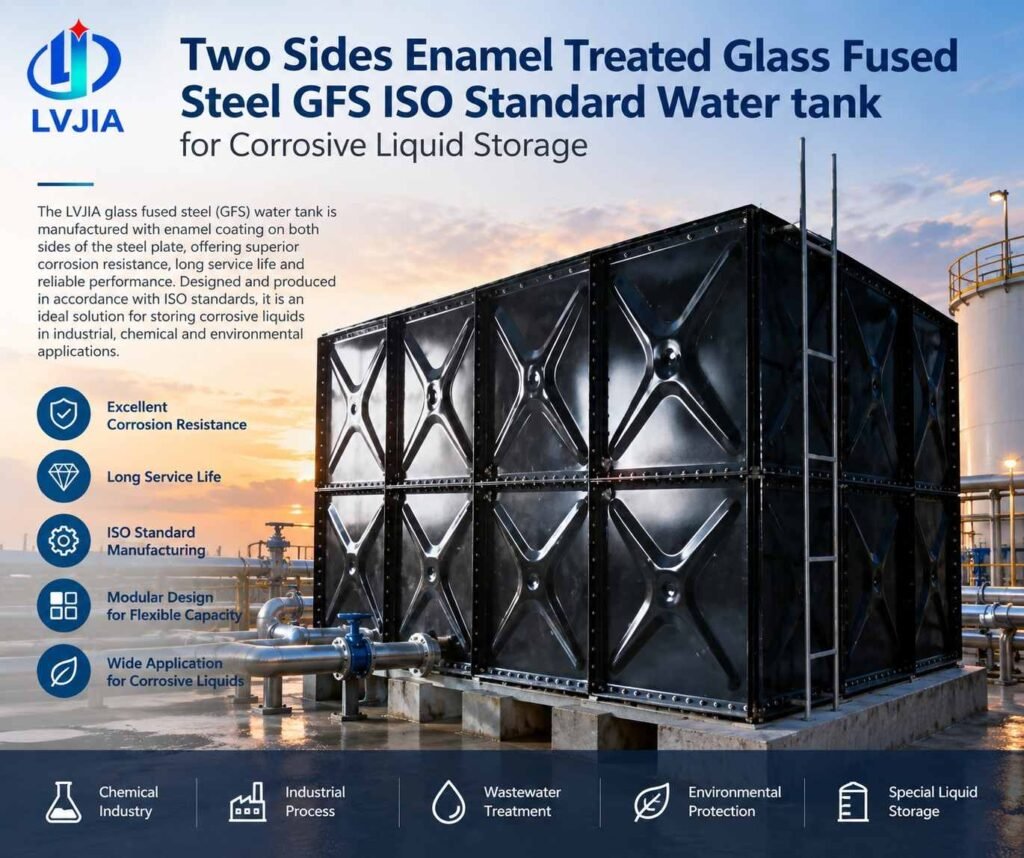
What do the 20 items tell a buyer?
They tell you whether the tank material changes how the water looks, smells and tastes, whether it shifts the water’s basic chemistry, and whether it releases metals or chlorinated organics. Grouped that way, each item answers a question a building owner or water authority would otherwise have to ask.
| Group | Items | What it tells a buyer |
|---|---|---|
| Sensory | Chromaticity, turbidity, odor and taste, visible matter | Whether the material changes what users see, smell and taste: the changes occupants notice first |
| General chemistry | pH, permanganate index, volatile phenols | Whether the material shifts pH or releases oxidizable organic matter; the permanganate index is the one to read on resin-based panels |
| Common metals | Iron, manganese, zinc, copper, aluminum | Whether steel, coatings or fittings release metals; zinc is the item to read on a hot-dip galvanized tank, whose coating is zinc |
| Metals and metalloids with health-based limits | Lead, mercury, cadmium, arsenic, chromium (VI), silver | Whether the material releases heavy metals or metalloids into the water |
| Chlorinated organics | Chloroform, carbon tetrachloride | Whether the material contributes chlorinated organic compounds to the water |
Read the report for the material you are buying with that table beside you. On a GRP/SMC tank, the sensory items and the permanganate index are the ones that speak to the resin, because resin is organic. On a stainless tank, chromium (VI) and the common metals are the natural focus. On a hot-dip galvanized tank, look at zinc first. On an enameled tank, the glass coating is the wetted surface, so iron in the metals section is worth a look.
How to read the results columns
Look for five things on each row: the item, the unit, the requirement, the measured result and the verdict. Read across, not down: a verdict of compliant tells you less than a measured value sitting well below its limit, and the gap between the two is the margin you are buying.
Two notations trip people up. A result written as “<” followed by a number means the item was below what the method can detect or report, not that it was zero; compare that number with the limit to see how much headroom the method leaves. Sensory items such as odor and taste or visible matter are usually judged against a descriptive requirement rather than a numeric limit.
How does GB/T 17219 compare with NSF/ANSI/CAN 61 and WRAS?
All three ask what a material adds to drinking water, and all three answer by exposing the material to water and analyzing the result. They are separate schemes with their own test waters, limits and recognition, so one does not stand in for another.
Under NSF/ANSI/CAN 61, as UL Solutions describes it, products are exposed to test water for a set sequence of times, the water is analyzed under a program built around the materials of construction, and contaminants are compared with pass/fail levels. WRAS product approval in the UK combines mechanical and water-quality testing, with each non-metallic material backed by a WRAS materials approval or a BS 6920 test report.
WRAS approval and NSF/ANSI/CAN 61 certification are not in our certificate register, and we do not describe our GB/T 17219 reports as equivalent to them. If your project is in a market that names one of those schemes, our guide to potable water tank standards by market explains what each requires and where our documents stop.
How can you verify a CMA test report?
Check the CMA mark and number on the report, check that the laboratory’s qualification is current, and confirm the report number with the laboratory itself. You should never have to rely on the supplier’s word.
CMA is China’s legal qualification for inspection and testing bodies. Under the SAMR measures on inspection and testing body qualification, it is the evaluation and license required of bodies that issue data and results with a proving function to the public. Such a body must put the qualification mark on those reports, and holds a certificate that states its scope, number and validity, which runs six years. The qualifying authorities must publish the qualified bodies and their certificate status on their official websites.
- Find the CMA mark and number on the report. Ours carry 231520118043.
- Check that the laboratory’s qualified scope covers the standard and the methods on the report.
- Quote the report number to the laboratory and ask it to confirm the result and the date.
- Check the seal and the signatures of inspector, checker and signatory on the stamped copy.
- Check the sample description: the material and range should match what you are buying.
- Check the edition: GB/T 17219-2025, not the abolished 1998 edition.
The institute’s address, telephone and email are listed with the issuing authorities on our certification register, so you can contact it without going through us.
What a test report can and cannot tell you
A test report speaks for the sample the laboratory received, on the dates it was tested. That is why the sample description matters as much as the verdict: it should name the material and the range, so you can tie the result to the tank on your order.
A report is also not a production audit. What links the tested sample to your tank is the factory behind it: material matched to its certificate on arrival, panels checked against the approved drawing, and a 48-hour water test on the assembled tank before it ships. The hydrostatic test sheet, the material certificates and the approved drawing travel with the tank, and they are worth reading alongside the report.
What should buyers ask for, and what comes next?
Ask for the GB/T 17219-2025 drinking water test report for the material you are buying, by number, as a stamped copy. If your market names another approval, ask for that too, and expect a supplier to say plainly whether it holds it.
- The report number for your range: SP2630502 for GRP/SMC, SP2630498 stainless, SP2630499 BDF, SP2630500 enameled, SP2630501 galvanized.
- A stamped copy addressed to your project, rather than a screenshot.
- The laboratory’s CMA number and contact details, so you can verify it.
- The edition of the standard and the test-method standard on the report.
- Written confirmation of any indicator your specification names that is not on the report.
- For export, the approval your destination market recognizes, or a written statement that it is not held.
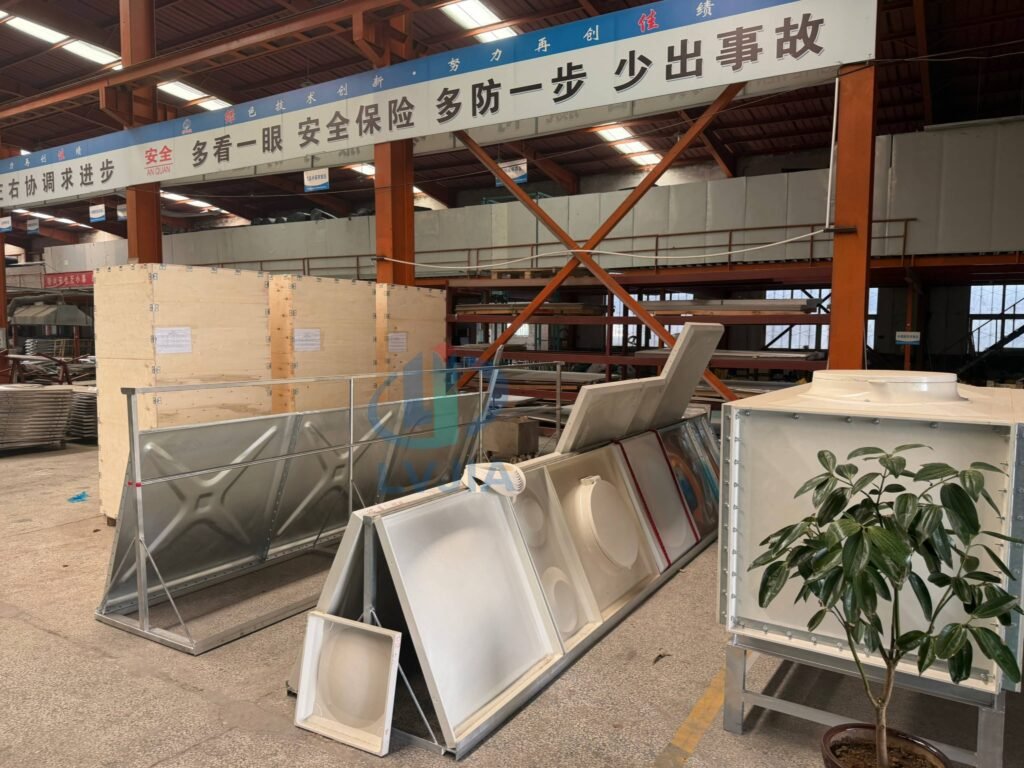
The reports sit alongside the documents that were already on our register: ISO 9001, ISO 14001 and ISO 45001 certificates from ZRX, and a CE Verification of Conformity to EN 13280:2001 for the GRP/SMC range. Standing documents and technical sheets are with the datasheets and CAD downloads, and the GRP water tank manufacturing page shows how the tested SMC panels are pressed.
What comes next is the ordinary work of keeping the register honest. Where a document is held, it is shown with its number and issuer. Where it is not, the register says so, and we will not claim an approval before we have it.
GB/T 17219-2025: frequently asked questions
Is GB/T 17219-2025 mandatory?
It is published as a recommended national standard, which is what the T in GB/T means. A recommended standard applies to a project when a regulation, a specification or a contract names it, so whether it is required on yours is for the specifying authority or the contract to say. Where a specification does name it, the report for your range answers that line.
Does one report cover all five tank ranges?
No. There are five reports, one per material, because stainless steel, zinc, glass enamel, bimetallic plate and SMC behave differently in water. Ask for the report that matches the range on your order, and check the sample description on it matches that material.
Is a report to the 1998 edition still useful?
As history, not as current evidence. The 1998 edition was abolished on the day the 2025 edition took effect, so a report run against it answers a question the national standard no longer asks. For any order placed now, ask for a report that names GB/T 17219-2025 on its face.
What does “none marginal” mean on SP2630502?
It means the GRP/SMC report returned every one of its 20 items as compliant, with no result recorded as marginal. It is a statement about that report, issued on 18 May 2026, and we quote it only for that report, not for the other four.
How long does the GRP/SMC report stay current?
Our certificate register lists SP2630502 as current, with a retest planned for 2027. When the new report is issued, it will go on the register with its number and date, and the stamped copy you request will be the latest one. Ask us which report is current before you file one with a tender.
Can I use the report to approve a tank in the UK or USA?
Not on its own. Those markets have their own approval routes, named by the specification or the authority, and a Chinese report is at most supporting evidence that a consultant may choose to consider. Ask the approving authority before you rely on it.
How do I get the stamped copies?
Ask through the contact page or the request form on the certification register, saying which reports you need and who they should be addressed to. Stamped copies go to a named person, so we know which specification each report is being read against.
Talk to an engineer
Ask for the report that matches your tank
Tell us the range, the project and the addressee, and we will send the stamped GB/T 17219-2025 report with its laboratory details.