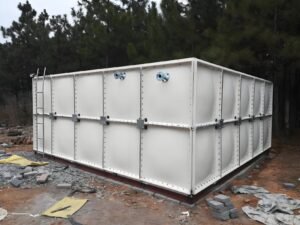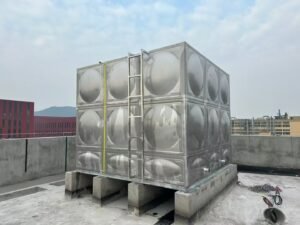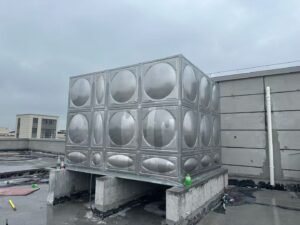


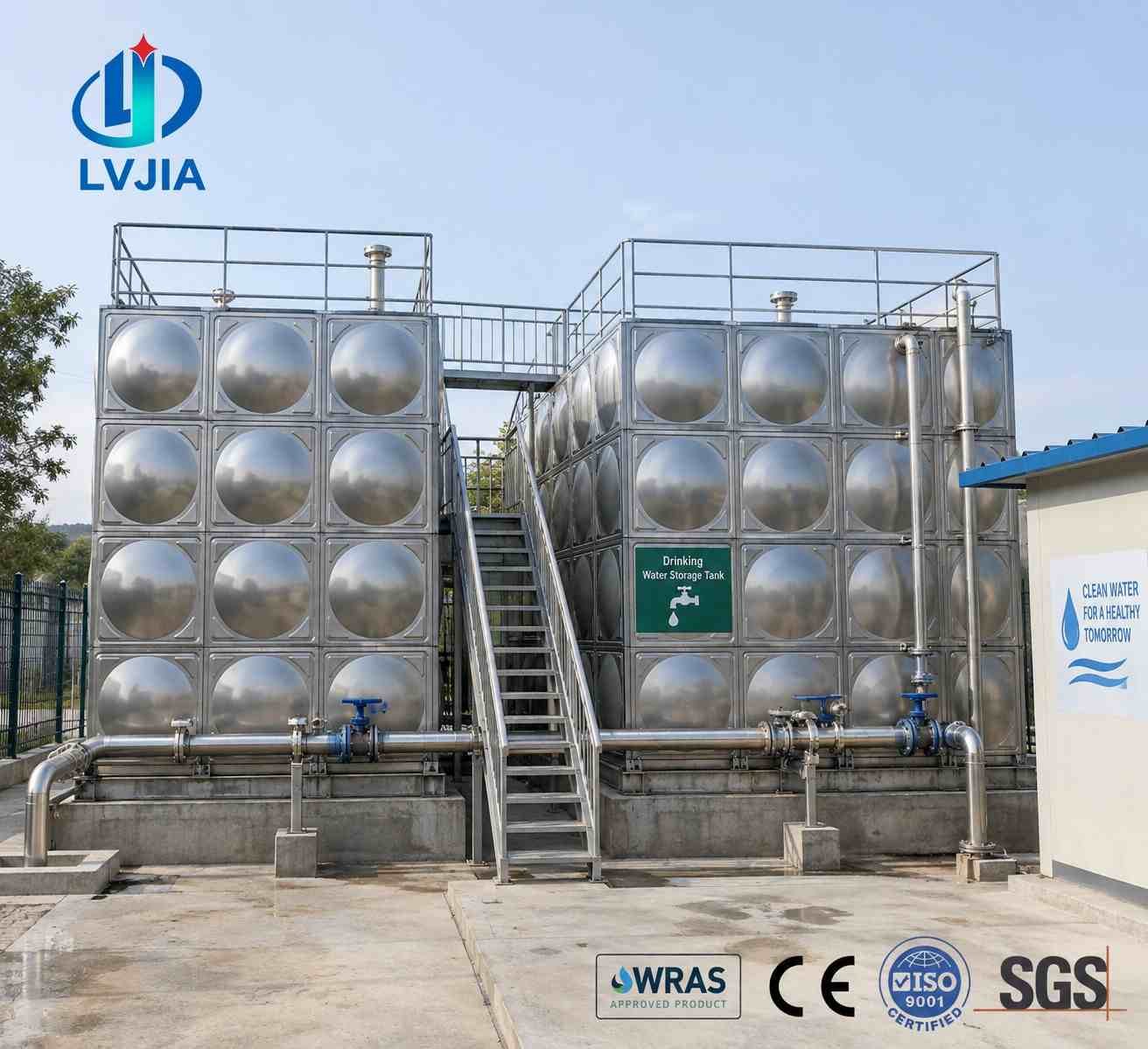
Water tank cleaning on a sectional tank follows one order: isolate and drain, remove sediment, wash the panels with methods the material tolerates, disinfect with a measured chlorine dose, hold it for the contact time, neutralize and flush, then test before the tank returns to service. UK guidance calls for an annual inspection of cold water storage tanks, inside and out, and we would clean whenever that inspection finds sediment, debris or biofilm. Below are the steps, the dose math and what not to use on each material.
Key takeaways
- Plan water tank cleaning around an annual internal inspection, and check hatches, vents and screens far more often.
- A tank is a confined space: work from outside where you can, and test the air before anyone enters.
- Match the cleaning method to the panel: no wire brushes on GRP or enamel, no chloride cleaners on stainless, no acids on galvanized.
- For water tank disinfection, chlorine dose = target mg/L × liters ÷ hypochlorite strength in mg/L. At 10 mg/L, 33.6 m³ needs at least 2.7 L of 12.5% solution.
- Neutralize before discharge, and return the tank to service only on a negative coliform result.
How often is water tank cleaning needed?
Inspect the inside at least once a year and check covers, hatches, vents and screens far more often. Clean and disinfect when an inspection finds sediment, debris, vermin or biofilm, after any repair that opens the tank, and before a new or long-idle tank goes into service.
In the UK, Table 2.1 of HSE’s HSG274 Part 2 lists an annual inspection of cold water storage tanks, with remedial work where necessary. Paragraph 2.57 says that inspection checks the tank’s condition inside and outside and the water in it, calls for the tank to be cleaned, disinfected and any faults put right, and asks for more frequent inspection where debris or traces of vermin are found.
The World Health Organization’s management advice sheet for storage tanks sets a tighter rhythm for the outside, from daily-to-weekly checks of covers, vents and screens to draining and cleaning as needed. LVJIA’s advice for any sectional tank is an annual internal inspection and clean, with gaskets and bolts checked at the same visit.
| Interval | Task | Basis |
|---|---|---|
| Daily to weekly | Cover, hatch lid, air vents and screens, overflow protection, surroundings kept clean, chlorine residual where dosed | WHO management advice sheet |
| Monthly to quarterly | Tank and support base inspected for signs of damage or failure | WHO management advice sheet |
| Annually | Inspection of cold water storage tanks inside and out, remedial work, stored-water temperature check | HSE HSG274 Part 2, Table 2.1 |
| Annually | Internal clean, gasket lines, bolts, tie rods and fittings checked | LVJIA advice |
| When debris or vermin traces are found | Inspect more often; clean and disinfect | HSG274 Part 2, para 2.57 |
| After repair or before first use | Disinfect and sample before the water is used | LVJIA advice; follow local rules |
Is it safe to go inside a water tank?
Only under a confined-space procedure, because a storage tank is enclosed, has restricted entry and is not designed for anyone to occupy. Plan water tank cleaning so as much as possible is done from outside, and where entry is unavoidable, test the air, keep a standby person at the hatch and have a rescue plan in place first.
HSE’s brief guide INDG258 lists storage tanks among the confined spaces that are easy to identify and sets out the three key duties under the Confined Spaces Regulations 1997: avoid entry, for example by doing the work from outside; if entry is unavoidable, follow a safe system of work; and put adequate emergency arrangements in place before work starts.
In the US, OSHA’s 29 CFR 1910.146 treats a confined space as permit-required if it contains or could contain a hazardous atmosphere, an engulfment or entrapment risk, or any other recognized serious hazard. The air is tested for oxygen first, then combustible gases, then toxic gases. Oxygen below 19.5% or above 23.5% counts as a hazardous atmosphere.
Watch out
Chlorinate by filling only after the crew is out. The spray method is the exception: it puts people inside with 200 mg/L solution, so it needs the entry controls above plus the protective equipment named on the product’s safety data sheet. Never mix hypochlorite with acid descalers, and lock off pumps and inlet valves so the tank cannot start filling with someone on the floor.
What are the steps in water tank cleaning and disinfection?
There are eight, and the order matters more than any single step. Skipped sediment removal and skipped neutralizing are where most jobs go wrong.
Agree the outage, arrange supply from the other compartment or a temporary source, lock off inlet valves and pumps.
Check the roof, hatch, vent screens, overflow and joints. Photograph anything to raise with the manufacturer.
Run the water down through the outlet, then the washout, keeping the last layer to carry sediment to the drain.
Squeegee or wet-vacuum deposits to the washout. Note their depth and color; they tell you about the supply.
Work top down with potable water and tools suited to the panel material, paying attention to joints, tie rods and corners.
Dose chlorine by a recognized method, measure the free chlorine after mixing and hold for the full contact time.
Dechlorinate the treated water, discharge it with consent, refill and flush until residuals match the supply.
Sample for coliform bacteria and free chlorine, return to service on a clean result, and file the record.
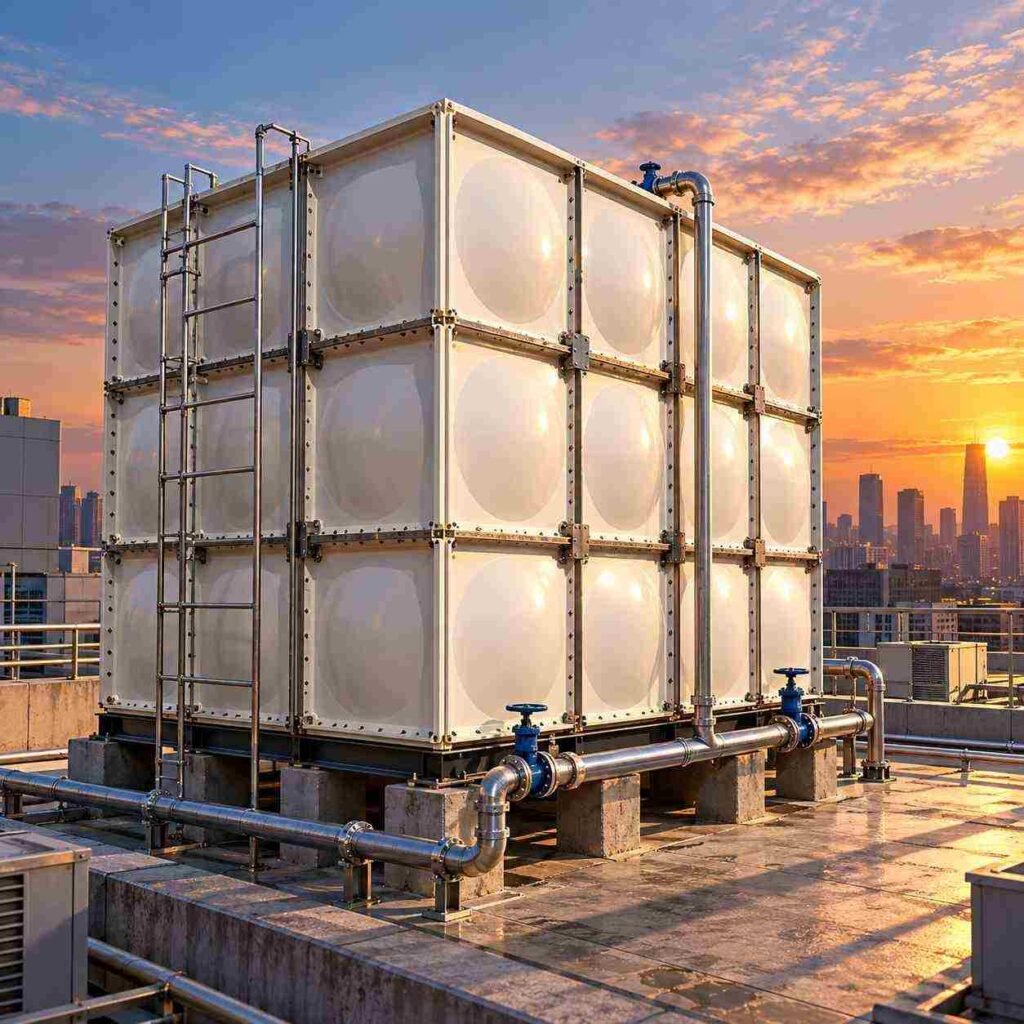
How do you take a sectional tank out of service without losing supply?
If the tank is partitioned, isolate and clean one compartment while the other keeps supplying. On a single-compartment tank, arrange a bypass or temporary supply before you start draining.
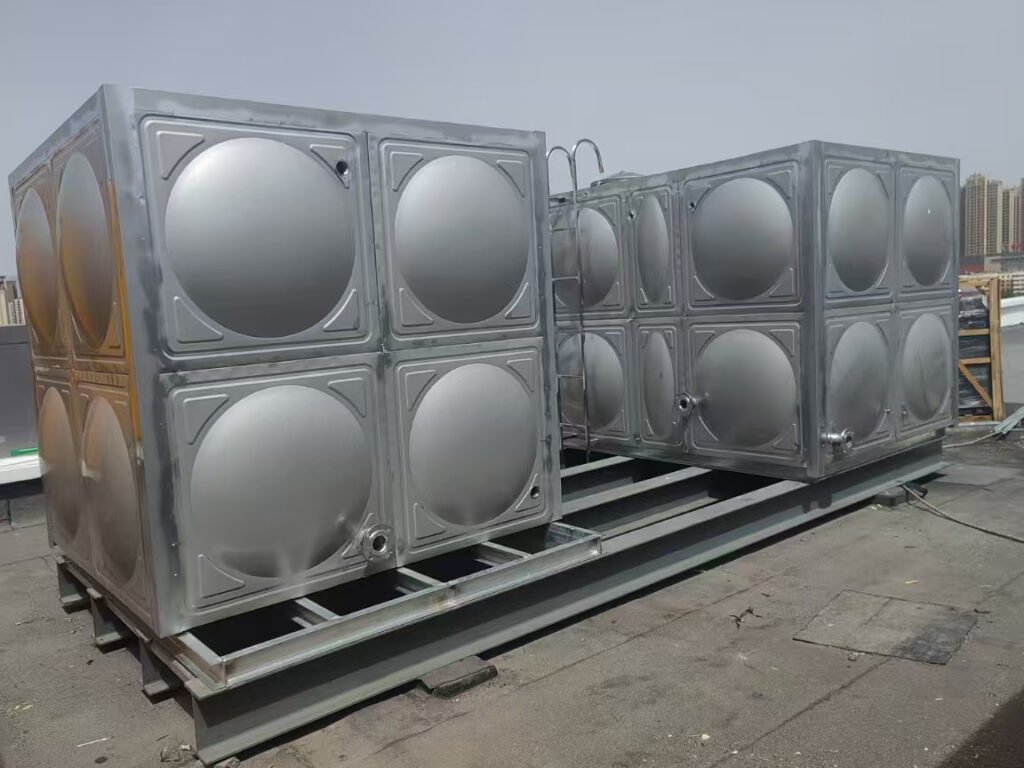
A bolted sectional tank is designed to be opened, and a partition or a second tank turns an outage into half an outage. Our two-compartment fire and rainwater tank shows the principle, with one tank split into two stores. Lock the valves on the side being cleaned, and check the partition joints for weeping as its level drops.
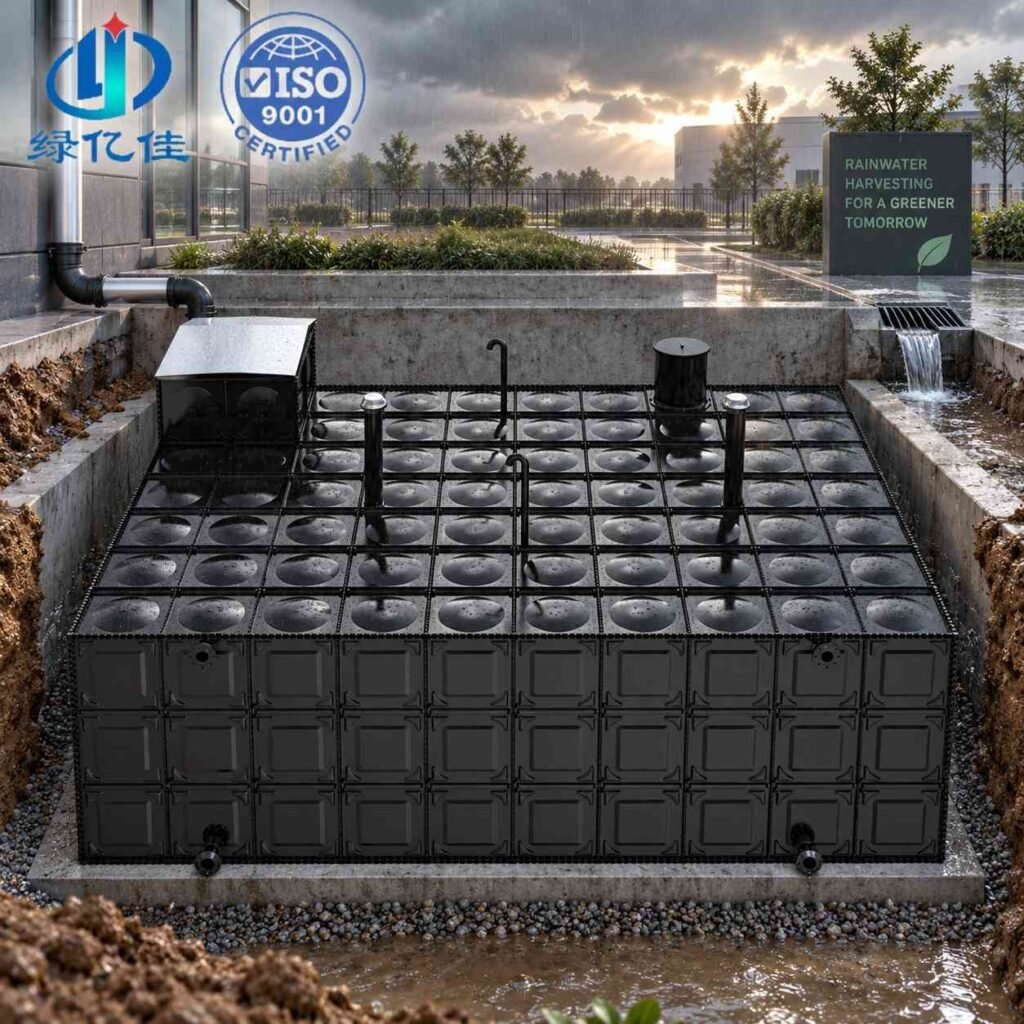
Buried tanks need one extra check. Before you drain an underground water tank, confirm that the groundwater is low. An empty buried tank in high groundwater can lift out of its pit, so plan BDF cleaning for the dry season.
How should sediment and biofilm be removed?
The physical part of water tank cleaning is simple: drain to a low level, move the sediment to the washout by squeegee or wet vacuum, then wash the walls and floor from the top down with potable water. Use soft or plastic brushes and a pressure washer kept moving and well back from gasket lines.
Look closely where water barely moves: corners, floor joints, the foot of the tie rods and around the inlet and outlet. Biofilm feels slippery before it is visible. A thick sediment layer points to a supply problem upstream or a tank oversized for its draw-off, so record its depth and photograph the floor before and after.
Which cleaning agents are safe on each tank material?
Potable water and soft brushes are safe on every panel type we make, and they do most of the water tank cleaning. The risks come from harsh chemicals and hard tools, and each material has its own list of things to keep away from it.
| Material | Use | Do not use | Why |
|---|---|---|---|
| GRP / SMC | Potable water, mild detergent then a full rinse, soft brushes, sponges | Wire brushes, abrasive pads, scrapers, solvents | Scratches roughen the molded surface and give biofilm a foothold |
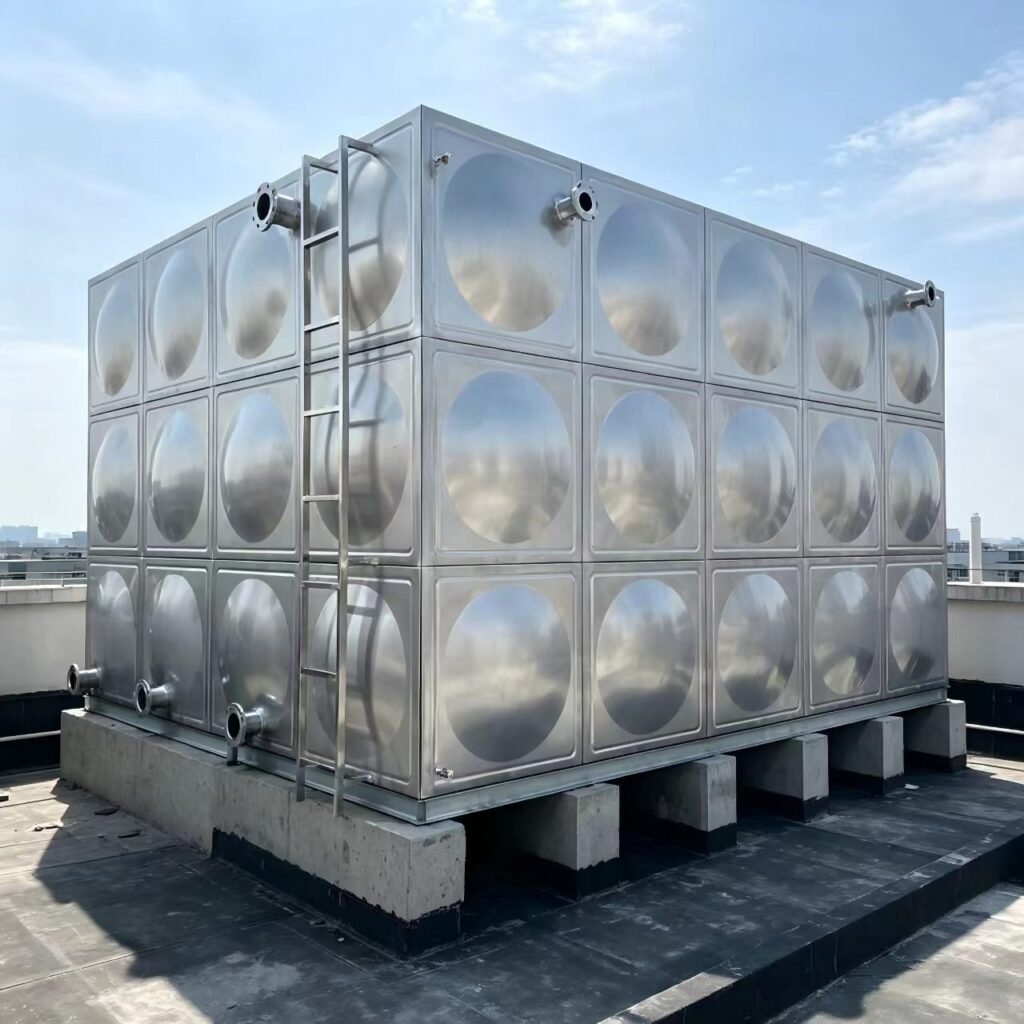
| Stainless steel 304 / 316 / 316L | Potable water, non-chloride detergent, nylon brushes or stainless brushes of equal or better grade | Hydrochloric acid cleaners, chloride cleaners, concentrated bleach on the surface, steel wool, carbon steel brushes, abrasive pastes | Chlorides cause pitting and staining; carbon steel particles rust on the surface |
| Hot-dip galvanized | Potable water, neutral detergent, soft brushes | Acid descalers, strong caustic cleaners, wire brushing, grit | Zinc is protective only within a pH window; abrasion removes the coating |
| Enameled (glass-fused-to-steel) | Potable water, mild detergent, soft brushes | Metal scrapers, hammers, abrasive pads | A chip exposes the steel beneath the glass |
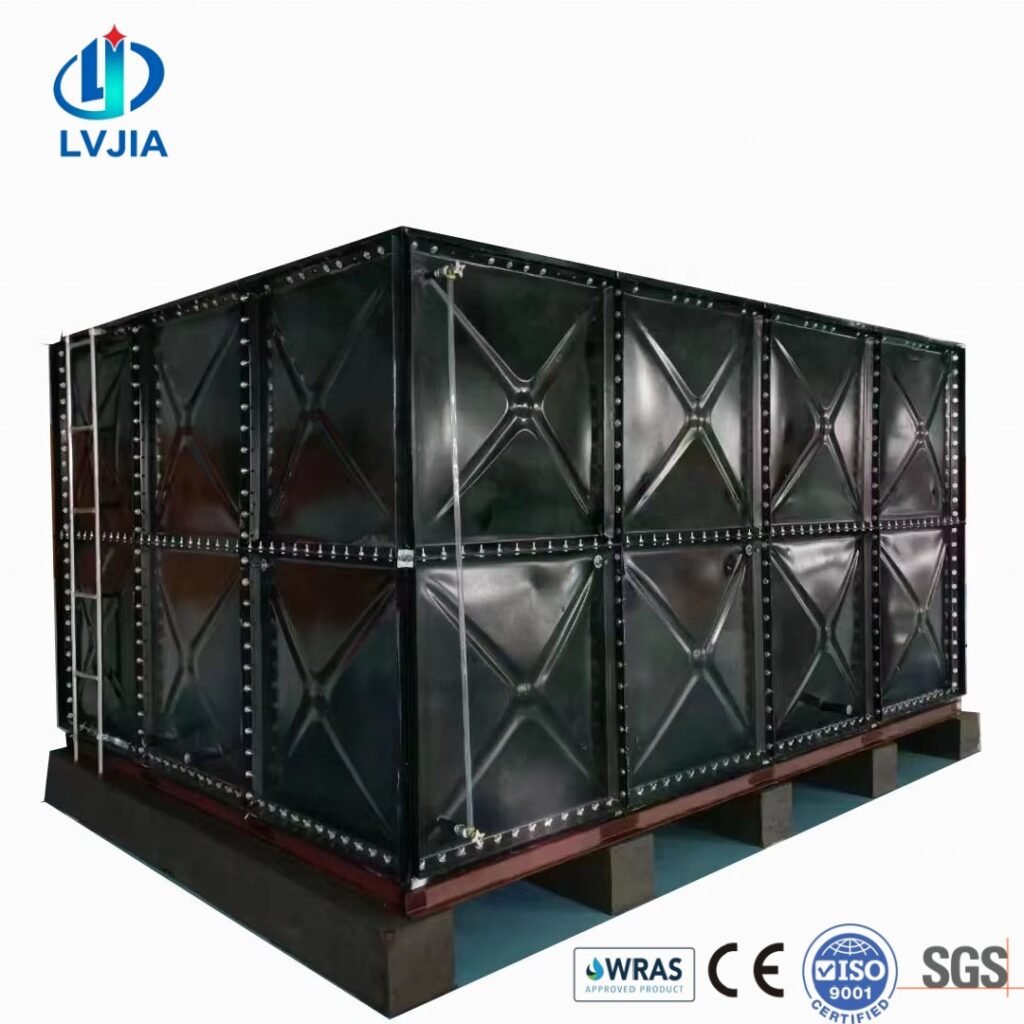
| BDF composite plate | Potable water, neutral detergent, soft or nylon brushes | Chloride and acid cleaners, strong caustics, wire brushes | The plate combines stainless and galvanized steel, so clean for the more sensitive of the two |
The stainless column follows the British Stainless Steel Association’s care guidance, which warns that chloride solutions, including hydrochloric acid cleaners and hypochlorite bleaches, can cause staining and pitting, and that wire brushes should be stainless of similar or better grade. It also treats thorough rinsing as part of the method. That matters for any stainless steel water tank, and most for a stainless steel drinking water tank that is chlorinated routinely.
For a galvanized water tank, the American Galvanizers Association notes that hot-dip galvanized coatings perform well in solutions with a pH above 4.0 and below 12.5. Keep cleaning chemicals inside that window. On an enameled water tank and on an SMC water tank, the main risk is mechanical: report any chip or deep scratch to us with a photograph and the drawing number.
How do you work out the chlorine dose for water tank disinfection?
Work out the mass of free chlorine the target concentration needs in the volume you are treating, then divide by the strength of the hypochlorite you have. For a 33.6 m³ compartment at 10 mg/L, that is 336 g of chlorine, or about 2.7 L of 12.5% solution.
The target depends on the method. AWWA C652, Disinfection of Water-Storage Facilities, describes three chlorination methods. Its scope says it is meant for tanks in public water systems, not storage tanks within building plumbing, where some materials may not tolerate its chlorine levels, so for a building tank follow local rules first. The method details below are as summarized in EPA Region 8’s finished water storage tank checklist.
| Method | Chlorine | Contact | Best suited to |
|---|---|---|---|
| C652 Method 1: full tank | At least 10 mg/L free chlorine remaining at the end of the retention period | 6 h with hypochlorite fed into the inlet while filling; 12 h with calcium hypochlorite tablets placed before filling | Small and medium tanks where the water can be neutralized |
| C652 Method 2: spray or brush | 200 mg/L on all water-contact surfaces | At least 30 min, then fill | Large tanks; applicators work inside the tank |
| C652 Method 3: part fill | 50 mg/L in about 5% of the volume, then fill to overflow | At least 6 h, then at least 24 h full with at least 2 mg/L free chlorine | Large tanks where discharging 10 mg/L water is difficult |
| Onsite tank fact sheet (LA County) | At least 10 mg/L free chlorine at normal operating level; 20 mg/L for high chlorine demand | Not stated | Private onsite storage |
Worked example
Chlorine dose for one compartment, 4 × 3 m in plan, water to 2.8 m
- Volume treated
4 × 3 × 2.8 = 33.6 m³33,600 L - Chlorine for Method 1
10 mg/L × 33,600 L = 336,000 mg336 g free chlorine, the minimum - Strength of 12.5% (w/v) hypochlorite
12.5 g per 100 mL = 125 g/L125,000 mg/L - Volume of 12.5% solution
336 g ÷ 125 g/L = 2.69 L≈ 0.71 US gal - Same dose from 5% bleach
336 g ÷ 50 g/L = 6.72 L2.5 times the volume - Method 3 instead
5% × 33,600 L = 1,680 L; 50 mg/L × 1,680 L = 84 g0.67 L of 12.5% - Method 3 after filling
84 g ÷ 33,600 L = 2.5 mg/Lbefore chlorine demand; C652 needs ≥ 2 mg/L after 24 h - Method 2 spray mix
200 mg/L × 20 L = 4 g → 4 g ÷ 125 g/L32 mL of 12.5% per 20 L sprayer
Result: a chlorine dose of at least 2.7 L of 12.5% hypochlorite for Method 1, or 0.67 L for Method 3. Method 1 needs 10 mg/L still present at the end of the retention period, so add a margin for chlorine demand, then measure free chlorine after mixing and again at the end.
Two checks keep the math honest. Label strength may be stated weight by weight rather than weight by volume, so use the supplier’s data sheet and treat an old container as weaker than its label. And the Los Angeles County onsite storage tank fact sheet gives 1 gallon of 12.5% bleach per 10,000 gallons for a 10 mg/L target. The formula gives 0.8 gallon, so the county’s figure carries a margin of about a quarter.
How long must the chlorine stay in contact during water tank disinfection?
As long as the method specifies, with the residual checked at the end rather than assumed. In EPA’s summary of C652 that is at least 30 minutes for the spray method, 6 or 12 hours for a full tank depending on how the chlorine goes in, and at least 6 hours plus 24 hours for the part-fill method.
The clock only counts while the residual holds. Test free chlorine at the start, part way through and at the end. If it drops sharply, organic matter is still in the tank, so drain, re-clean the problem areas and dose again rather than topping up.

How do you neutralize and discharge chlorinated water responsibly?
Water tank disinfection leaves strong chlorinated water behind, so reduce the residual to near zero with a dechlorinating chemical before it leaves the site, or discharge to a sewer only with the operator’s consent. Never send it to a stream, ditch or storm drain.
The US EPA’s dechlorination fact sheet explains why: residual chlorine is toxic to many kinds of aquatic life. It lists sulfur dioxide, sodium metabisulfite, sodium bisulfite, sodium sulfite and sodium thiosulfate among the agents, and warns that overdosing sulfite can suppress dissolved oxygen and lower pH. The LA County sheet states plainly that draining chlorinated water into surface water is illegal there.
Size the neutralizer from what is left, not from the chlorine dose you added. In our example, a residual of 8 mg/L after contact leaves 8 × 33,600 = 268,800 mg, about 269 g of chlorine. Multiply that by the ratio on your dechlorinating product’s data sheet, dose, mix, and confirm with the test kit that the residual is at or near zero before any valve opens.
How do you flush and test before the tank goes back into service?
Refill with supply water, flush until the chlorine residual matches the incoming supply, then sample from the full tank for coliform bacteria and free chlorine. The tank returns to service only when the coliform result is negative.
EPA Region 8’s checklist quotes C652: the record of compliance is the bacteriological test result certifying that the stored water is free of coliform contamination. Use an accredited laboratory and a sample tap flushed and disinfected before sampling. If a result is positive, the tank stays out of service until your authority’s resample or re-disinfection procedure gives a clean result. For a GRP potable water tank or any drinking-water store, keep the laboratory certificate with the tank’s drawing.
What records should you keep after water tank cleaning?
Keep enough to show what was found, what was done and what the water tested at before it went back into use. The next inspector, auditor or insurer will ask for the same file.
- Date, tank reference and drawing number, and who did the work.
- Inspection findings with photographs: sediment depth, joint condition, damage, vermin.
- Entry permit, atmosphere readings and rescue arrangements where anyone went inside.
- Chemicals used (product, strength, batch, quantity), target and measured residuals, and contact time.
- Neutralizing agent, discharge route and any consent reference.
- Laboratory results, the return-to-service date, and any gaskets, bolts or panels replaced.
Our five GB/T 17219-2025 drinking-water contact reports, one per range, are on our certification register. They describe the panel materials as tested; your records prove the condition of your tank today. Our page on how SMC panels are pressed shows the molded surface you are cleaning.

Water tank cleaning: frequently asked questions
Can I skip cleaning and go straight to water tank disinfection?
You can add chlorine to a dirty tank, but sediment and biofilm consume it and shelter bacteria underneath, so the residual falls and the result is unreliable. Physical cleaning comes first; disinfection finishes the job. Even a new tank that has only seen assembly dust needs a rinse before dosing.
Is household bleach acceptable for a drinking water tank?
Use unscented sodium hypochlorite with no added detergents or fragrances, and where the tank serves drinking water, a product your authority accepts for water treatment. Household products are usually weaker than trade solutions, so the volume rises; the chlorine dose formula in this guide handles any strength once you know it.
Will chlorination damage a stainless steel tank?
The risk grows with strength and time. Neat hypochlorite splashed on a panel and left to dry, or high-chlorine water left standing for days, is what pits stainless. Mix the dose into water rather than pouring it onto the surface, drain as soon as the contact time ends, and rinse. Where the tank will be chlorinated often, 316 or 316L gives more margin than 304.
How long does water tank cleaning take?
The physical work is rarely what sets the outage. The retention time of the disinfection method, the neutralizing and flushing, and above all the laboratory turnaround decide when the water can be used again. Book the laboratory before you drain, have the sample bottles on site, and agree who signs the tank back into service when the result arrives.
Do fire water tanks need cleaning too?
Yes, although the reason is different. Sediment in a fire reserve can block suction strainers and foot valves when the pumps start. Chlorination may not be required for non-potable storage, but inspection, sediment removal and a check of the joints and fittings belong on the same schedule. Follow the fire system’s own inspection regime as well.
Talk to an engineer
Planning water tank cleaning or a repair?
Send the drawing number and photographs from your inspection. Our engineering desk replies in writing within two hours with the next step.