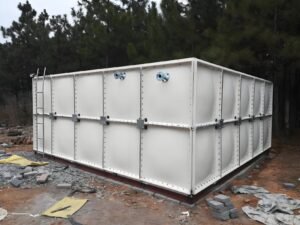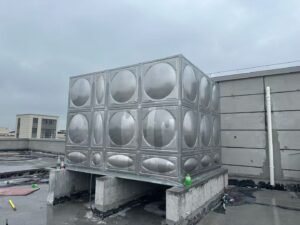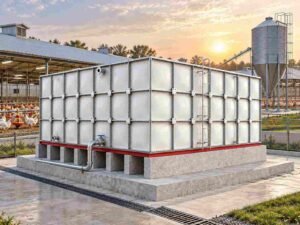


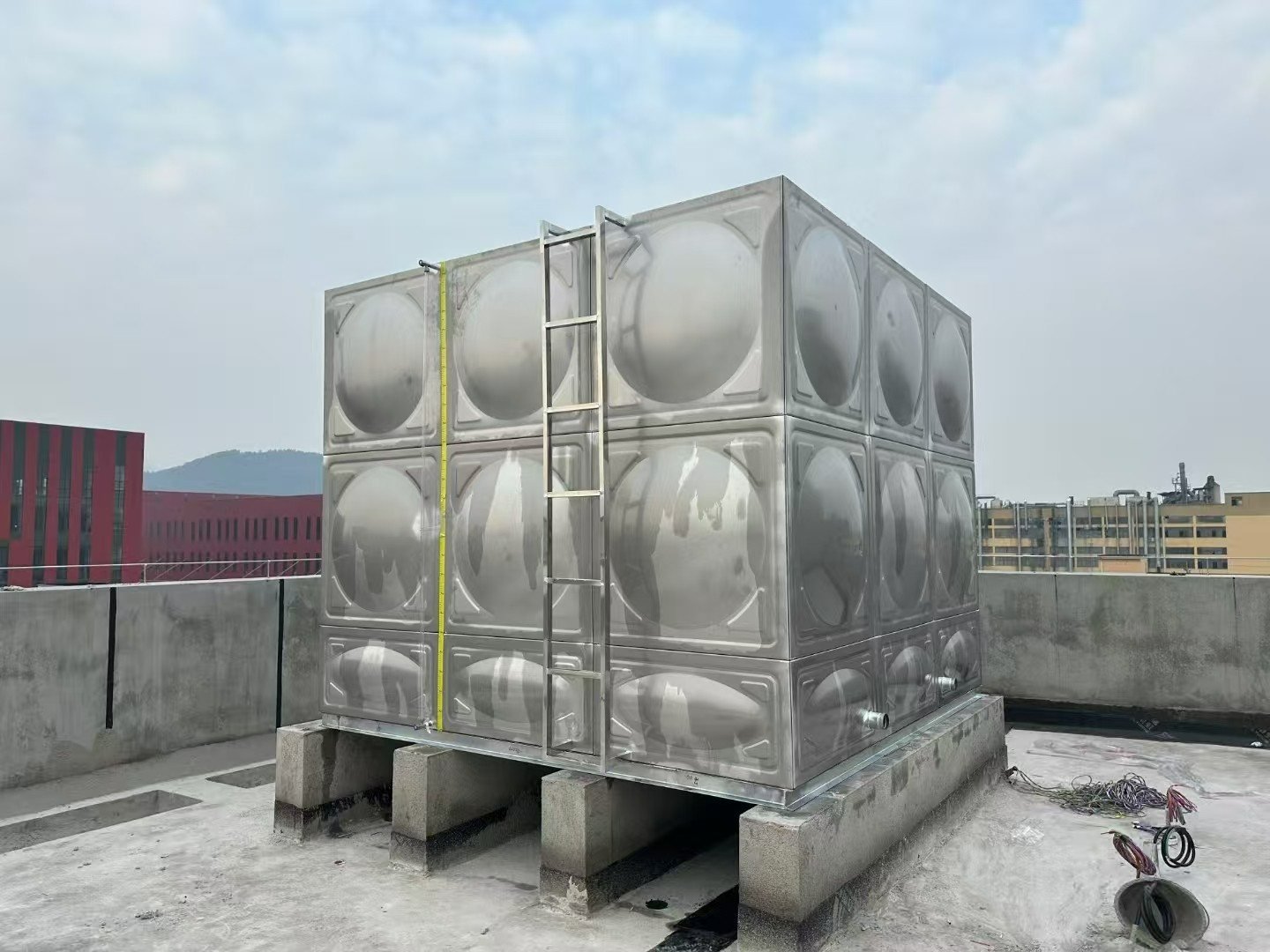
An RO water storage tank on a bottling line has to buffer the gap between what the reverse osmosis plant makes and what the line draws, without becoming the place where clean water picks up metal or bacteria. For a line drawing 8 m³/h of RO permeate we designed a welded 316L tank with a floor that falls to one outlet and a filtered vent. It holds 20.9 m³ effective, enough to run the line for at least 2 h 15 min with the RO plant stopped.
Engineering case study. This is a design worked through end to end with LVJIA‘s argon-arc welded 316L stainless steel tank construction for a typical beverage bottling line’s treated water duty. The figures are design figures for that duty, not measured results from a named customer. Send us your own numbers and we will run the same exercise on your site.
Project file
- Duty
- Buffer storage of RO permeate used as product water on a bottling line
- Sector
- Food and beverage
- Tank type
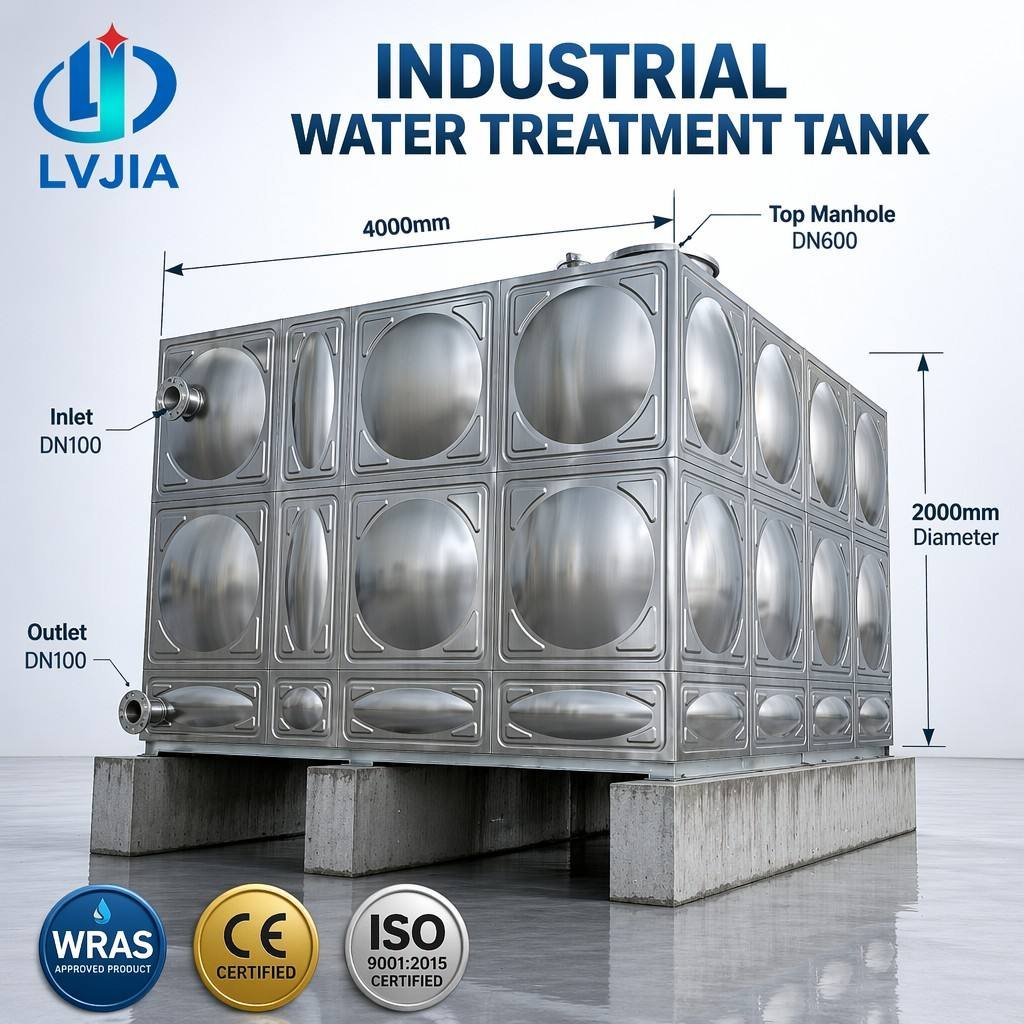
- Argon-arc welded 316L rectangular tank, floor laid to fall, shipped whole
- Capacity
- 27.1 m³ nominal · 20.9 m³ effective
- Size
- 5.6 × 2.2 × 2.2 m internal; about 5.8 × 2.3 × 2.5 m shipping envelope
- Plate
- 316L: floor 3.0 mm, walls 2.5 mm, roof 2.0 mm, external stiffeners
- Guidance used
- EHEDG and 3-A hygienic principles, FDA high purity water guide, ASTM A380 / A967
- Water
- RO permeate: low mineral content, low alkalinity, no chlorine residual
- Design life target
- 20 years in the owner’s brief; gaskets and vent filter replaceable
- Documents
- GA drawing, weld and passivation records, 48 h water test sheet, material certificates, EN/中文 manual
The brief: what an RO water storage tank must do on a bottling line
The tank must keep the bottling line supplied through RO stops and through the short, heavy draws of batch blending, while adding nothing to the water it holds. It also has to drain completely and be cleaned and sanitized on the plant’s own schedule, because the water inside carries no disinfectant to protect it.
Typical requirements from a beverage plant’s QA and engineering teams:
- Cover a stated RO outage at full line speed, plus the peak draw when a blend tank fills.
- No bolted joints or gaskets in the wetted surface other than hygienic connections.
- A floor that drains completely to one low outlet.
- A vent that breathes without letting plant room air, insects or dust in.
- Level control that starts and stops the RO plant and protects the transfer pump.
- Welds pickled and passivated, with records an auditor can read.
The brief for this RO water storage tank did not ask for maximum storage. Where RO permeate is an ingredient, more hours in the tank is not more security; it is more time for anything that got past the membranes to grow.
The constraints: aggressive water, no residual, hygiene and approvals
RO permeate is stripped of minerals and alkalinity and arrives without disinfectant, which makes it hard on some metals and makes residence time a hygiene variable. Around that sit the food industry’s hygienic design expectations and a food-contact question only the buyer’s QA can close.
Why RO permeate is aggressive
A Florida Water Resources Journal article on desalination post-treatment, by a University of Central Florida researcher, describes membrane permeate as depleted in minerals and often aggressive toward distribution system components. Carbon dioxide passes through the membrane unhindered, while the minerals that would buffer it stay behind.
Stainless steel does not rely on a mineral scale from the water. It protects itself with a thin, chromium-rich oxide film that re-forms in oxygenated water, which is why a 316L tank is the starting point for this duty.
No disinfectant residual
A review in the Journal of Membrane Science notes that aromatic polyamide thin-film composite membranes lose performance after about 1,000 ppm·h of chlorine exposure, so chlorine has to be removed from the feed. The permeate therefore reaches the tank with no free chlorine. The FDA’s guide to inspections of high purity water systems adds that RO filters are not absolute, and microbiological contamination is not unusual.
Hygienic design and approvals
The food industry’s hygienic design references are the EHEDG guidelines, whose Guideline 8, Hygienic Design Principles sets the criteria behind EHEDG equipment certification, and the 3-A Sanitary Standards. We use their principles as design guidance; our tanks are not EHEDG-certified and do not carry the 3-A Symbol.
LVJIA does not hold a food contact material declaration. Our stainless range has a GB/T 17219-2025 drinking-water contact report, SP2630498, which is a drinking-water test and nothing more. The buyer’s QA must specify and approve every gasket and seal material against the food contact rules of their market; the drawing names each one for that approval.
Options we compared
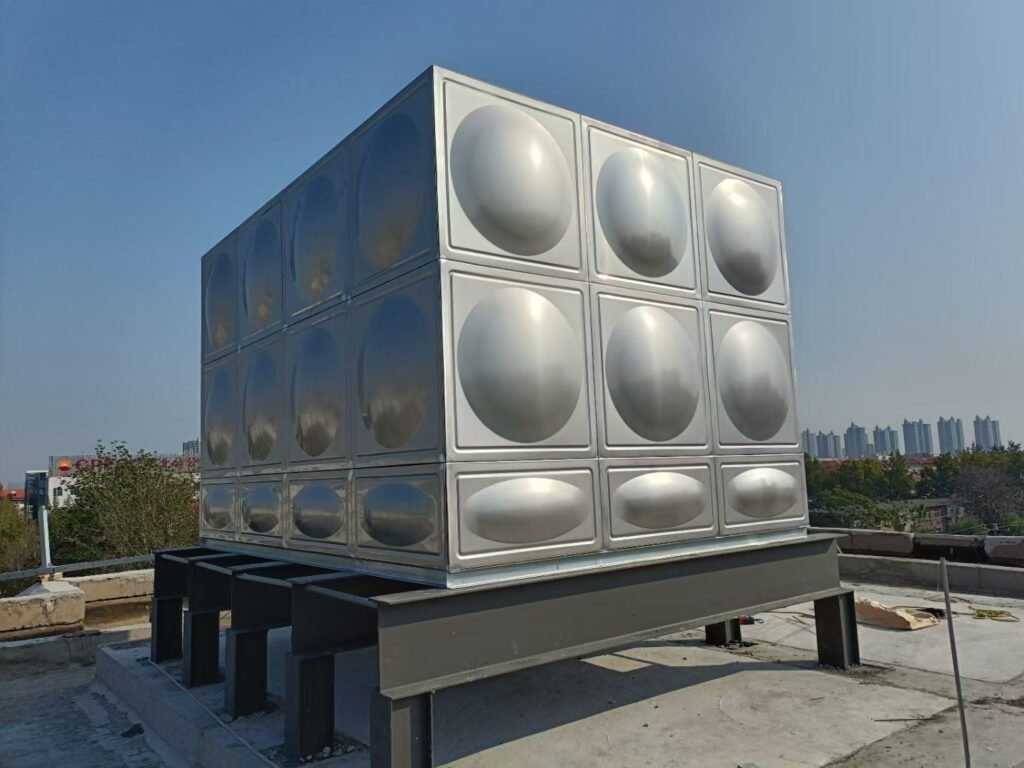
We compared six constructions, from a bolted 316L sectional tank to a cylindrical process vessel. We chose a 316L tank welded complete at our works and shipped whole, because every wetted weld is then made, treated and water-tested before the tank reaches the buyer’s filling hall.
| Option | For | Against | Verdict |
|---|---|---|---|
| Bolted 316L sectional tank | Any size, flat-packed, no site welding | Gasketed joints and crevices across the wetted surface | Rejected for ingredient water |
| Welded 316L rectangular tank, shipped whole | No wetted gaskets; welding, weld treatment and water test finished before shipping | Size limited by transport; rectangular corners are harder to spray-clean than a cylinder | Chosen |
| Larger 316L tank welded on site | No transport limit | Hot work, pickling paste and passivation inside a food plant | Only if volume forces it |
| Cylindrical process vessel, dished bottom | Best spray coverage, easiest to validate | Different product and supplier class; higher cost | Right answer if QA needs validated CIP |
| GRP/SMC sectional tank | Inert, lower cost | Bolted and gasketed; plant standard asked for stainless | Rejected |
| Hot-dip galvanized tank | Low cost | Our HDG range is built for fire, irrigation and bulk storage, not ingredient water | Rejected |
We will say plainly when this is not our tank. If your QA requires a polished, cone-bottom vessel with a validated spray device and hot-water sanitization, that is a process vessel job. For RO product water held at ambient temperature and sanitized chemically, a welded rectangular 316L tank is a sound answer at lower cost.
Shipping the tank whole is a deliberate choice, and transport sets its limits. Over stiffeners, base skid and manway the design is about 5.8 × 2.3 × 2.5 m: too tall to load through the doors of a standard box container, and too long for the roughly 5.7 m between the end walls of a 20 ft flat rack listed by the German Insurance Association’s Transport Information Service. It is planned on a 40 ft flat rack, about 11.8 m inside, and the GA gives the envelope, weight and lifting lugs for the forwarder to confirm.
The design draws on our welded stainless steel water tank construction with the grade of the 316L process water tank, within our stainless steel water tank range of 150 L to 200 m³ and above. For utility water where 304 is enough, the model we list as the Food Grade Stainless Steel Tank is nearer; that is a product name, not a food contact declaration.
Sizing the RO water storage tank: line demand, RO rate and buffer time
The tank is sized from three numbers: the line’s RO permeate demand, the RO plant’s net production, and the longest RO stop the line must ride through. With 8 m³/h demand, 12 m³/h production and a 2-hour stop, 20.9 m³ effective in a 5.6 × 2.2 × 2.2 m tank covers the stop with 2 m³ in hand and absorbs a blend-tank fill inside the RO control band.
Worked example
Buffer volume for a bottling line’s RO permeate
- RO outage volume
8 m³/h × 2.0 h = 16.0 m³line demand ≈ 35 US gpm - Blend-fill peak deficit
(24 − 12) m³/h × 0.25 h = 3.0 m³24 m³/h draw for 15 min, RO running - Plan area
5.6 m × 2.2 m = 12.32 m²internal - RO control band
3.0 m³ ÷ 12.32 m² = 0.24 m → RO start 1.95 − 0.24 = 1.71 mRO stops at 1.95 m - Outage reserve above pump trip
(1.71 − 0.25) m × 12.32 m² = 18.0 m³18.0 ÷ 8 = 2.25 h ≈ 2 h 15 min - Effective volume
(1.95 − 0.25) m × 12.32 m² = 20.9 m³≈ 5,500 US gal; nominal 27.1 m³ - Floor fall
5.6 m × 1/100 = 56 mmentirely below the 0.25 m pump trip level - Mean residence at full speed
20.9 m³ ÷ 8 m³/h = 2.6 hat the RO stop level - RO cycle
fill 3.0 ÷ (12 − 8) = 0.75 h; draw 3.0 ÷ 8 = 0.375 habout one start every 68 min
Result: 20.9 m³ effective covers a 2-hour RO stop with 2.0 m³ in hand, absorbs a 15-minute blend fill inside the control band, and turns the stored water over every 2.6 hours at full line speed.
Two choices hide in those numbers. The 1:100 floor fall costs no usable volume, because all 56 mm of it sits below the pump trip level. And the control band sets how often the RO plant starts: if your RO supplier limits starts, widen it, since each 0.1 m adds 1.23 m³ and about 18 minutes to each fill.
Weekend shutdowns are handled by a drain-down at the end of production and a flush before restart, written into the bottling line’s own procedures, not by a bigger tank.
The specification
The specification is a fully welded 316L tank with dressed, pickled and passivated seams, a floor that falls to one outlet, external stiffening, hygienic connections only, and a filtered vent with pressure and vacuum relief. Each item closes a specific hygiene or corrosion route.
| Item | Specification |
|---|---|
| Material | 316L plate: floor 3.0 mm, walls 2.5 mm, roof 2.0 mm, to be confirmed by our structural check on the GA |
| Construction | Argon-arc welded throughout, continuous internal seams, stiffeners outside so the wetted face carries no brackets or tie rods |
| Internal finish | Ra ≤ 0.8 µm on wetted surfaces including dressed welds, measured at a hold point |
| Floor and roof | Floor falls 1:100 to a sump at the outlet end; roof laid to a slight fall so rinse water runs off |
| Outlet and drain | Bottom outlet from the sump with a sanitary drain valve; no dead legs |
| Vent | Hydrophobic vent filter in an accessible housing, plus a separate pressure and vacuum relief device |
| Cleaning access | Hinged roof manway; nozzle for a spray device and a CIP return from the sump |
| Level | Continuous level transmitter for RO start and stop; independent high-high and low-low switches |
| Connections | Sanitary clamp or welded connections only; sample valve on the outlet |
| Gaskets and seals | Materials specified and approved by the buyer’s QA; named on the drawing |
| Weld treatment | Pickled to remove heat tint, then passivated; method agreed under ASTM A380, verified by a test from ASTM A967 |
A 2003 Food Safety Magazine article on hygienic design reports that 3-A and EHEDG specify a maximum roughness of Ra 0.8 µm on food contact surfaces, and that cold-rolled stainless sheet is usually smoother than that as supplied. The plate is rarely the problem; welds, grinding marks and handling scratches are, so the finish is measured after dressing.
The vent is where an RO water storage tank quietly fails. The FDA guide expects integrity testing of the vent filter, notes that filters are typically jacketed so condensate cannot block the hydrophobic membrane, and warns that if the filter blocks, either it ruptures or the tank collapses. A rectangular atmospheric tank is not built for vacuum, so the relief device is not optional.
Agree the sanitizing chemistry before order. ASSDA gives 316 as coping with about 5 ppm chlorine in continuous exposure at ambient temperature and neutral pH, and warns that over 60 °C both 304 and 316 risk chloride stress corrosion cracking. Stronger hypochlorite for a short contact needs your chemical supplier’s data and a thorough rinse; our cleaning and disinfection guide covers dose arithmetic.
How it is made
In this design the 316L tank is cut, formed and argon-arc welded at our works in Wucheng County, Dezhou, its seams dressed, pickled and passivated to the method named on the drawing, and the whole tank water-tested before it ships. Nothing is cut until the plant has approved the drawing.
The drawing fixes plate thickness, floor fall, every nozzle position, the finish and the weld treatment. Plate is cut on our own laser and cutting machines; the stainless tank manufacturing page shows the lines, and the factory tour shows the 11,000 m² site that SGS checked in person.
Heat tint is removed, not polished over. The British Stainless Steel Association explains that heat tint draws chromium from below the surface, leaving a lower-chromium layer that corrodes more easily. ASTM A380 is the practice for cleaning, descaling, pickling and passivation, and ASTM A967 specifies chemical passivation treatments with tests to confirm them. The drawing names the method and the test.

Inspection and documents
Inspection is built around hold points the plant’s QA can witness: material identity, weld appearance, surface finish, passivation and a 48-hour water test with the level logged at start and finish. Plate is identified against its 316L material certificate before cutting, each internal seam is inspected before and after dressing, and the tank is drained to prove the fall before the water test.
A third-party inspector is welcome, and their hold points are written into the inspection and test plan before cutting starts. The water test sheet, material certificates, approved drawing and manual (EN/中文) travel with the tank; test reports and management system certificates are on the certifications page.
Installation and commissioning
Installing the RO water storage tank is a lift onto a level base and hygienic pipe connections, with no welding in the plant. Commissioning proves the drain, vent, level control and water before the line uses any of it.
Before the tank ships, walk the route from delivery point to base. A whole tank needs an opening larger than its envelope and room for the lifting gear.
Lift onto a level base, check the floor fall with a level, and confirm the outlet is the low point.
Make up sanitary connections for RO inlet, outlet, drain, CIP supply and return, with no dead legs.
Install the vent filter and relief device, and integrity-test the filter as its maker specifies.
Fill with permeate and check RO start, RO stop, high-high and low-low against the drawing levels.
Run the plant’s cleaning and sanitizing procedure, rinse, and drain to confirm no water stands on the floor.
Sample to the plant’s HACCP plan and release the tank to production when results pass.
What the design delivers
By design, the 316L tank holds 20.9 m³ usable, covers a two-hour RO stop at full line speed and turns over every 2.6 hours in production. Every wetted weld is specified to be pickled, passivated and recorded before the tank ships, and the floor drains to one point.
Each outcome is checkable. Time a full drain and look for standing water, read the roughness and passivation records, and log how long the bottling line runs on a planned RO stop. Then trend microbiological results from the sample valve, the check that matters most for an RO water storage tank.
Mistakes we see on an RO water storage tank
The mistakes on this duty are nearly always oversizing, poor drainage and poor venting. Each one turns clean permeate back into a hygiene risk.
- Buffer sized in days. Permeate with no residual sits for days in a warm plant room.
- A flat floor. A few millimeters left after draining is enough to seed the next fill.
- An open or unfiltered vent. Every fill pushes plant room air out, and every draw pulls it back in.
- A filter with no relief. One wet membrane and the tank goes into vacuum as the pump draws.
- Threaded fittings. The FDA guide allows none in a pharmaceutical water system, a sensible benchmark for ingredient water.
Watch out
Do not let the fabricator pick the gasket. On a food duty the elastomer at the manway, the spray nozzle and each clamp is a food contact material, and its approval belongs to your QA. We name every seal on the drawing precisely so that someone who can approve it has to.
Frequently asked questions about an RO water storage tank
Why use 316L rather than 304 for RO water?
RO permeate carries little chloride, so 304 would often survive the water itself. The case for 316L is everything around it: sanitizing chemicals, welded seams where a low-carbon grade avoids sensitization, and a molybdenum margin if a hypochlorite clean runs long.
Can a spray device clean a rectangular tank?
Yes, with care at the corners and under the roof, which a spray reaches last. The roof nozzle is placed on the drawing so the spray maker can confirm coverage of every internal face. Check coverage at commissioning; if your QA needs validated figures, choose a cylindrical vessel.
Do LVJIA tanks carry EHEDG certification or a food contact declaration?
Neither. EHEDG and 3-A principles guide the design, but the tank is not EHEDG-certified, does not carry the 3-A Symbol, and LVJIA holds no food contact material declaration. For the seals your QA approves, ask the gasket supplier for its own food contact evidence; we supply the drinking-water report and material certificates.
How large should the vent filter be?
Large enough to pass air as fast as water can leave or enter the tank: here up to 24 m³/h (400 L/min) if a blend fill runs with the RO stopped, and faster on a drain-down. Ask the filter maker for its airflow rating at a low pressure drop, and remember that condensate cuts that flow.
Does passivation ever need repeating?
Yes, after any grinding, welding or contact with carbon steel tools on the wetted surface. Free iron picked up from a tool can rust on the stainless surface, and removing contaminant iron is what ASTM A967 passivation and its tests address. Record the repeat treatment and its test as you did the first.
Talk to an engineer
Send us your RO rate and line demand
We will size the buffer, draw the levels and fall, and return a marked-up drawing that names every weld treatment and seal for your QA.