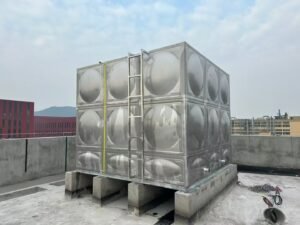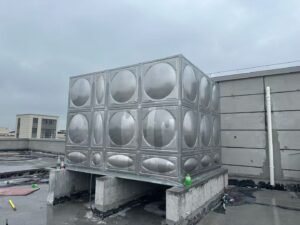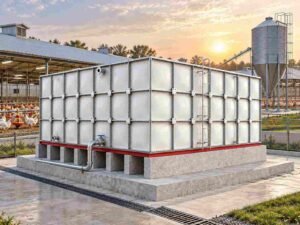


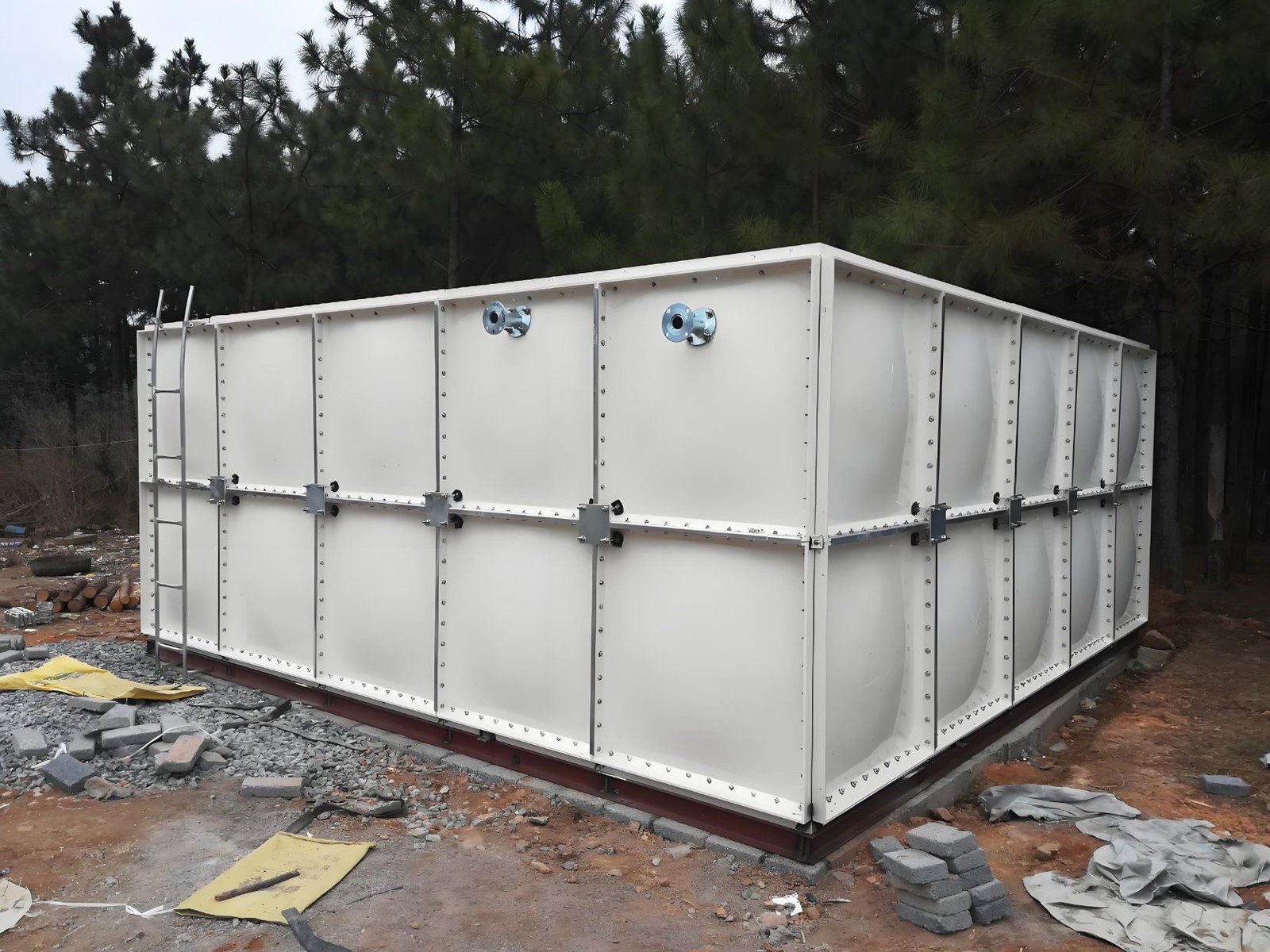
This is a verified order, not a design exercise. A buyer in the Netherlands ordered GRP/SMC sectional tanks through our Alibaba.com store, received them and rated the order 5.0 on 13 August 2026. The GRP water tank Netherlands order followed LVJIA’s standard route: SMC panels 6–22 mm thick stepped by water head, a drawing approved before pressing, one crate per tank, shipped through Tianjin. Below are the seven stages, the documents behind them and the Dutch and EU rules a buyer still has to check.
Project file
- Status
- Verified purchase on Alibaba.com, rated 5.0 on 13 Aug 2026
- Market
- Netherlands (EU)
- Tank type
- GRP/SMC sectional tank, bolted on site with stainless fasteners and gaskets
- Panel modules
- 2×1, 1.5×1, 1×1, 1×0.5 and 0.5×0.5 m
- Panel thickness
- 6–22 mm, stepped by water head
- Standard referenced
- EN 13280:2001, CE Verification of Conformity ICR/VC/HS2506113
- Water-contact test
- GB/T 17219-2025, report SP2630502, 20 of 20 items passed
- Capacity, sector, buyer type, site
- Not published; still being confirmed with the buyer
- Shipping and terms
- Flat-packed, one crate per tank, through Tianjin, T/T
Stage 01: What did the buyer in the Netherlands order?
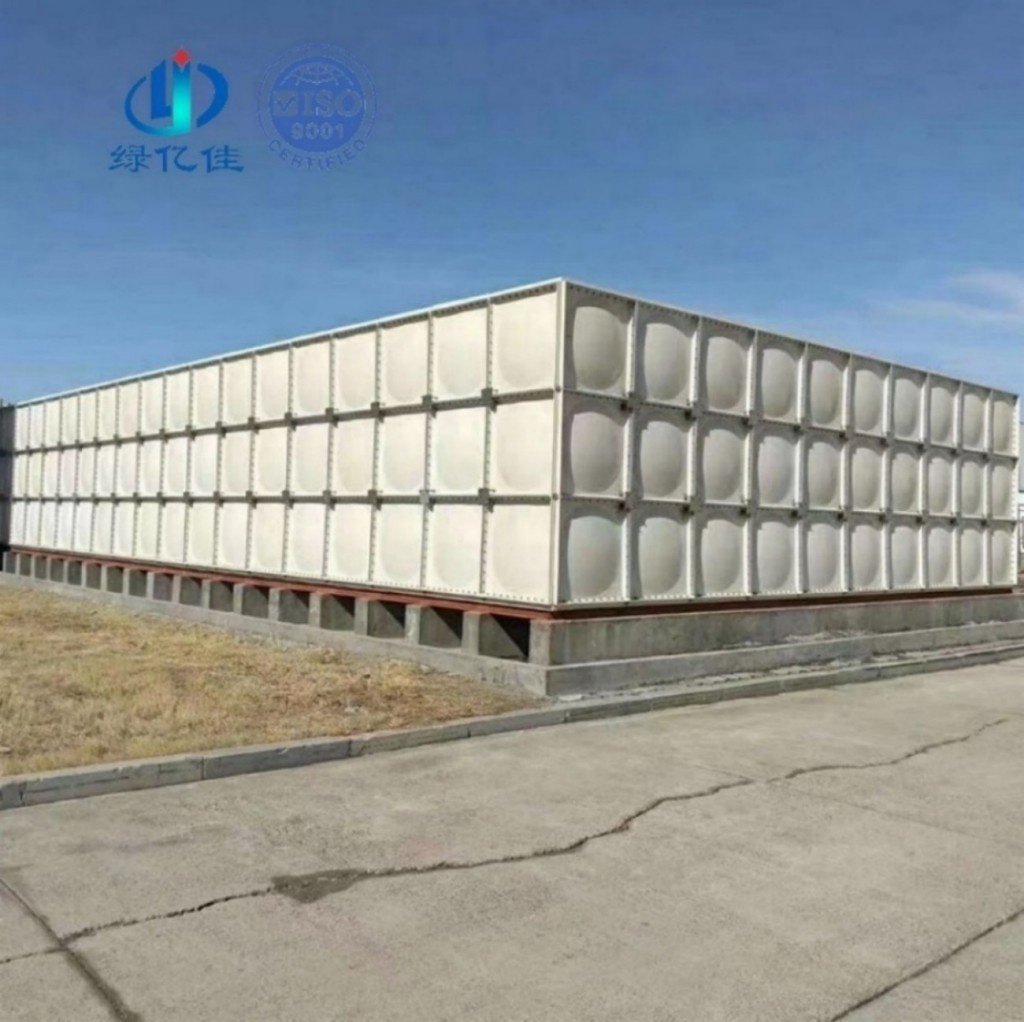
The buyer ordered GRP sectional tanks through our Alibaba.com store for delivery to the Netherlands. A sectional tank answers one specific brief: it travels as flat panels in a crate and becomes a tank only when it is bolted together at the destination.
Before our engineers draw anything, we need three numbers: the stored volume, the footprint available and the water head or fill arrangement. Those three fix the panel layout, the number of courses and the thickness of each course. The capacity, the sector, the buyer type and the site of this order are not published here. We are still confirming them with the buyer, and we will not guess them.
Stage 02: Where can an export order like this go wrong?
On an export order the risk sits in the parcel, not in the panel. The panels are bolted up a sea voyage away by a crew working from our drawing, and there is no quick second shipment to fall back on.
A bolted sectional tank is only as good as its hole positions. If one hole pitch is out, or one gasket strip is missing, the fault shows up on site weeks after dispatch. So the drawing has to be clear enough to build from without a phone call, and the packing list has to match the crate down to the last bolt.
Watch out
Export orders rarely fail on the panel. They fail on the packing list: a kit box packed per batch instead of per tank, a missing gasket roll, a ladder shipped in another container. Ask your supplier how the crate is reconciled against the drawing before it is closed.
Stage 03: How did our engineers lay the GRP sectional tanks out?
They fitted our pressed panel modules to the buyer’s footprint and issued a general arrangement drawing with the panel schedule, nozzle positions and panel thickness stepped by water head. Nothing was pressed until the buyer approved that drawing.
We press SMC panels at 2×1, 1.5×1, 1×1, 1×0.5 and 0.5×0.5 m, so a layout is built to a module rather than rounded up to a catalog size. The thinnest panels go on the top course and the heaviest on the base, because water pressure grows with depth. Every GRP sectional water tank we build follows the same logic.
The approved drawing then becomes the contract: the panels, the crate and the site build are all checked against it, which is why buyer approval is a hold point, not a formality. A modular GRP water tank drawn this way can be fitted to an awkward plant-room footprint.
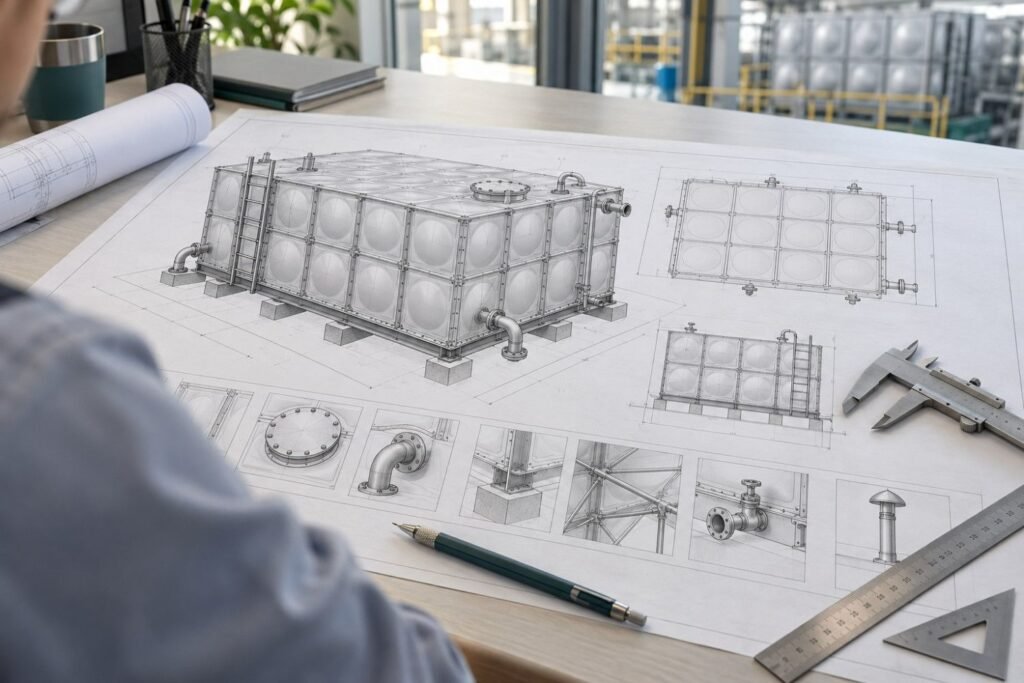
The calculation below is the check we would ask any buyer to run on a drawing before approving it. It uses an illustrative layout with assumed allowances, not the Netherlands order, because that order’s capacity is not yet published.
Worked example
Reading a module layout before you approve it (illustrative 4 × 3 × 2 m tank)
- Panel count, 1×1 m modules
walls 2 × (4 + 3) × 2 courses = 28; floor 12; roof 1252 panels - Nominal volume
4 × 3 × 2 = 24 m³to the roof line - Effective volume
4 × 3 × (2 − 0.15 above overflow − 0.10 below outlet) = 4 × 3 × 1.7521 m³, 87.5% of nominal - Pressure at the base course
9.8 kN/m³ × 1.85 m = 18.1 kPatop water level at the overflow - Pressure at the foot of the top course
9.8 kN/m³ × 0.85 m = 8.3 kPaabout 46% of the base figure
Result: size against the 21 m³ you can actually draw, not the 24 m³ on the roof line, and expect the base course to be heavier than the top one. Approve the drawing only when the effective volume and the thickness by course both match your duty.
The unit weight of fresh water used above, 9.8 kN/m³, is the value given in the FHWA geotechnical reference manual. Head is measured from the overflow, because the water can never stand higher than that.
Stage 04: How were the SMC panels made and kitted?
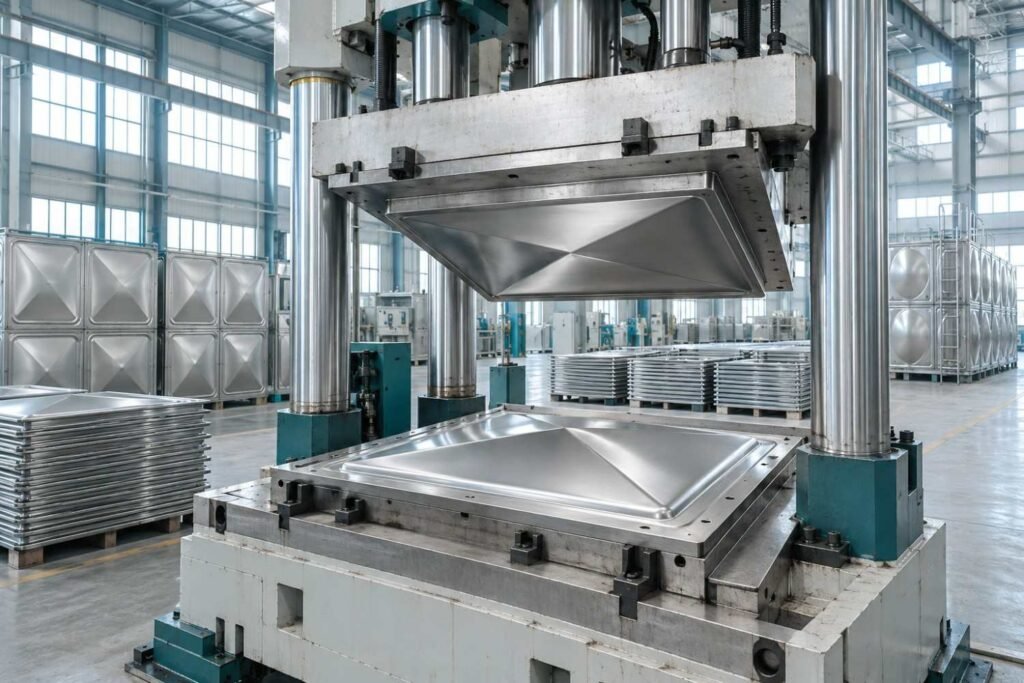
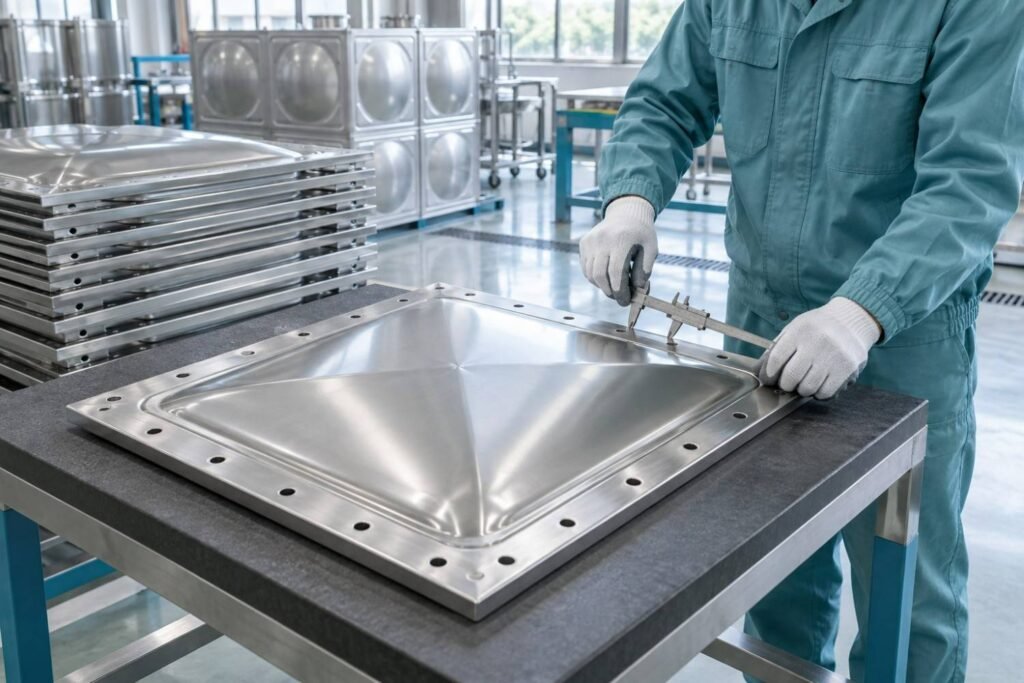
The panels were hot compression-molded from SMC, then punched for bolting on our own lines. The panels, bolts, gaskets, sealant, ladder and fittings for each sectional tank were then packed together, one crate per tank.
The works in Wucheng County, Dezhou, runs three production lines and 25 machines on an 11,000 m² floor, including hydraulic presses, laser cutting, automatic and semi-automatic punching and a mechanical arm. SGS checked the machine list and floor area on site for our Alibaba.com supplier assessment, report 492271438_P+T. Our page on how we make GRP water tanks walks the press line step by step.

Kitting per tank matters more than it sounds. When a crate holds a share of a batch, the site crew reconciles counts across several crates before the first bolt goes in. When one crate is one tank, the count is closed at the works, against the drawing.
Stage 05: Which checks and documents stand behind the tanks?
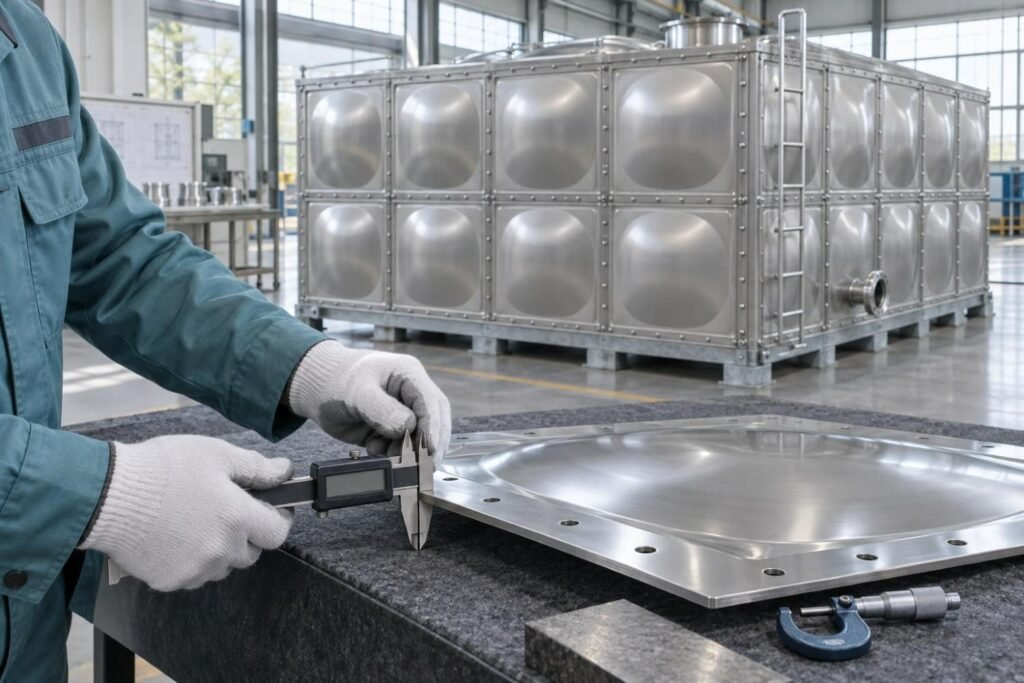
Panel size and hole position are checked against the approved drawing, not against the last batch, and each sectional tank is trial-assembled and water-tested for 48 hours at the works before it is stripped and crated. The GRP/SMC range also carries a CE Verification of Conformity to EN 13280:2001 and a GB/T 17219-2025 drinking-water contact report.
The water level in that 48-hour test is logged at the start and at the finish. The hydrostatic test sheet, material certificates, the approved drawing and the assembly manual in English and Chinese travel with each tank, so the site crew builds from the same documents we checked against.
| Document | Issuer and number | What it shows | What it does not show |
|---|---|---|---|
| CE Verification of Conformity | ICR Co., Ltd (tested by Unico), ICR/VC/HS2506113, 24 Jun 2025 to 23 Jun 2030 | The GRP/SMC range assessed against EN 13280:2001 | A Dutch drinking-water quality declaration |
| Drinking-water contact report | Dezhou Institute of Product Quality Standards and Metrology (CMA 231520118043), SP2630502, issued 18 May 2026 | 20 of 20 GB/T 17219-2025 items passed on the GRP/SMC range | Compliance with Dutch or EU hygiene schemes |
| ISO 9001:2015 certificate | ZRX, 07624Q0960R3S-SD/001, valid to 21 Jun 2027 | An audited quality management system | Any product approval |
| Hydrostatic test sheet | LVJIA works, one per tank | 48-hour water test at the works, level logged at start and finish | The site leak test after your own bolt-up |
| Approved GA drawing | LVJIA engineering, approved by the buyer | Panel schedule, thickness by course, nozzles, ladder and manhole positions | Foundation design, which stays with the site engineer |
The GB/T 17219-2025 report covers twenty items, from chromaticity, turbidity and pH to lead, mercury, arsenic, chloroform and carbon tetrachloride. It is strong evidence for the material, but it is a Chinese test report to a Chinese standard, and we present it as that. Every number and date is listed on our certification register so it can be checked with the issuer.
Stage 06: What shipped, and how does it go together on a Dutch site?
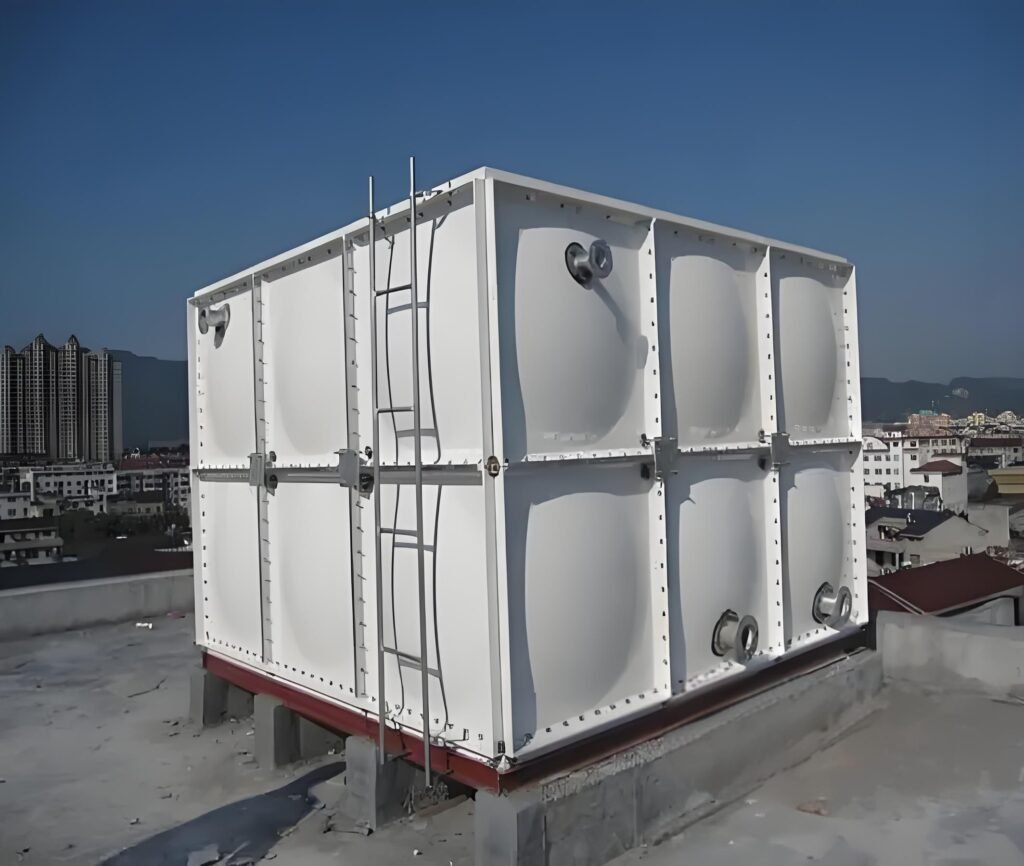
Flat-packed crates left through Tianjin, each holding one complete GRP sectional tank with its bolts, gaskets, sealant and fittings, on T/T payment terms. On site the tank is bolted together with stainless fasteners and gaskets, with no welding; at the date of the review the tanks had been delivered but not yet installed.
Flat packing is what makes a Dutch delivery ordinary. A tank that would never fit on a truck in one piece travels as container freight instead. We quote FOB, CFR, CIF or EXW. Under Incoterms 2020, FOB applies only to sea or inland waterway transport, and so do CFR and CIF, so write the named port on the order.
A GRP sectional tank goes up floor first, then the walls course by course, then the roof, with bolts brought up to torque in a pattern rather than corner by corner. The plinth must be flat to 3 mm over any 3 m. A high spot opens a joint and a low spot leaves a gasket under-compressed, and both show up as a weep during the first fill.
Stage 07: What does the record actually show?
The record holds one verified review of the GRP water tank Netherlands order, rated 5.0 out of 5 by the buyer on 13 August 2026, after delivery and before installation. Around it sit the platform’s own store figures: 100% on-time dispatch, a 33% reorder rate and a response time of one hour or less.
The review reads, in full: “Delivery: Great · Quality: Looks good but not yet installed · Design: Perfect fit · Service: Excellent service from Lvjia Guan!” (verified buyer, Netherlands, Alibaba.com). We quote it exactly, including the line that says the tanks were not yet installed, because that is the honest state of the record.

Engineer’s note
This is the only customer review on public record, and it predates installation. We have no in-service data from this site yet, so we claim none. The store opened in 2025, so the sample is small. We would rather show one verified order than ten invented ones. The full background is on our Alibaba store page and in our water tank case studies.
GRP water tank, Netherlands: is a drinking-water certificate needed?
If the tank stores water for human consumption, generally yes: Dutch rules cover materials in contact with drinking water, storage tanks included, and the proof they accept is a recognized quality declaration, in practice a Kiwa Water Mark certificate. We do not hold one, so a buyer with a drinking-water duty must check what their water company or inspector will accept before ordering.
The Dutch framework rests on three instruments: the Drinkwaterwet, the Drinkwaterbesluit and the Regeling materialen en chemicaliën drink- en warm tapwatervoorziening. According to RIVM, the National Institute for Public Health and the Environment, they cover materials in public supply and in buildings, with pipes, filters and storage tanks named as examples. Kiwa Nederland B.V. is currently the only certification body whose mark the ministry recognizes for these requirements.
Products that meet Kiwa’s assessment guidelines (BRL) receive a certificate carrying the Kiwa Water Mark, which replaced the older ATA (Attest Toxicologische Aspecten). The name changed because the regulation now sets microbiological and organoleptic criteria as well as toxicological ones. If the tank will hold fire reserve, irrigation or process water, the drinking-water rules may not apply at all. That is the buyer’s call to confirm, not ours.
EN 13280:2001 answers a different question. Its published scope covers GRP one-piece cisterns and rectangular sectional tanks for above-ground water storage in domestic and industrial use, with sectional tanks from 500 L upwards. It is a construction and performance specification. Our CE Verification of Conformity to it is real and checkable, but it is not a hygiene approval and we never present it as one.
| Rule or scheme | What it covers | Our position | What the buyer does |
|---|---|---|---|
| EN 13280:2001 | GRP cisterns and sectional tanks for above-ground storage | CE Verification of Conformity held, valid to 23 Jun 2030 | Ask for the certificate and check its scope |
| Dutch Regeling materialen en chemicaliën | Materials in contact with drinking water, including storage tanks | No Kiwa Water Mark held | Confirm with the water company or inspector whether your use needs it |
| Directive (EU) 2020/2184, Article 11 | Minimum hygiene requirements for materials in contact with drinking water | No certificate under the new EU scheme | For a new drinking-water installation, ask what the scheme requires |
| GB/T 17219-2025 | Chinese safety evaluation of materials in drinking-water systems | Report SP2630502, 20 of 20 passed | Use it as material evidence, not as a Dutch approval |
What changes for GRP tanks under the EU rules from 31 December 2026?
Article 11 of Directive (EU) 2020/2184 sets minimum hygiene requirements for materials that come into contact with water intended for human consumption. Six Commission acts dated 23 January 2024 and published on 23 April 2024 fill in the detail: European positive lists of starting substances, conformity assessment and an EU marking. The Commission’s implementation page gives 31 December 2026 as the application date for products used in new installations or repair works, with transition to 31 December 2032.
RIVM puts the Dutch dates at 1 January 2027 for new products and no later than 1 January 2033 for products that already hold a recognized quality declaration, and expects the Kiwa Water Mark to be replaced gradually by the EU mark set out in Delegated Regulation (EU) 2024/371. Much of the groundwork came from the 4MS initiative of France, Germany, the Netherlands and the United Kingdom, whose common approaches went to the Commission as proposals for these acts.
What should a European buyer put in a GRP tank order?
Write the drawing, the standard and the document list on the order itself, not in an email thread. A platform, an inspector or a court can only enforce what the order says.
Stored volume, the footprint and headroom you have, and the head or fill arrangement. Our engineers reply in writing within two hours and the layout follows from these.
Quote the approved GA drawing on the order. It fixes the panel schedule, thickness by course, nozzle positions and access.
List EN 13280 conformity, report SP2630502, the hydrostatic test sheet, material certificates and the assembly manual, so the crate can be checked against the order.
FOB, CFR, CIF or EXW, with the port written out. It settles who pays freight and where risk passes.
Name the stages your inspector wants to witness, so they are written into the inspection and test plan.
Confirm the plinth layout from the drawing and the 3 mm in 3 m flatness before the crate lands, not after.
For a drinking-water duty, our GRP potable water tank is the starting model, subject to the Dutch certification point above. The full GRP panel water tank range lists all 13 models, and our datasheets and CAD blocks let a consultant draw on our module before sending the layout for review.
GRP water tank Netherlands orders: frequently asked questions
Is this a real order or an engineering example?
A real one. Alibaba.com records the purchase and the 5.0 review against a verified buyer, so neither the order nor the rating is our own claim. Our other case studies are design cases worked through for a typical duty, and each says so in a box at the top. This page carries no such box because the order is real; its one illustrative calculation is labeled as such.
Why are the capacity and end use missing?
Because the buyer has not yet agreed what can be published about their site. We could estimate from the order, but an estimate presented as a project figure would break the rule this page is built on. When the buyer confirms the details, we will add them with the date they were confirmed.
What size of GRP sectional tank can you build?
The GRP/SMC range runs from 0.125 m³ to 5,000 m³, with walls up to 5 m high, and our minimum order is 1 m³. Because height is capped, a bigger volume grows in plan, so the footprint you can offer usually decides the layout. The 13 catalog models are starting points; every tank is drawn to its own site.
Can LVJIA supply a Kiwa Water Mark certificate?
Not today; we hold no Kiwa Water Mark for any range. If your application is drinking water in the Netherlands, raise it before you order. We will send the GB/T 17219-2025 report and the material details so your adviser can judge what route, if any, is open for your project. For fire, irrigation or process storage the question may not arise.
Which payment and delivery terms apply to a Dutch order?
Payment is by T/T. For delivery we quote FOB, CFR, CIF or EXW. Under EXW you collect from our works in Wucheng County and arrange export, freight and import yourself; under the other three we load at Tianjin and you name the destination port for CFR and CIF.
Can my inspector witness the water test in China?
Yes. Tell us which stages you want to see while the drawing is still open, and they become hold points in the inspection and test plan. Your inspector checks the panels against the approved drawing, the same document our own inspectors use, so any disagreement is settled against one reference rather than two.
Talk to an engineer
Planning a GRP sectional tank for a European site?
Send the volume, the footprint and the head, plus the standard you are buying against. You get a drawing to approve before anything is pressed.